For centuries, the temple simply disappeared.
It had been built around AD 800, on a hill in the middle of Java, by kings of the Sailendra dynasty. Then, for reasons no one fully understands, perhaps a volcanic eruption, a shift of power, or the spread of Islam, it was abandoned. Volcanic ash from nearby Mount Merapi fell on it. The jungle grew over it. Local villagers knew there was something on the hill, and told stories about it, but it became a forested mound.
In 1814, Java was briefly under British rule. The lieutenant governor, Thomas Stamford Raffles, heard reports of a buried monument and sent an engineer, H.C. Cornelius, to investigate. It took Cornelius and 200 men six weeks just to clear away the trees and earth from part of it.
What they uncovered was the largest Buddhist temple in the world.
A mountain to climb, a path to enlightenment
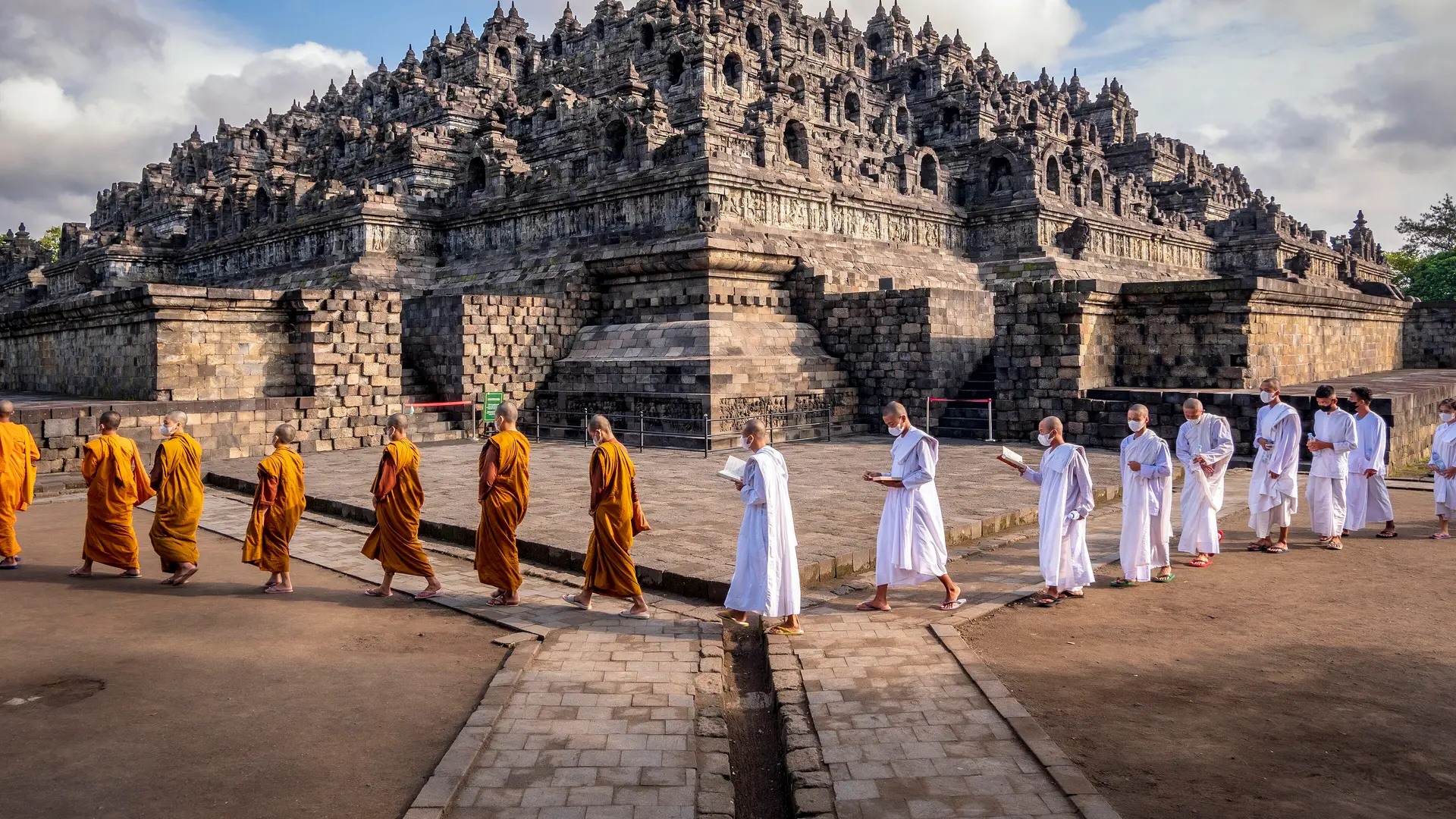
Borobudur isn’t a temple you go inside. It’s a temple you climb, a stone mountain shaped like a giant mandala. Its nine stacked platforms, six square and three circular, rise toward a great central stupa at the top.
Pilgrims walk it in a clockwise spiral, terrace by terrace, about 5 kilometers in all, rising through the three levels of Buddhist thought:
- The world of desire, at the base, with carved scenes of everyday life and the consequences of good and bad actions.
- The world of forms, through galleries lined with 2,672 relief panels, the longest and most complete set of Buddhist carvings anywhere. They tell the life of the Buddha and stories of his previous lives.
- The world of formlessness, at the top: open circular terraces, plain and quiet, with 72 bell-shaped stupas of stone latticework. Inside each one sits a stone Buddha, visible through the openings.
The whole monument holds 504 Buddha statues.
Saving Borobudur
After its rediscovery, Borobudur was in a bad state: collapsing walls, water damage and souvenir hunters. Between 1975 and 1982, Indonesia and UNESCO led one of the biggest restoration projects ever attempted. They took apart a huge portion of the monument stone by stone, installed drainage, and put it back together. In 1991 it became a UNESCO World Heritage Site.
Visiting and the climbing rules
To protect the stone, which was being worn down by millions of feet, visits changed in 2023:
- Only a limited number of people each day can climb the temple structure, on a specific ticket with a guide.
- Climbers wear special woven sandals called upanat, made by local craftspeople, to protect the stones.
- Visitors without a climbing ticket can walk the gardens around the base.
- No touching the Buddhas inside the stupas. Reaching in used to be a lucky tradition, but no longer.
Book in advance, especially for weekends and holidays.
Sunrise over the volcanoes
The magical image of Borobudur is at dawn: the temple rising from a sea of mist, with the cones of Mount Merapi and Mount Merbabu behind it, lit pink by the sunrise.
The classic viewpoint is Punthuk Setumbu, a hill a short drive away. Arrive in the dark with a headlamp, climb up through the trees to the viewing platform, and wait for the mist and the light. Nearby is the quirky Gereja Ayam (the “Chicken Church”), a strange building shaped like a bird.
Prambanan, the Hindu neighbor
About an hour away, near Yogyakarta, stands Prambanan, a great 9th-century Hindu temple complex, built not long after Borobudur. Its tall, pointed towers are dedicated to the gods Shiva, Vishnu and Brahma, and carved with scenes from the Ramayana epic.
Visit Borobudur at sunrise and Prambanan in the late afternoon. On many evenings in the dry season, an outdoor Ramayana ballet is performed with the floodlit temples as a backdrop.
Yogyakarta
Most visitors stay in Yogyakarta (“Jogja”), Java’s cultural capital: the home of a reigning sultan, batik workshops, puppet shows, street food and a lively student scene. Visit the Kraton (the sultan’s palace), the old Taman Sari water palace, and walk Malioboro street in the evening. A few luxurious hotels sit near Borobudur itself, some with views of the temple from the pool.
When to go
The dry season (May to September) is best, with clearer mornings for sunrise. The rainy season brings afternoon downpours and more cloud. Avoid Indonesian public holidays, when the temples are extremely busy. Vesak, the Buddhist festival in May or June, brings pilgrims and processions, a beautiful but crowded time.
The honest bits
The climbing quota means you need to plan ahead, and the experience is more controlled than it once was. Sunrise viewpoints are busy, and morning mist doesn’t always cooperate. But walk the galleries slowly with a good guide, reading the stories carved into the stone, and climb out onto the open terraces at the top with the volcanoes all around. You’ll feel why people walked this spiral to reach enlightenment.
Borobudur: questions people ask
Can you still climb Borobudur?
Yes, but with limits. Since 2023, only a set number of visitors per day can climb the temple structure, with a guide and on a specific ticket, wearing special woven sandals provided at the site. Other visitors can explore the grounds around the base.
Where is the best place to watch sunrise near Borobudur?
Punthuk Setumbu hill, a short drive away, looks across mist-filled valleys to Borobudur with Mount Merapi and Mount Merbabu behind. Arrive in the dark to get a spot.
How do you get to Borobudur from Yogyakarta?
It's about 1–1.5 hours by car. Most visitors hire a driver for the day to combine Borobudur with sunrise and the Hindu temples of Prambanan.
Can I touch the Buddha statues inside the stupas?
No. Reaching into the stupas to touch the 'lucky' Buddha used to be a tradition, but it is now forbidden to protect the stone.