There’s an old story every guide on the Wall will tell you if you give them half a chance.
A young woman called Meng Jiangnü married a scholar named Fan Qiliang. Days after the wedding, soldiers dragged him north to build the emperor’s wall. Months passed with no word. When winter came she sewed him warm clothes and walked hundreds of miles to deliver them, only to be told he’d died on the work gang and been buried inside the wall itself. She sat down and wept, and wept, until a whole stretch of the wall collapsed and showed her his bones.
It’s a legend, of course. But it tells you something true. To the people who built it, the Great Wall wasn’t a wonder. It was a graveyard, a prison sentence and a long way from home. That’s worth remembering when you’re standing on a watchtower at Mutianyu with the hills rolling away in every direction and the stone warm under your hands.
One wall? Not really
There isn’t a single Great Wall. There are dozens, built and rebuilt over roughly two thousand years by different kingdoms and dynasties, all trying to keep northern horsemen out. China’s first emperor, Qin Shi Huang, joined several older walls together around 221 BC, mostly from rammed earth. Most of that has worn back into the landscape.
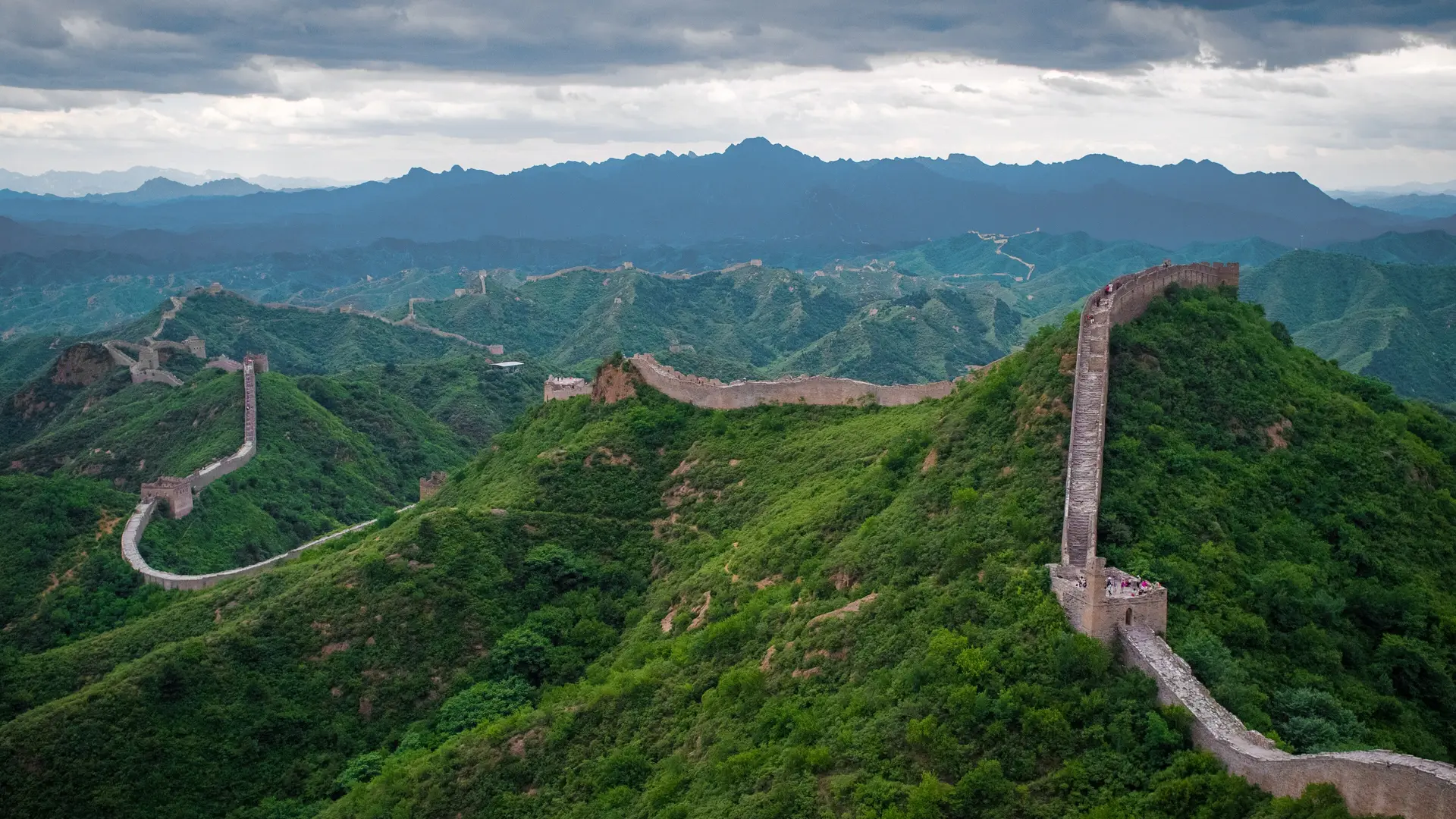
The Wall in your photos, with crenellated brick, watchtowers every few hundred meters and stairs so steep they feel like ladders, is mostly Ming dynasty, built between the late 1300s and the 1600s. Add up every branch and spur and a 2012 survey put the total at about 21,000 kilometers.
One lovely detail: Ming builders mixed sticky rice into their lime mortar. Scientists have since confirmed it. The starch made the mortar tougher and more water-resistant, which is part of why so much of it still stands.
Which section should you visit?
This is the decision that makes or breaks your day. All of these can be done from Beijing.
Mutianyu (about 90 minutes from Beijing). The best choice for most people. Restored, gorgeous, lined with trees that turn fiery in October, and far calmer than Badaling. Take the cable car or chairlift up, walk for two or three hours between towers, then ride the toboggan down. It’s ridiculous and wonderful.
Badaling (about 75 minutes). The most famous and most visited section. It’s well restored and easy to reach by high-speed train, but on weekends and holidays it can feel like a shopping mall at Christmas. Reservations are required. Go only if time is very tight.
Jinshanling (about 2.5 hours). For walkers. Partly restored, partly crumbling, with dramatic towers and wide views. The classic hike runs along the ridge for 4–6 km. You’ll share it with a fraction of the crowd, and sunrise here is unforgettable.
Simatai (about 2 hours). Wild and steep, and one of the few sections you can visit at night, when the towers are lit. You enter through Gubei Water Town, a reconstructed old town with canals and lanterns. It’s touristy, but romantic in the evening. Book ahead.
Jiankou. The famous “wild wall” in photographers’ pictures: unrestored, overgrown and genuinely dangerous in places. Only go with an experienced local guide, never alone.
When to go
April–May and September–October are the sweet spots: mild, clear and green or golden. Autumn is especially beautiful at Mutianyu.
Avoid Golden Week (1–7 October) and the May Day holiday. In summer (June–August) it’s hot, humid and often hazy, with afternoon storms. Winter can be magical, with snow on the battlements and almost no crowds, but the stone is icy and the wind cuts straight through you.
Whatever the season, arrive early. Tour groups arrive mid-morning. If you’re on the first cable car you’ll get an hour of near-silence.
Tickets and practicalities
- Entry tickets run roughly ¥40–65 depending on the section, plus cable cars or chairlifts at around ¥100–140 return. Prices change, so check before you go.
- Bring your passport. Many sites issue real-name tickets and check ID.
- Payment is overwhelmingly by phone in China. Set up Alipay or WeChat Pay with a foreign card before you arrive, and carry some cash as a backup.
- Wear proper shoes. The steps are uneven, sometimes knee-high, and polished slippery by millions of feet.
- Bring water and snacks. Vendors on the wall charge a lot, and on quieter sections there aren’t any.
Getting there from Beijing
For Mutianyu, the easiest option is a private driver or small-group tour, which takes about 90 minutes each way and saves a lot of bus-changing. Public buses from Dongzhimen do run, but they eat up half your day. For Badaling, the high-speed train from Beijing North (Qinghe) takes under an hour. For Jinshanling and Simatai, a driver or tour is close to essential.
Hotels near the Wall are a great idea and few people use them. A guesthouse in the village below Mutianyu, or a boutique lodge near Jinshanling, lets you walk up at sunrise before a single bus arrives.
A perfect day at Mutianyu
6:30 a.m. Your driver picks you up in central Beijing. The ring roads are still half empty, and by the time the city thins out into orchards and walnut groves the sun is up.
8:00 a.m. You’re at the gate as it opens. Skip the shops and the “last chance for water!” calls (actually, do buy water), and take the chairlift up to around Tower 6. The cable car is fine too, but the open chairlift with your feet dangling over the treetops feels more like an adventure.
8:30–11:00 a.m. Walk west, uphill, toward Tower 20 and beyond. This is the steep, quiet stretch. Every tower you pass has fewer people than the last. Stop inside the towers. The arched windows frame the Wall rolling away over the ridge like paintings, and the stone stays cool even on a hot day.
11:30 a.m. Back down via the toboggan: a metal track that twists down through the forest on a little wheeled sled you control with a lever. Everyone pretends it’s for the kids.
12:30 p.m. Lunch in the village below. Several restaurants serve trout from local ponds, and one or two cafés are run by expats who’ve lived here for years. Then back to Beijing by mid-afternoon, tired and happy.
Smoke signals, a dragon’s head and the western gate
Every few hundred meters along the Wall stands a beacon tower. When raiders were spotted, soldiers lit fires by night and sent up smoke by day, and the warning raced from tower to tower across the mountains far faster than any horse. Tradition says they burned wolf dung because its smoke rose straight up in a thick column. Whether or not that’s true, the Chinese phrase for war smoke, langyan, literally means “wolf smoke.”
If the Wall gets under your skin, two places make a wonderful extension:
- Shanhaiguan, on the coast east of Beijing, where the Wall runs right down into the Bohai Sea at a spot called the Old Dragon’s Head. Watching the stones disappear into the waves is strangely moving.
- Jiayuguan, far to the west in Gansu province, the great fortress at the western end of the Ming wall, with desert all around and snowy mountains on the horizon. For centuries this was where China ended. Exiles who passed through the gate were said to throw a stone at the wall. If it bounced back, they’d return home one day.
The honest bits
Badaling on a holiday weekend is not the experience you’ve imagined. The hawkers at the bottom of Mutianyu are persistent. Air quality around Beijing has improved a great deal, but some days are still grey and soft-focus.
And yet. Stand at a tower at Jinshanling as the light comes up, watch the Wall run away over ridge after ridge until it disappears into the haze, and the scale finally lands. Somebody carried every one of these bricks up here by hand. It’s very hard to forget that.
Great Wall of China: questions people ask
Which section of the Great Wall is best for first-time visitors?
Mutianyu. It's about 90 minutes from central Beijing, beautifully restored, much less crowded than Badaling, and has a cable car up and a toboggan slide down. If you want a proper hike with fewer people, choose Jinshanling.
Can you see the Great Wall from space?
Not with the naked eye. It's long but only a few meters wide and roughly the color of the land around it. Astronauts have confirmed it's a myth.
How long is the Great Wall of China?
A Chinese government survey in 2012 measured all its branches and sections at about 21,196 km. The famous brick-and-stone stretches near Beijing were mostly built by the Ming dynasty between the 14th and 17th centuries.
Do I need my passport to visit the Great Wall?
Yes, bring it. Tickets in China are often issued in your real name and checked against your passport, and Badaling requires an advance reservation.
When should I avoid visiting the Great Wall?
Avoid China's Golden Week (1–7 October) and the May Day holiday (around 1–5 May), when domestic crowds are enormous. Midsummer is hot and hazy, and winter is beautiful but icy and bitterly windy.