When the first reports of Yellowstone reached the eastern United States, people thought they were tall tales.
Fur trappers and mountain men told stories of boiling rivers, mud that bubbled and burped, ground that hissed steam, petrified forests, and fountains of hot water that shot a hundred feet into the sky on a schedule. Newspapers refused to print them. One editor reportedly called an early account “impossible.”
So in 1870 and 1871, expeditions went to check, with a painter, Thomas Moran, and a photographer, William Henry Jackson. Their images showed it was all true. In 1872, President Ulysses S. Grant signed a law making Yellowstone the world’s first national park.
Living on a volcano
Yellowstone sits on top of one of the largest volcanic systems on Earth, a supervolcano. Its last huge eruption, about 640,000 years ago, left a giant caldera roughly 50 by 70 kilometers. Underneath, magma still heats the ground, powering the park’s extraordinary hydrothermal features: about half of all the geysers on the planet, along with hot springs, mud pots and steam vents.
Don’t worry: scientists monitor it closely, and there’s no sign of a big eruption coming.
Geysers and hot springs
Old Faithful. The most famous geyser in the world erupts roughly every 60 to 110 minutes, shooting water up to about 40–55 meters for a couple of minutes. Predictions are posted at the visitor center. Watch from the benches, or from the Observation Point trail above for a quieter view.
Upper Geyser Basin. Around Old Faithful, boardwalks loop past dozens more geysers and colorful pools, including Morning Glory Pool and Grand Geyser.
Grand Prismatic Spring. The largest hot spring in the United States, with rings of brilliant blue, green, yellow, orange and red, colored by heat-loving microbes. From the boardwalk you see steam. For the full rainbow, hike the Fairy Falls trail to the overlook on the hillside above.
Mammoth Hot Springs, in the north, where hot water has built cream-and-orange limestone terraces.
The Grand Canyon of the Yellowstone
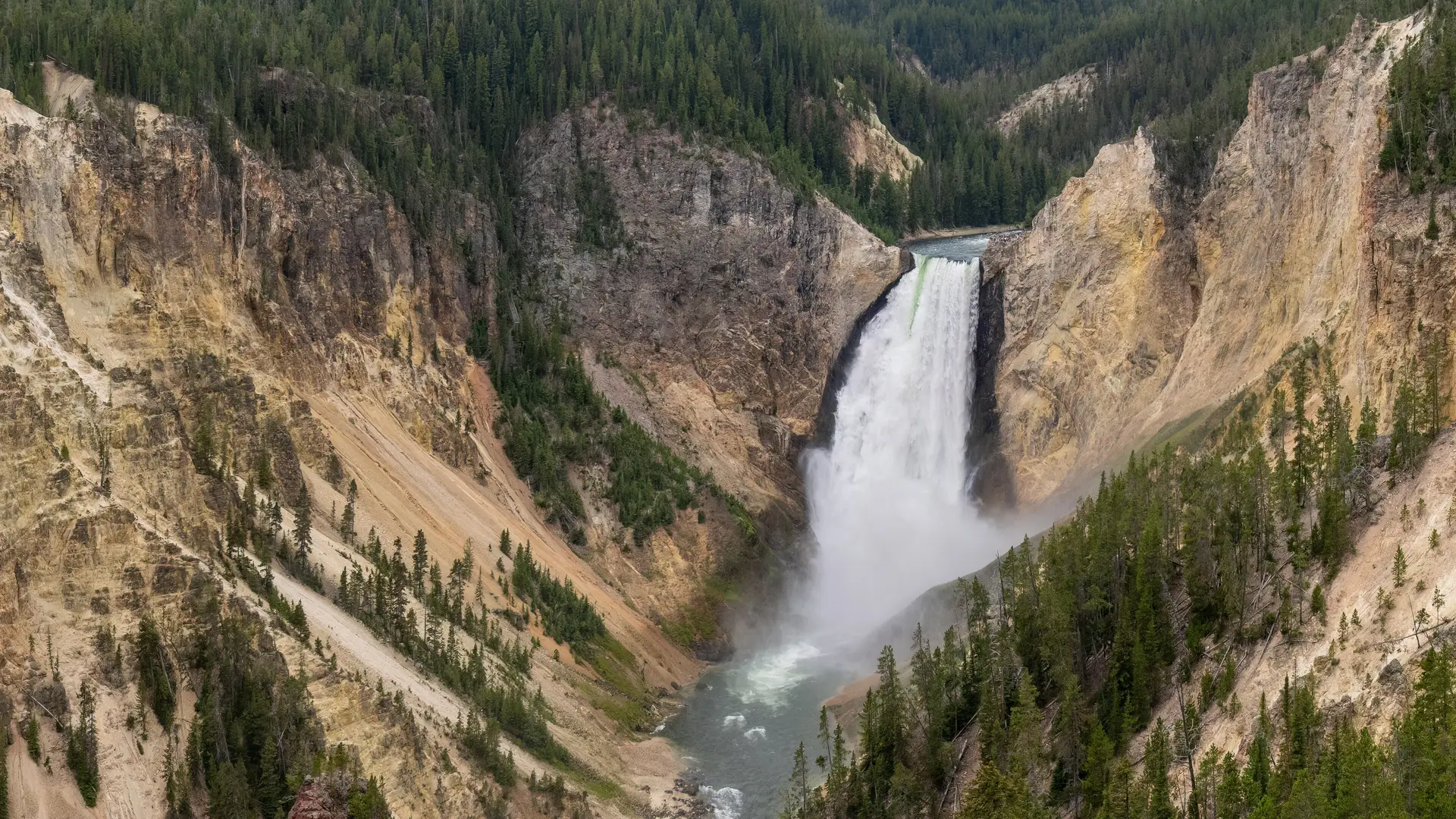
The Yellowstone River plunges over the Lower Falls, about 94 meters high, nearly twice the height of Niagara, into a canyon of yellow, pink and orange rock. Viewpoints like Artist Point and the trail down to the brink of the falls are spectacular.
Wildlife
Yellowstone is one of the best places in North America to see wildlife:
- Bison: huge herds roam the valleys and cause traffic jams. They’re the descendants of a tiny herd that survived the slaughter of the 1800s.
- Wolves, reintroduced in 1995, can be seen at dawn and dusk in Lamar Valley, often through the spotting scopes of patient wolf-watchers.
- Grizzly and black bears, elk, pronghorn, moose, bighorn sheep, bald eagles and more.
Safety: this matters
- Stay on the boardwalks in thermal areas. The ground is thin, and the water can be boiling and acidic. People have died after stepping off the paths.
- Keep your distance from wildlife: at least 25 yards from bison and elk, 100 yards from bears and wolves. Bison injure more visitors than any other animal.
- Carry bear spray on trails and know how to use it.
Getting around and staying
The park’s roads form a big figure-of-eight loop. It’s huge, so allow several days. Stay inside the park if you can, at the historic Old Faithful Inn (built of logs in 1904), lodges or campgrounds, which book up far in advance. Gateway towns include West Yellowstone, Gardiner, Cody and Jackson, near Grand Teton National Park to the south.
Entry is charged per vehicle. Fees for international visitors have risen at the busiest national parks, so check the official NPS site.
When to go
- Late May–June: baby bison (nicknamed “red dogs”), lots of wildlife, but cold, wet weather and possible snow.
- July–August: warmest and busiest.
- September: fewer people, golden aspens and the elk rut, with bulls bugling across the valleys.
- Winter: magical and quiet, with steam and snow, but most roads are closed to cars.
The honest bits
Yellowstone is big and busy in summer, with crowded boardwalks, slow traffic and wildlife jams. Lodging is expensive and books out early. The weather can change fast.
But stand on the boardwalk as Old Faithful roars into the sky with a hiss and a rumble of steam, just as fur trappers swore it did two hundred years ago.
Yellowstone: questions people ask
How often does Old Faithful erupt?
Roughly every 60 to 110 minutes. The park posts predicted times at the visitor center and online, usually accurate to within about 10 minutes.
How close can I get to wildlife in Yellowstone?
Stay at least 25 yards (23 m) from bison, elk and other animals, and at least 100 yards (91 m) from bears and wolves. Bison injure more visitors than any other animal in the park.
When is Yellowstone open?
Most park roads are open from about late April or May to early November. In winter, only the northern road is open to cars; the rest of the park is reached by snowcoach or snowmobile tour.
Is Yellowstone a supervolcano?
Yes. It sits on a huge volcanic system that has had three massive eruptions over the past 2.1 million years. Scientists monitor it constantly and see no signs of an imminent eruption.