Stand at the foot of the great pyramid, face the staircase, and clap your hands once.
What comes back isn’t an echo of a clap. It’s a chirp: a falling, bird-like chee-ooo that bounces down off the steps. Acoustic researchers have studied it for years. Some think it was intended to imitate the quetzal, the sacred bird whose green tail feathers were worth more than gold to the Maya. Others say it’s a happy accident. Either way, everyone around you starts clapping too, and for a moment the whole plaza is full of birdsong.
A city that was also a clock
At its height, roughly between AD 600 and 1200, Chichén Itzá was one of the most powerful cities in the Maya world. It drew pilgrims, traders and ideas from as far away as central Mexico. The name means “at the mouth of the well of the Itzá,” after the great natural sinkholes, or cenotes, that gave the dry Yucatán its only water.
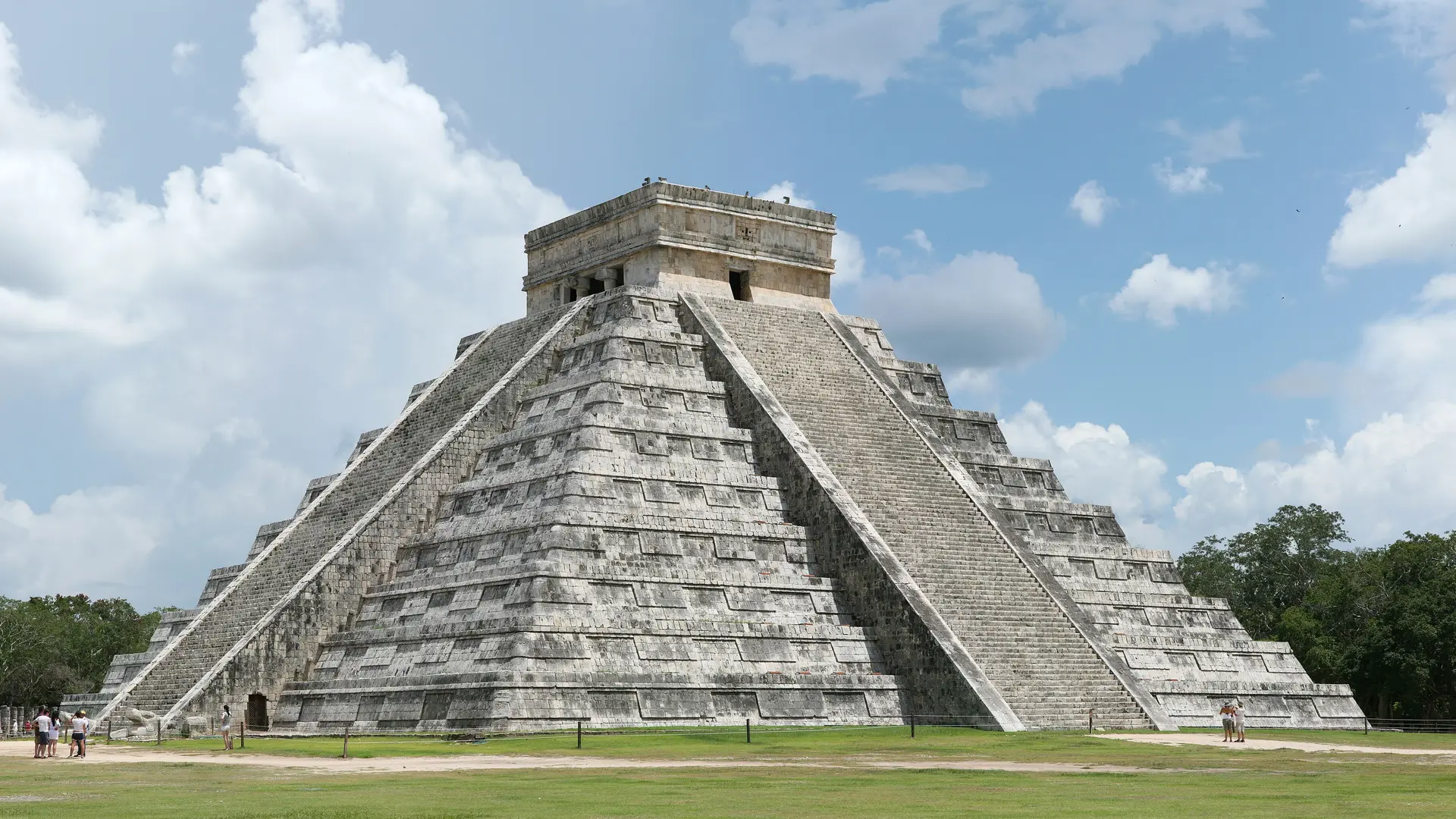
Its centerpiece, El Castillo, also called the Temple of Kukulcán, is a calendar in stone. Each of its four staircases has 91 steps. Add the shared top platform and you get 365, one for every day of the year. The nine terraces are split by the staircases into 18 sections, the number of months in the Maya solar calendar.
The serpent of light
Twice a year, the pyramid comes alive.
On the late afternoons around the spring and autumn equinoxes, the setting sun catches the stepped edge of the pyramid and throws a row of triangular shadows onto the northern staircase. They link together into a long, rippling body that seems to slither down the steps to the stone serpent head at the bottom. The feathered serpent god, Kukulcán, descending to earth.
Tens of thousands of people come to watch, dressed in white, arms raised to the sun. It’s moving and wildly crowded. The effect is visible for several days on either side of the equinox, so if you want the serpent without the crush, go a few days early or late.
What to see
El Castillo. You can’t climb it any more. That was banned in 2006. But walk all the way around it and look at how the faces change in the light.
The Great Ball Court. The largest in Mesoamerica, about 168 meters long, with stone rings set high in the walls. Players struck a heavy rubber ball with their hips. The carvings along the base show a decapitated player with serpents of blood spraying from his neck. Whether it was the winners or the losers who were sacrificed is still argued about.
The Sacred Cenote. A short walk down a raised causeway leads to a huge, green-water sinkhole. Divers and dredgers in the 20th century pulled out jade, gold, incense and human bones. Offerings, to the rain god Chaac.
The Temple of the Warriors with its rows of carved columns, the Tzompantli wall of carved skulls, and the round El Caracol observatory, where Maya astronomers tracked the movements of Venus.
When to go, and what time
Go between November and March, when it’s warm, dry and not stifling. April and May are fiercely hot. June to October brings humidity and afternoon storms.
More important than the month is the hour. Arrive at 8 a.m. when the gates open. For two or three hours the site is calm, cooler and full of long shadows. By late morning the coaches from Cancún have arrived, the vendors are fully set up, and the sun is brutal. There’s very little shade.
Tickets and getting there
Entry is a combined ticket covering federal and state fees, roughly 600-plus pesos for foreign visitors. Prices rise most years, so check the current rate. Bring cash as a backup and expect a small extra charge for video cameras.
- From Valladolid: about 45 minutes. This colonial town is the best base by far.
- From Mérida: under 2 hours.
- From Cancún or Playa del Carmen: about 2.5–3 hours each way, which is why the day tours arrive at the worst time.
- By train: the Tren Maya has a station near the site.
Sleeping near the ruins is the ultimate trick. A handful of hotels sit right at the edge of the site, which lets you walk in at opening before anyone else arrives.
Cool off in a cenote
The Yucatán is dotted with cenotes, and swimming in one after a hot morning at the ruins is pure joy. Ik Kil is nearby and famous, a deep round well hung with vines, though it gets busy. Around Valladolid are quieter, beautiful options such as Suytun, Oxman and the cave cenotes of Dzitnup. Shower before you swim, and use biodegradable sunscreen or none at all.
A perfect Chichén Itzá day
7:30 a.m. Leave Valladolid after a quick coffee and a pastry from the square. The road is quiet and straight, lined with low jungle.
8:00 a.m. First in through the gates. Head straight to El Castillo while the plaza is empty. Clap at the base, walk all the way around, and watch the shadows on the staircases.
8:45 a.m. Walk the causeway to the Sacred Cenote before the heat builds, then loop back through the Great Ball Court. Stand at one end and talk quietly. Your voice carries surprisingly clearly to the other end.
10:00 a.m. The Temple of the Warriors, the Group of a Thousand Columns and El Caracol observatory. By now the first tour buses are arriving.
11:00 a.m. Leave the crowds to it and drive to a cenote for a swim.
1:30 p.m. Lunch in Valladolid. Try cochinita pibil, slow-roasted pork marinated in sour orange and achiote, the great Yucatán dish. Then a siesta.
Evening. Stroll Valladolid’s Calzada de los Frailes, a pretty colonial street of pastel houses, as the lights come on.
More Maya cities worth your time
Chichén Itzá is the famous one, but the Yucatán is full of ancient cities, many quieter and just as atmospheric.
- Uxmal, south of Mérida, is perhaps the most beautiful of all. Its Pyramid of the Magician has rounded sides and soaring stairs, and the buildings are covered in intricate stone mosaics of rain-god masks. A legend says a dwarf built the pyramid in a single night.
- Ek Balam, near Valladolid, has a tall acropolis with a stunning carved stucco doorway in the shape of a monster’s open jaws. It also has a lovely cenote nearby.
- Cobá, near Tulum, is a jungle city spread out along ancient white roads called sacbeob, which you can explore by bicycle.
Climbing rules at these sites change, so check locally before you go. But at any of them you might share a pyramid with a few iguanas and nobody else, which is almost impossible at Chichén Itzá.
The honest bits
The site is lined with souvenir stalls, hundreds of them. Vendors call out, demonstrate jaguar-roar whistles, and are mostly good-humored. A polite “no, gracias” is enough. In the middle of the day, the heat can be a real health risk. Bring lots of water, a hat and patience.
But get there early, stand in the empty plaza at eight in the morning, and clap your hands. When the quetzal answers, you’ll understand why people built a whole world around this pyramid.
Chichén Itzá: questions people ask
Can you climb the pyramid at Chichén Itzá?
No. Climbing El Castillo has been banned since 2006 to protect the structure and visitors. You can still walk right up to its base.
When does the serpent appear on the pyramid?
Around the spring and autumn equinoxes (about 20 March and 22 September), late in the afternoon. The setting sun throws a series of triangular shadows down the northern staircase that join the carved serpent head at the bottom. Expect very large crowds on those days.
How long does it take to get to Chichén Itzá from Cancún?
About 2.5–3 hours by road. It's around 45 minutes from Valladolid and under 2 hours from Mérida. The Tren Maya also stops near the site.
What's the best time to arrive at Chichén Itzá?
At opening, 8 a.m. Tour buses from Cancún and the Riviera Maya usually arrive from around 11 a.m., when the heat is also at its worst.