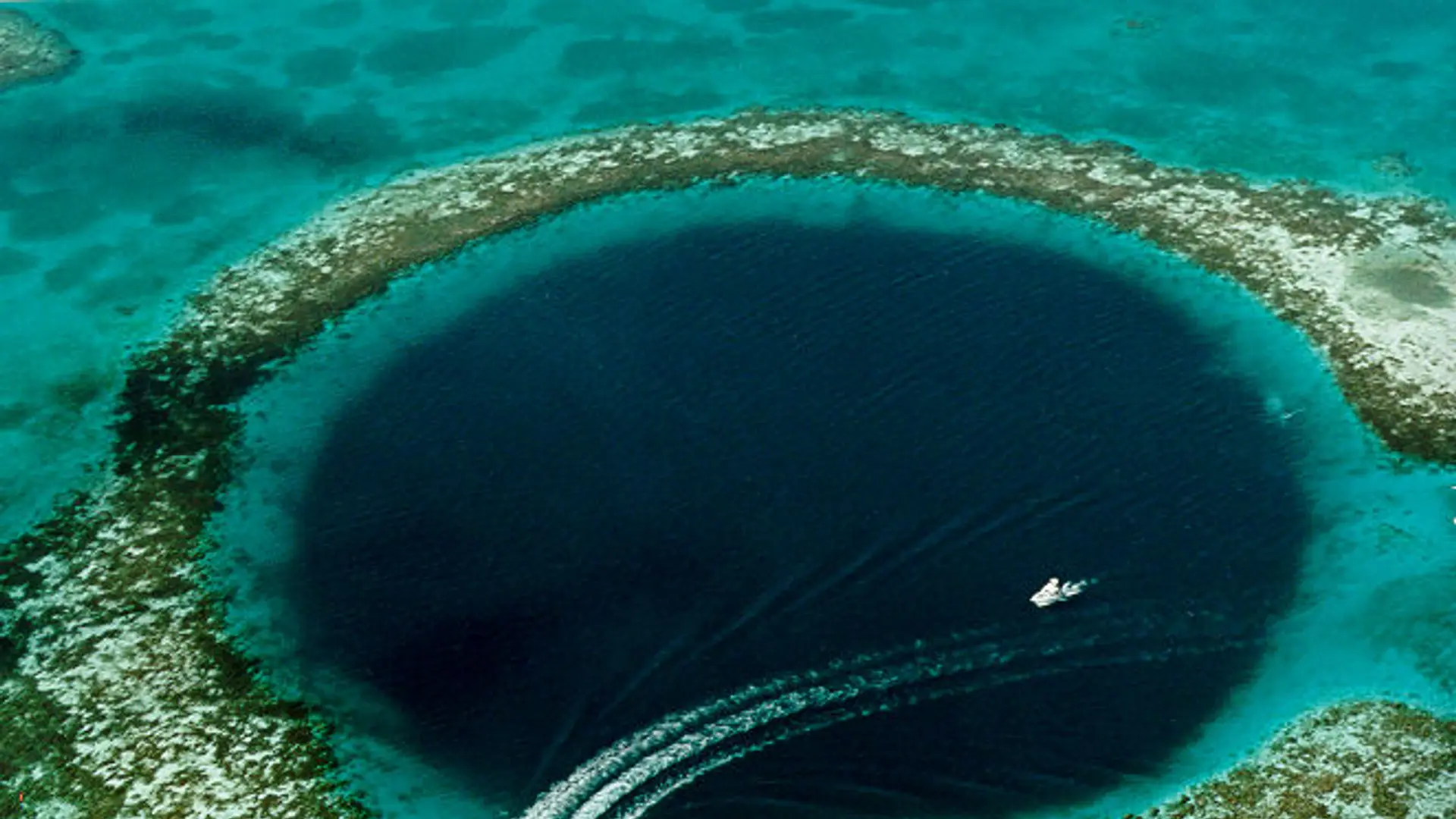
From the window of the small plane, the sea below is every shade of turquoise and green, streaked with coral. Then, in the middle of it, a perfect circle of deep, dark blue appears, as if someone had cut a hole in the ocean.
The pilot banks so everyone can see. It’s about 300 meters across, perfectly round, ringed by pale coral, with the open Caribbean beyond. Its blue is so deep it’s almost black.
This is the Great Blue Hole, and from up here, it looks like an eye looking back at you.
A cave beneath the sea
The Great Blue Hole is a giant marine sinkhole on Lighthouse Reef, an atoll about 70 kilometers off the coast of Belize. It’s roughly 300 meters wide and about 125 meters deep.
It wasn’t always underwater. During the last ice age, when sea levels were much lower, this was dry land: a limestone cave system. The roof of a giant cave collapsed, leaving a deep vertical shaft. When the ice melted and the seas rose, the ocean poured in and flooded it.
Deep down, divers can still see stalactites, formations that grow only in air-filled caves, hanging from ledges at around 40 meters. They’re the proof that the Great Blue Hole was once on land.
Cousteau’s hole
The Great Blue Hole became world-famous after Jacques Cousteau brought his ship Calypso here in 1971 to explore and film it. He declared it one of the top dive sites in the world, and divers have been coming ever since.
It’s part of the Belize Barrier Reef, the second-largest barrier reef system in the world and a UNESCO World Heritage Site.
The dive: what it’s really like
The classic Great Blue Hole dive is a deep dive down the wall to about 40 meters, where you swim among the giant stalactites hanging under a ledge. Then you rise slowly back to the surface. You may see Caribbean reef sharks circling in the blue.
What to know:
- It’s deep: most operators require an advanced certification and recent experience.
- It’s short: because of the depth, your time at the bottom is only a few minutes.
- It’s dark and blue, not colorful. There isn’t much coral or fish life inside the hole. It’s about the scale and the eeriness.
For many divers, it’s a once-in-a-lifetime bucket-list dive. Others find the best diving of the day comes after.
A day trip
Day trips usually leave San Pedro (on Ambergris Caye) or Caye Caulker very early, around 6 a.m., for a 2–3 hour boat ride across open water, which can be rough. Typical trips include three dives or snorkels:
- The Great Blue Hole.
- Half Moon Caye: a tiny island with a nesting colony of red-footed boobies, plus great wall diving.
- The Aquarium: a shallow, colorful reef full of fish, turtles and rays.
You’ll get home in the evening, tired and salty.
Seeing it from the air
Honestly, the most spectacular way to see the Great Blue Hole is from above. Scenic flights from San Pedro, Caye Caulker or Belize City fly over it and along the barrier reef. The circle of blue is perfect, and the colors of the reef are stunning. It’s the classic photo, and you don’t need to dive.
When to go
April to June usually brings the calmest seas and good visibility. The dry season runs from about December to May. June to November is hurricane season, with more rain and the risk of storms, especially from August to October.
Around Belize
- Caye Caulker: a laid-back island with sandy streets and the motto “go slow.”
- Ambergris Caye: bigger and livelier, with resorts and restaurants.
- Hol Chan Marine Reserve and Shark Ray Alley for easy snorkeling with nurse sharks and rays.
- Inland, Maya ruins like Xunantunich and Caracol, and cave tubing.
The honest bits
The Great Blue Hole is expensive to reach, involves long boat rides on choppy seas, and the dive itself is short, deep and not colorful. Some divers are disappointed.
But see it from the air, a perfect blue circle in the turquoise reef, and you’ll understand why Cousteau sailed all the way here to dive into it.
Great Blue Hole: questions people ask
Can beginners dive the Great Blue Hole?
Usually not. The classic dive goes to about 40 meters, so most operators require an advanced certification and recent experience. Snorkelers can join some trips, but the best view is from the air.
What's the best way to see the Great Blue Hole?
From a scenic flight. From above, you see the perfect circle of deep blue in the turquoise reef. The dive is famous for its stalactites and sharks, but it's deep and dark rather than colorful.
How far is the Great Blue Hole?
It's on Lighthouse Reef, about 2–3 hours by boat from San Pedro (Ambergris Caye) or Caye Caulker. Day trips leave very early.