At about half past eight in the morning, the little red train is still climbing through the rainforest. Monkeys sit on the branches. The air smells of wet leaves. People crane their necks at the windows because every few minutes the trees open and there it is: the city far below, glittering, and then gone again.
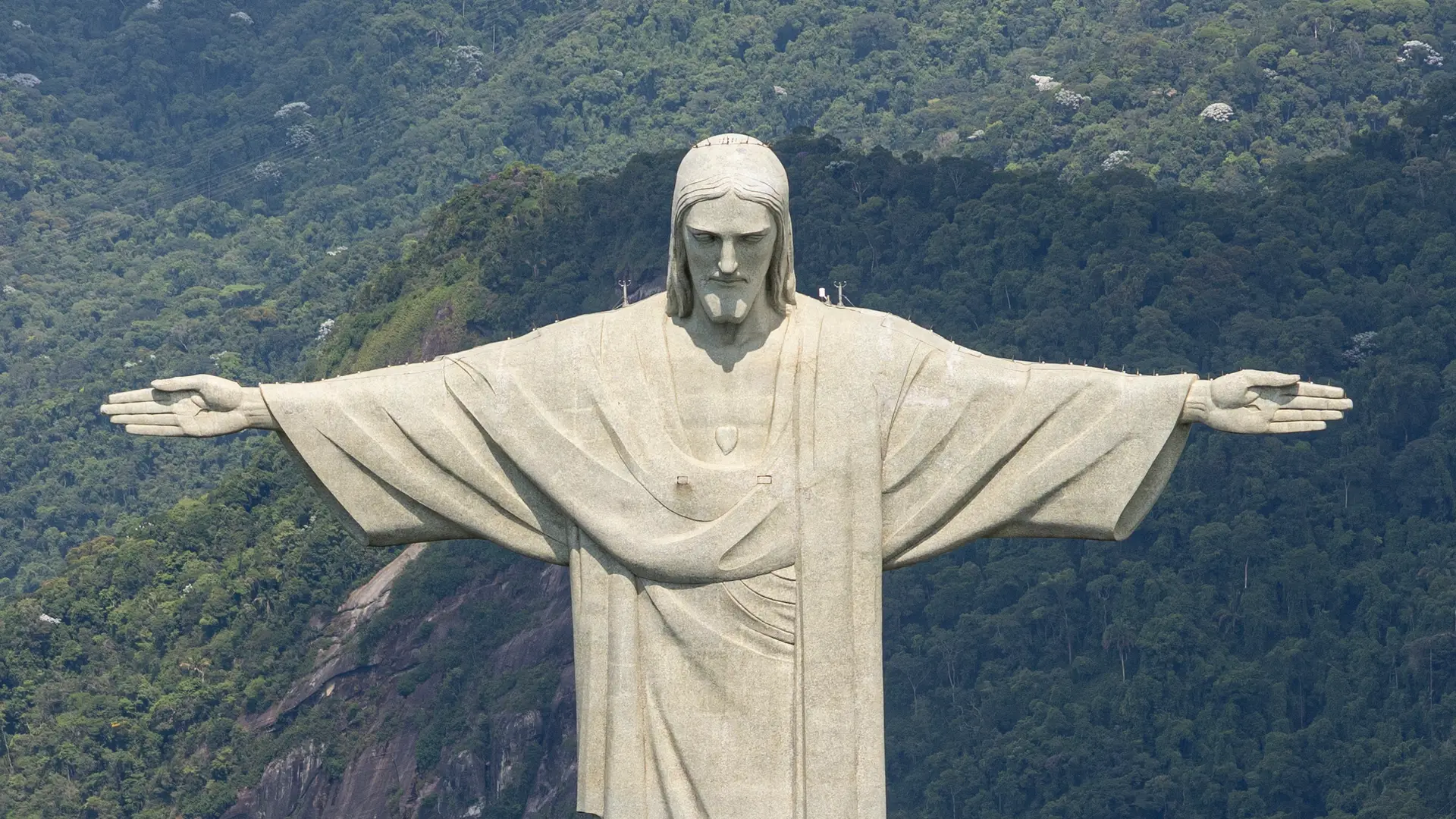
At the top you climb the last steps, turn around and look up. He’s bigger than you expected. And then you turn the other way, toward what he’s looking at, and you forget about him completely.
A statue built in pieces, in France and Brazil
The idea of a giant Christ on Corcovado had been floating around since the 1850s. It finally happened in the 1920s, after Brazilian Catholics raised money for a monument to mark the centenary of independence.
The engineer Heitor da Silva Costa designed the structure. The French sculptor Paul Landowski created the figure, and a Romanian sculptor working with him, Gheorghe Leonida, shaped the face. The head and hands were made in sections in France and shipped over.
The body is reinforced concrete, which was cutting-edge at the time. Silva Costa wanted the surface covered in something durable and luminous, and chose soapstone. Thousands of small triangular tiles were stuck onto cloth by hand, many by local women from church groups. Some of them are said to have written names and wishes on the back before they were fixed in place. Those messages are still up there, facing inward.
The statue was inaugurated on 12 October 1931. It’s about 30 meters tall on its pedestal, and its arms span 28 meters. It’s struck by lightning several times a year. Restorers have had to repair its fingers and head more than once.
How to get up
The cog train (Trem do Corcovado). Leaves from Cosme Velho, takes about 20 minutes and climbs through the Tijuca Forest. Tickets are for timed departures. Book online in advance, especially in high season, and take the first one if you can.
Official vans. Run from Copacabana, Largo do Machado and Barra. They’re convenient and a little cheaper, but they drop you at a station partway up where you change vehicles. Lines can be long at midday.
Hiking. A steep trail climbs from the lovely gardens of Parque Lage to the summit in about two to three hours. It’s beautiful and sweaty, with a short section of chains. For safety, go in a group or with a local guide, and not too late in the day.
Tickets cost roughly R$100–160 depending on the route and season, including park entry. Check the official sites. At the top there are escalators and lifts, plus around 220 steps if you prefer to walk.
Clouds, crowds and timing
Corcovado makes its own weather. The mountain catches the moist air from the ocean, and on many days the statue vanishes into cloud by late morning. People ride all the way up and stand inside a white blur.
Three rules:
- Check a webcam before you go. Several show the summit in real time.
- Go early. The first hour is calmest and clearest.
- Be flexible. Keep the visit loose in your plans and go on the first clear morning.
The drier, milder months, May to October, tend to be best. Summer (December–March) is hot, humid and stormier, and Carnival week is wildly busy.
Up close
The famous photo has you lying on the ground to fit the statue in, arms wide. You’ll be one of fifty people doing it. Play along, it’s part of the fun. Then walk round to the small chapel in the base, which marks the spot as a sanctuary. Then go to the railings.
From up here you can see the whole layout of Rio at once: Sugarloaf standing in the mouth of Guanabara Bay, the curve of Copacabana, the lagoon, Ipanema and the Dois Irmãos peaks, and the favelas climbing up the hills. You can see why the Cariocas say God made the world in six days and spent the seventh on Rio.
Into the Tijuca Forest
The train climbs through the Tijuca National Park, and it’s worth coming back to spend a few hours in it properly. This is one of the largest urban forests in the world: steep, green mountains full of waterfalls, trails, toucans and marmosets, right in the middle of a city of six million people.
Much of it was replanted by hand. By the mid-1800s, coffee farms had stripped the hills so badly that Rio’s water supply began to fail. Emperor Pedro II ordered the slopes reforested. Over about thirteen years, a small team, including enslaved workers, planted tens of thousands of seedlings. The forest you see today grew back from that.
Places to stop:
- Vista Chinesa, a little Chinese-style pavilion on a bend in the road, honoring the Chinese workers brought to Rio to grow tea in the 1800s. The view over the lagoon, Ipanema and the sea is superb.
- Mesa do Imperador, the “Emperor’s Table,” a stone picnic table where the royal family is said to have dined with the city at their feet.
- Cascatinha Taunay, a waterfall that pours down a smooth slab of rock beside the road.
- Pico da Tijuca, at just over 1,000 meters the highest point in the park. It’s a steep hike with carved steps near the top, and has views over the whole city.
A half-day jeep or hiking tour through the forest, ending at Corcovado, makes a lovely alternative to the train.
Photography tips
The statue faces roughly east, out toward Guanabara Bay. That means morning light falls on his face, and in the afternoon he’s backlit against the sky. Another reason to take the first train. For the full figure, stand near the back of the platform and shoot up with a wide angle. For the classic view over the city, go to the railings on the south side, where Sugarloaf and the bay line up beautifully. And if a cloud drifts across his face, take the shot anyway. The mist-wrapped photos are often the most dramatic.
Pair it with
- Sugarloaf Mountain by cable car at sunset. Do Christ in the morning and Sugarloaf in the evening for the perfect Rio day. See our guide to the Harbor of Rio.
- Santa Teresa, the arty hillside neighborhood with cobbled streets and cafés.
- The Selarón Steps, a staircase covered in tiles from around the world.
The honest bits
The summit platform is small, and when it’s busy it’s elbow-to-elbow. Phone snatching happens in Rio, so keep your phone strapped or zipped in crowds and use app-based taxis rather than hailing in the street. And if the cloud rolls in while you’re up there, wait twenty minutes. Sometimes it parts as suddenly as it came, and the whole city reappears under those open arms.
Christ the Redeemer: questions people ask
What's the best way to get up to Christ the Redeemer?
The Corcovado cog train from Cosme Velho is the classic route: about 20 minutes through the Tijuca rainforest, with timed tickets you can book online. Official vans from Copacabana and Largo do Machado are a good alternative. Fit walkers can hike up from Parque Lage, ideally with a guide.
What time should I visit Christ the Redeemer?
Take the first train of the morning. You'll beat the crowds and often the clouds, which tend to build around midday. Check a Corcovado webcam before you leave: if the statue is in cloud, wait and go later.
How tall is Christ the Redeemer?
The statue is 30 meters tall on an 8-meter pedestal, and its arms stretch 28 meters across. It stands on the 700-meter summit of Corcovado.
Is Christ the Redeemer worth it?
Yes, but go for the view as much as the statue. From the platform you see Sugarloaf, Copacabana, Ipanema, the lagoon and Guanabara Bay all at once. On a clear morning it's one of the great views on Earth.