At Arpoador, the rocky point between Copacabana and Ipanema, people start gathering in the late afternoon. Students with beer, old men with dogs, couples sharing a blanket, surfers drying off. Someone has a guitar. Everybody faces west.
As the sun drops behind the twin peaks of Dois Irmãos and sets fire to the sea, the whole rock bursts into applause. People clap and cheer, as if the sun has just given a good performance and deserves its ovation. It does this every clear evening, and the Cariocas, the people of Rio, never seem to get tired of it.
The “River of January”
In January 1502, Portuguese sailors pushed into a wide, sheltered bay surrounded by strange green mountains. Believing they’d found the mouth of a great river, they named it the Rio de Janeiro, the River of January.
There was no river. They’d found Guanabara Bay, one of the largest bays in the world, about 30 kilometers long. The name stuck anyway.
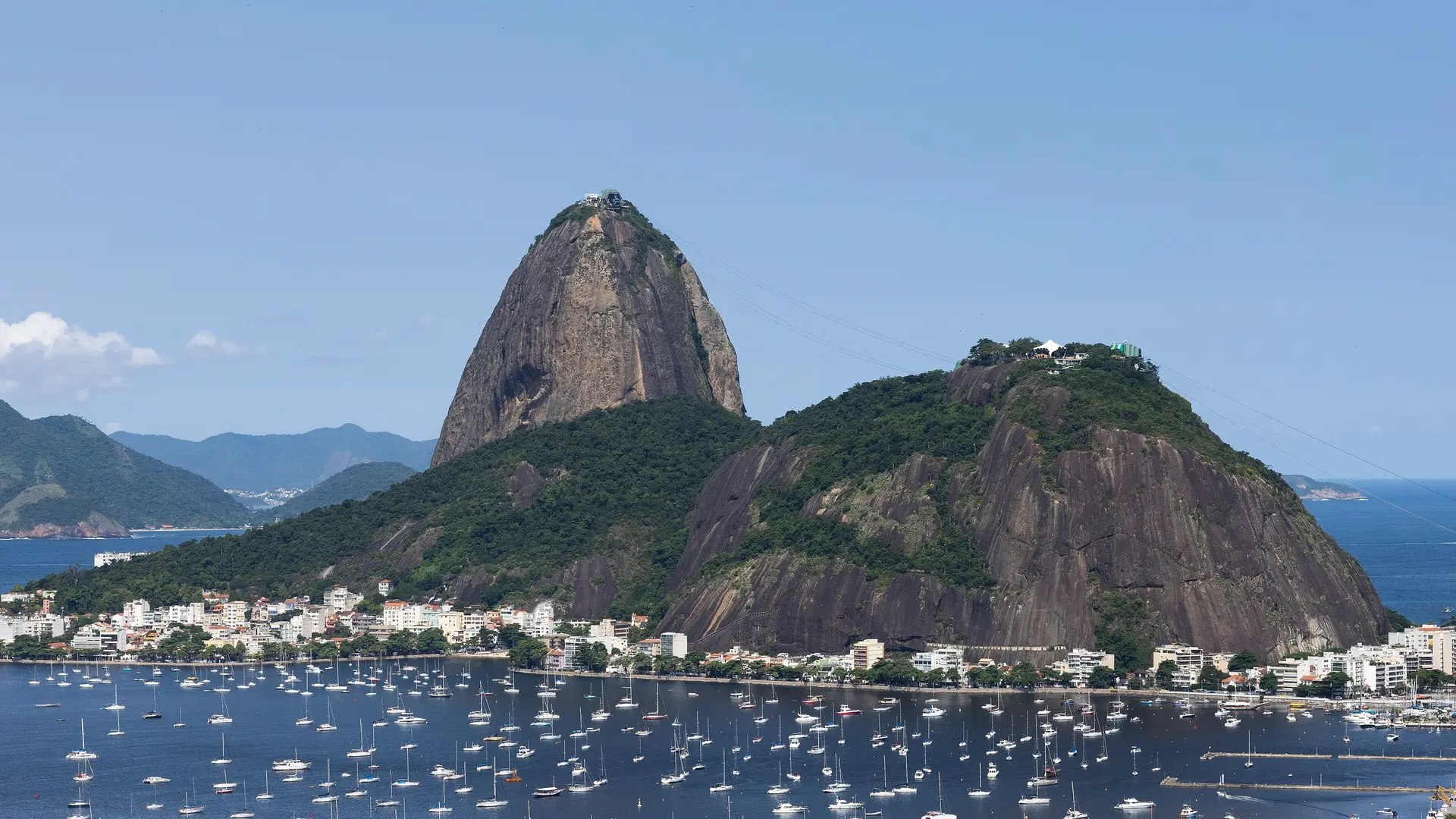
What makes the harbor a wonder isn’t the water alone. It’s the giant granite domes that rise straight out of the sea and the city: Sugarloaf, Corcovado, the Two Brothers, the mountains of the Tijuca Forest. Millions of years ago they were molten rock deep underground. Erosion has since stripped away everything softer, and left these smooth, bare peaks standing in the bay. UNESCO listed the city’s landscape in 2012 as “Carioca Landscapes between the Mountain and the Sea”.
Tijuca itself has a wonderful backstory. By the 1800s coffee plantations had stripped the mountains bare, and Rio’s water supply began to fail. In the 1860s Emperor Pedro II ordered the hills replanted, and a small team of workers, many of them enslaved, planted tens of thousands of trees by hand. The result is one of the largest urban forests in the world.
Sugarloaf at sunset
Sugarloaf (Pão de Açúcar) stands 396 meters high at the mouth of the bay. A cable car, first opened in 1912, takes you up in two stages, first to the smaller Morro da Urca, then on to the summit.
Go about an hour before sunset. You’ll see the whole sweep of the bay in daylight, with Copacabana, the beaches, the fortresses and the bridge to Niterói. Then you’ll watch the sun go down behind Christ the Redeemer on Corcovado, and the city lights come on one by one. Tickets cost roughly R$200. Buy them online to skip the line.
For something more adventurous, you can hike up Morro da Urca on a short trail from Praia Vermelha, or rock climb to the top of Sugarloaf with a guide.
More ways to see the harbor
Christ the Redeemer. The view from Corcovado covers the whole bay. Read our full Christ the Redeemer guide.
The Niterói ferry. Ferries cross the bay from Praça XV in about 20 minutes, and they’re cheap and used by locals. On the other side, the flying-saucer Niterói Contemporary Art Museum, designed by Oscar Niemeyer, hovers over the water with perfect views back to Rio and Sugarloaf.
Hang gliding. Run off a ramp at Pedra Bonita and glide over the forest, then down to land on São Conrado beach. Tandem flights with an instructor need no experience. It’s as thrilling as it sounds.
Hikes. Dois Irmãos, starting through the hillside favela of Vidigal, and Pedra do Telégrafo, famous for photos where you appear to hang off a cliff, look down over the whole coastline. Go with a local guide.
Beaches. Copacabana, Ipanema and Leblon are the classic beaches, with the mountains behind them.
The last ball of the Empire
On a tiny island in the bay, just off the old city center, stands the Ilha Fiscal: a pale green, neo-Gothic customs house that looks like a castle from a fairy tale.
On 9 November 1889, Emperor Pedro II threw a great ball there in honor of visiting Chilean naval officers. Thousands of guests danced until dawn under lanterns, and boats ferried them back and forth across the dark water. Six days later, on 15 November, the army overthrew the monarchy and declared Brazil a republic. The emperor and his family were sent into exile in Europe.
It went down in history as the last ball of the Empire. Today the island belongs to the Brazilian Navy and can be visited on guided tours from the Navy’s cultural center near Praça XV.
A perfect day around the bay
Morning. First train up Corcovado for the view over the whole bay, while it’s clear.
Late morning. Down to the old center: the grand Theatro Municipal, the gilded Confeitaria Colombo café (opened in 1894) for a coffee and a pastry, then the waterfront at Praça XV.
Afternoon. Catch the ferry across to Niterói, walk to the Niemeyer museum perched on its cliff, and look back at Rio’s skyline with Sugarloaf in the middle.
Sunset. Back across the bay and up Sugarloaf by cable car, staying until the city lights come on.
Night. Dinner in Botafogo or Lapa, then live samba in a bar until late.
Eat and drink like a Carioca
- A caipirinha, made with cachaça, lime and sugar, at a beach kiosk.
- An ice-cold açaí bowl after a swim.
- Pão de queijo, warm cheese bread, any time of day.
- Feijoada, the black bean and pork stew, traditionally eaten on Saturdays with rice, greens and orange slices. Plan for a nap afterwards.
- Grilled cheese on a stick, sold by beach vendors who carry a little burner. Try it once.
When to go
May to October is drier, milder and clearer, which is best for views from the peaks. December to March is summer: hot, humid, rainy in the afternoons, and the best time for beach life. Carnival (February or March) is spectacular and packed, and prices soar. New Year’s Eve on Copacabana, with fireworks over the bay, draws millions.
Where to stay
Copacabana and Ipanema are the classic beach bases. Leblon is quieter and more upmarket. Arty Santa Teresa has boutique guesthouses with bay views. Botafogo is local, lively and close to Sugarloaf.
The honest bits
Guanabara Bay is beautiful from above, but its inner waters are badly polluted, so the swimming beaches face the open Atlantic. Petty crime is a real issue in Rio: carry little, keep your phone discreet, and use app-based taxis. The city can be loud, hot and chaotic.
And then the sun goes down behind the mountains, the bay turns gold and pink, and a few hundred strangers on a rock start clapping. You’ll be clapping too.
Harbor of Rio de Janeiro: questions people ask
What exactly is the 'Harbor of Rio' natural wonder?
It's Guanabara Bay, the great bay at Rio's heart, together with the granite mountains around it, such as Sugarloaf, Corcovado and the Tijuca peaks. It's one of the largest bays in the world.
When is the best time to go up Sugarloaf Mountain?
About an hour before sunset. You'll see the bay by day, watch the sun go down behind Corcovado, and then see the city lights come on. Buy tickets online to avoid queues.
What's the best time of year to visit Rio?
May to October is drier and milder, with clearer views. December to March is hot, humid and rainy, but it's peak beach and Carnival season.
Is Rio de Janeiro safe for tourists?
Millions visit safely every year, but petty crime, especially phone and bag snatching, is common. Carry little, keep your phone out of sight, use app-based taxis, and ask locally before visiting unfamiliar areas, especially at night.