In 1835, a local landowner named Cornelius O’Brien built a small round stone tower on the highest point of the cliffs. It wasn’t a fort or a lookout. It was for tourists, an observation point for the Victorian visitors already coming to stare at the Atlantic.
Locals joked that O’Brien built everything in County Clare except the cliffs themselves.
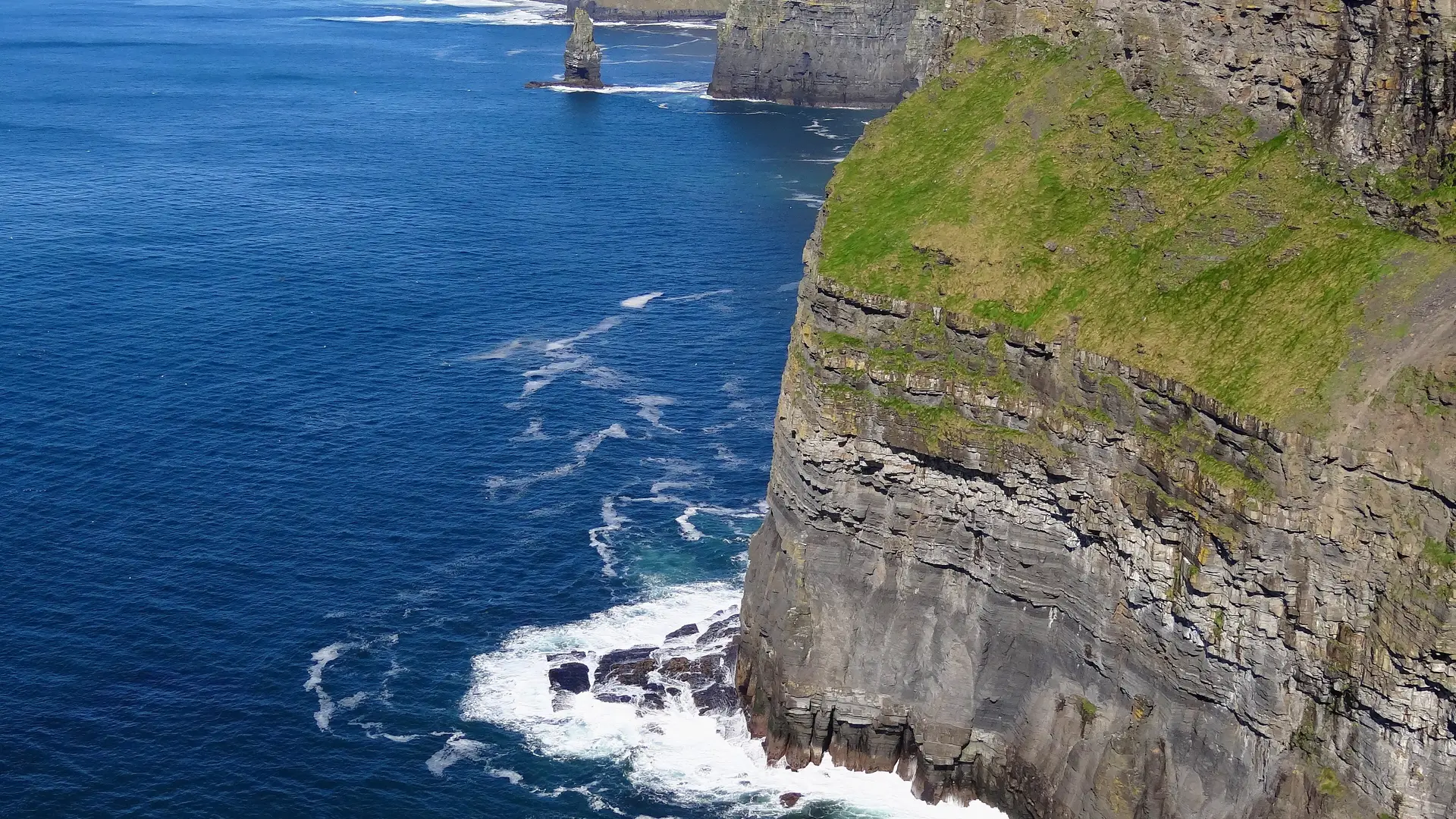
Nearly two centuries later, people still climb up beside O’Brien’s Tower, lean into the wind, and look down 200 meters to the Atlantic boiling white at the foot of the cliffs. It still takes their breath away.
The cliffs
The Cliffs of Moher stretch for about 14 kilometers along the coast of County Clare in western Ireland. At their highest point, near O’Brien’s Tower, they rise about 214 meters straight up from the sea.
They’re made of layers of shale and sandstone laid down by rivers about 300 million years ago. Each layer is a page in the story, and the wind and waves are still slowly tearing them out. The name comes from Mothar, an old ruined fort that once stood on the headland of Hag’s Head, at the southern end.
On a clear day, you can see the Aran Islands out in Galway Bay, the hills of Connemara, and sometimes the mountains of Kerry far to the south.
Wildlife
The cliffs are home to thousands of seabirds, including guillemots, razorbills, kittiwakes, fulmars and choughs. The stars are the puffins, little black-and-white birds with orange beaks, which nest on the ledges and on the sea stack called Goat Island (Branaunmore) from about April to July. Bring binoculars.
How to see them
The visitor centre. Built into the hillside so as not to spoil the view, with exhibitions, cafés and paved paths along the cliffs on either side. The main viewing areas and O’Brien’s Tower are close by. Tickets cost roughly €10–12, cheaper if booked online. Arrive early or late to avoid the coach tours.
The coastal walk. The Cliffs of Moher Coastal Walk runs about 18 kilometers from the village of Doolin, along the cliff tops, past the visitor centre, to Hag’s Head. The northern section from Doolin is wild and beautiful, with the cliffs rising ahead of you. Guided walks are available, and shuttle buses can bring you back.
From the sea. Boat trips from Doolin sail right along the base of the cliffs, with the rock towering overhead and the seabirds wheeling all around. Some trips combine this with a visit to the Aran Islands.
Sunset. On a clear evening, the sun sets over the Atlantic, lighting up the cliffs in gold and orange. It’s the most romantic time to be there.
Safety
The cliffs have no barriers along much of the coastal walk, and the wind can be fierce. People have died here.
- Stay on the path, well back from the edge.
- Don’t climb over walls or barriers for photos.
- Be careful in wet and windy weather: the edges can be slippery and unstable.
Around the Cliffs
- Doolin, a small village famous for traditional Irish music sessions in its pubs every night.
- The Burren, a strange limestone landscape of cracked stone pavements, where Arctic, Alpine and Mediterranean flowers grow side by side in spring, and ancient tombs like Poulnabrone Dolmen stand.
- The Aran Islands, where Irish is still spoken, with stone walls, cliffs and the great prehistoric fort of Dún Aonghasa.
The cliffs are about 1.5 hours from Galway and about an hour from Shannon Airport.
When to go
April to September brings longer days, puffins and the best chance of good weather. Summer is busiest. Late afternoon and evening are usually quieter and best for light. The weather is famously changeable, and fog can hide the cliffs completely, so be flexible.
The honest bits
The visitor centre area can be crowded with tour buses in the middle of the day. Fog and rain can roll in with no warning. The wind can make walking near the edge uncomfortable.
But walk the path from Doolin in the late afternoon, with the cliffs glowing gold and the Atlantic crashing far below, then end the night in a pub with a fiddle playing and a pint in front of you. That’s the west of Ireland.
Cliffs of Moher: questions people ask
When can you see puffins at the Cliffs of Moher?
From about April to July, when they nest on the cliffs and on the sea stack called Goat Island (Branaunmore). Bring binoculars.
Can you walk along the Cliffs of Moher?
Yes. The Cliffs of Moher Coastal Walk runs about 18 km from Doolin to Hag's Head, passing the visitor centre. Stay on the path, well back from the edge; the wind can be strong.
Can you see the Cliffs of Moher from the sea?
Yes. Boat trips from Doolin sail along the base of the cliffs, giving a dramatic view of their full height. Some combine this with a trip to the Aran Islands.