According to Māori tradition, the fiords of the south-west were carved by Tū-te-raki-whānoa, an atua (god) who worked his way up the coast with a giant adze, slicing valleys into the mountains. His last and finest work was Piopiotahi, Milford Sound.
It was so beautiful that people who saw it wanted to stay forever. Hinenuitepō, the goddess of death, didn’t like that. So she released the te namu, the sandflies, to bite them and keep them moving.
Stand on the shore at Milford with your face being eaten alive by tiny black flies, gazing up at the mountains, and you’ll believe every word.
A fiord, not a sound
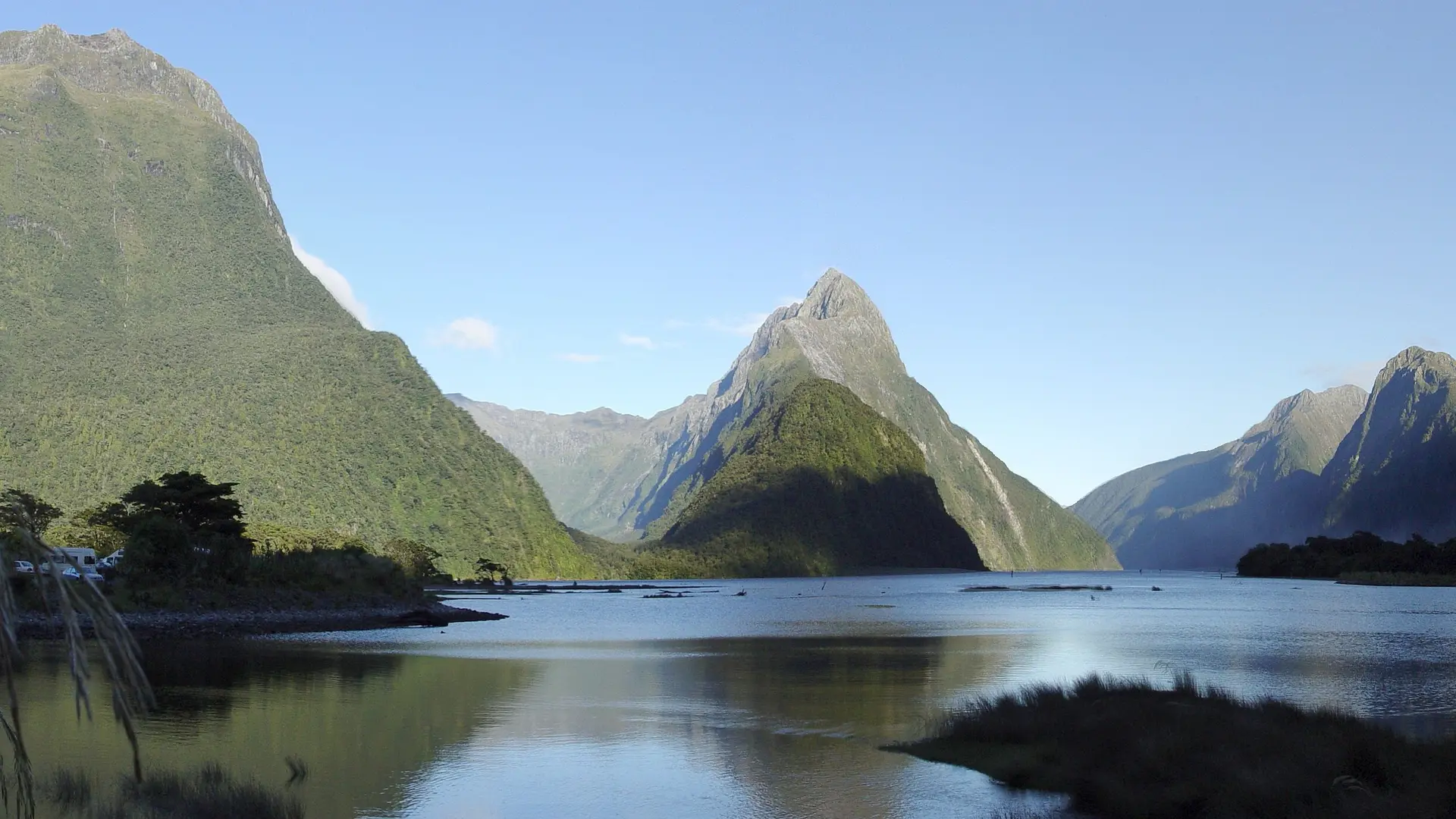
Despite the name, Milford Sound is actually a fiord, a valley carved by glaciers and flooded by the sea, not a sound, which is carved by rivers. It runs about 15 kilometers in from the Tasman Sea, with cliffs rising straight up more than a kilometer from the water.
At its heart stands Mitre Peak, about 1,690 meters tall, rising almost straight out of the water. It’s one of the most photographed mountains in New Zealand.
The writer Rudyard Kipling is often quoted as calling it the “eighth wonder of the world.” Whether or not he really said it, people have been repeating it ever since.
The rain is the magic
Fiordland is one of the wettest places on Earth: Milford gets around 6.7 meters of rain a year. That sounds like a problem. It isn’t.
When it rains heavily, hundreds of temporary waterfalls appear, pouring down every cliff face. Some fall hundreds of meters, blown into spray halfway down. It’s dramatic and otherworldly. On a clear, calm day you get the opposite: mirror-like water reflecting Mitre Peak. Either way, you win.
The permanent waterfalls are impressive too: Lady Bowen Falls, near the wharf, and Stirling Falls, where the cruise boats nose right into the spray.
How to see it
Cruises. Most visitors take a boat cruise of about two hours, out to the Tasman Sea and back. Look out for fur seals basking on rocks, bottlenose dolphins and, in season, Fiordland crested penguins (tawaki). Overnight cruises let you see the fiord after the day boats have left.
Kayaking. Paddle out on the calm water under the cliffs. It’s the most peaceful way to experience the scale of the place.
Scenic flights. Small planes and helicopters fly from Queenstown and Te Anau over the mountains and glaciers, often landing at Milford. Some helicopters touch down on snowfields.
The Milford Track. A 53-kilometer, four-day Great Walk through rainforest, alpine passes and waterfalls, ending at Milford Sound. It’s been called “the finest walk in the world.” Hut places are limited, so book as soon as the season opens.
The Milford Road
The drive from Te Anau (about 2 hours) is part of the experience. It’s one of the world’s great road trips, through beech forests, past the Mirror Lakes, through the steep Eglinton Valley, and finally through the Homer Tunnel, a 1.2-kilometer tunnel blasted through the mountain by hand and machine over almost two decades.
- Fill up with fuel in Te Anau. There’s none on the road.
- Watch out for kea, cheeky alpine parrots that may try to steal rubber from your car.
- In winter, chains may be required and the road can close because of avalanche risk.
Many people do the whole trip as a long day from Queenstown, about 4 hours each way. It’s much nicer to stay in Te Anau.
When to go
November to April (spring to autumn) brings longer days and milder weather. But Milford is beautiful in all weather. Winter brings snow on the peaks and fewer crowds, but potential road closures.
New Zealand also charges international visitors a tourism and conservation levy on entry.
The honest bits
The road is long, the weather is unpredictable, and the sandflies are relentless. Bring repellent. The middle of the day can be busy with tour buses and boats arriving together. Scenic flights get cancelled in bad weather.
But be on an early boat on a rainy morning, with a thousand waterfalls thundering down the cliffs around you, Mitre Peak disappearing into the clouds, and a seal watching you from a rock. You’ll forgive Hinenuitepō for the sandflies.
Milford Sound: questions people ask
Is Milford Sound worth visiting in the rain?
Yes, many people say it's even better. Heavy rain creates hundreds of temporary waterfalls pouring down the cliffs. Clear days give you the classic reflections of Mitre Peak.
How long is the drive from Queenstown to Milford Sound?
About 4 hours each way, or about 2 hours from Te Anau. Staying in Te Anau makes the day easier. Scenic flights from Queenstown take about 40 minutes.
Do I need to book the Milford Track?
Yes. It's one of New Zealand's Great Walks, with limited hut places in the main season, and they book out quickly when bookings open.