At 4:30 in the morning at Gorak Shep, the water in your bottle has frozen. You pull on every layer you own, switch on your headlamp and start up the dark slope of Kala Patthar. Every step is an effort. At over 5,000 meters, each breath has about half the oxygen you’re used to. You stop every twenty paces. Your guide waits, unbothered, humming.
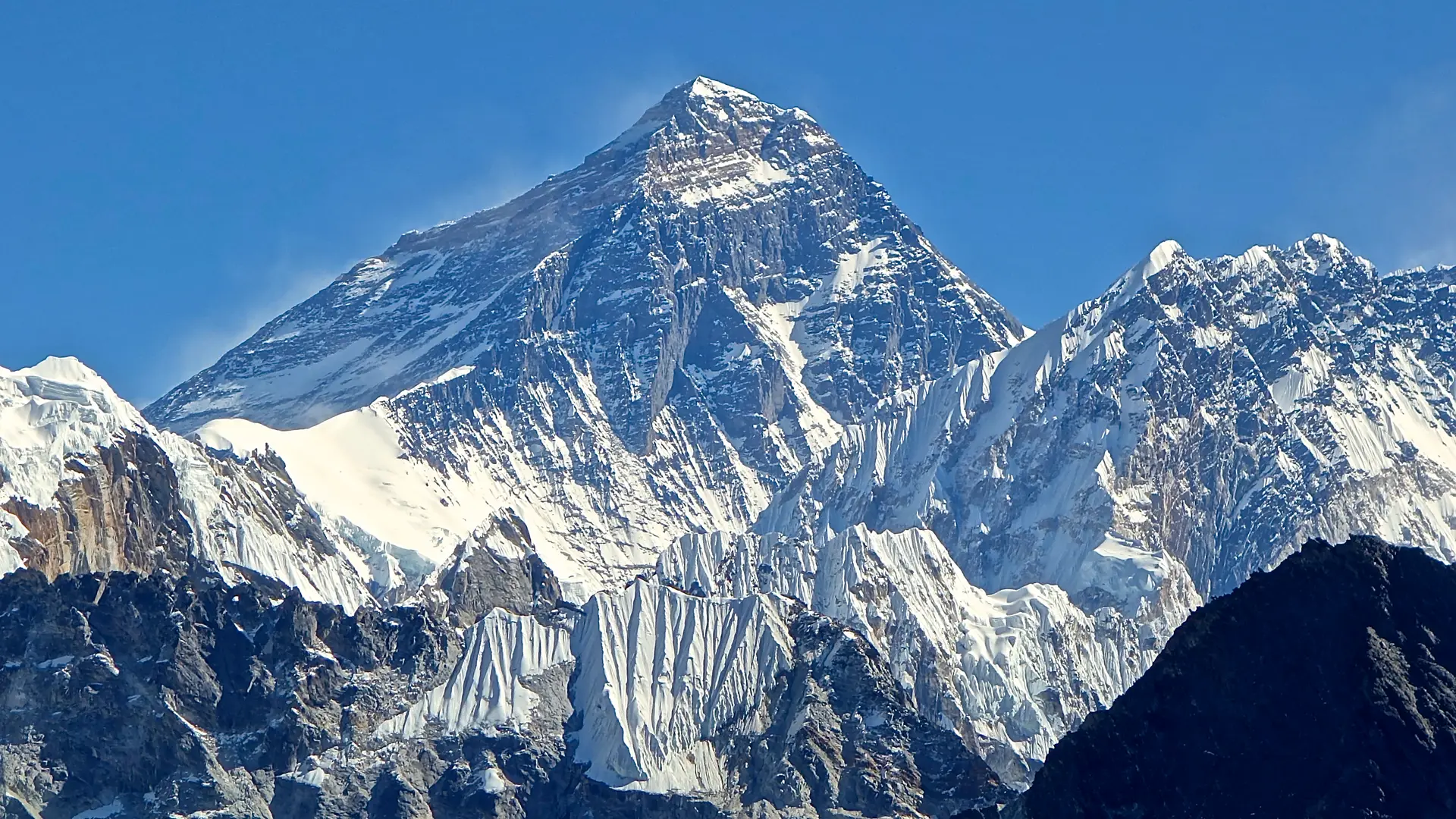
At the top, among the prayer flags snapping in the wind, you turn and face east. The sky behind the mountains goes from black to blue to pink. Then the first sunlight hits the dark rock summit of Everest, and it lights up gold, higher than everything around it, with a long white plume of snow streaming from its tip.
The mountain of many names
To the Sherpa and Tibetan people who live in its shadow, the mountain is Chomolungma, often translated as “Goddess Mother of the World.” In Nepal it’s Sagarmatha, “Forehead of the Sky.” The British Survey of India called it simply Peak XV, until measurements in the 1850s showed it was the highest on Earth.
In 1865 it was named after Sir George Everest, the former Surveyor General of India. He’d objected: his name, he said, couldn’t be written in Hindi or pronounced by locals. And he pronounced it “Eve-rest,” not the way we all say it now.
Its official height today is 8,848.86 meters, from a joint Nepal–China survey in 2020. It’s still rising by a few millimeters a year as India pushes into Asia.
The ones who went up
Before 1953, at least ten expeditions tried and failed. In 1924, the British climbers George Mallory and Andrew “Sandy” Irvine were last seen “going strong for the top,” then vanished into the cloud. Mallory’s body was found in 1999. In 2024 a film crew found a boot on the glacier below with the remains of a foot inside, and a sock stitched with the name A.C. Irvine. Did they reach the top? No one knows.
On 29 May 1953, Edmund Hillary, a New Zealand beekeeper, and Tenzing Norgay, a Sherpa from the Khumbu, stood on the summit for about fifteen minutes. Tenzing left a few sweets and a pencil from his daughter in the snow as an offering. Hillary later spent much of his life building schools and hospitals in the Sherpa villages.
How ordinary travelers see Everest
You don’t need to climb it. There are three main ways to see it.
1. The Everest Base Camp trek (Nepal). The classic. Fly from Kathmandu to the tiny mountain airstrip at Lukla. In busy seasons flights often leave from Ramechhap instead. Then walk for about 12–14 days round trip up the Khumbu valley.
Along the way:
- Namche Bazaar, the horseshoe-shaped Sherpa trading town, with bakeries, gear shops and a first glimpse of Everest.
- Tengboche Monastery, a Buddhist monastery with Everest and Ama Dablam, perhaps the most beautiful mountain in the world, behind it. Try to hear the monks’ evening chanting.
- Everest Base Camp (about 5,364 meters), a jumble of rock and ice at the foot of the Khumbu Icefall. In spring it’s a tented city of climbing expeditions.
- Kala Patthar (about 5,645 meters), for the best sunrise view of the summit.
You sleep in teahouses, simple lodges with shared rooms, dal bhat and a yak-dung stove in the dining room. You’ll need a Sagarmatha National Park permit and a local Khumbu area permit. Nepal has been tightening its rules on trekking without a licensed guide, so check the latest before you go. A local guide makes the trip safer and richer anyway, and directly supports the communities.
2. A mountain flight from Kathmandu. For those short on time, or not keen on two weeks of walking. Hour-long sightseeing flights leave Kathmandu at dawn and fly along the Himalaya. You get a window seat and, on most airlines, a turn in the cockpit as Everest comes into view. It’s easy and surprisingly emotional. Afterwards, helicopter tours can land at Kala Patthar or the Hotel Everest View for breakfast with the mountain, though at that altitude you can only stay a short while.
3. The Tibet side (China). A road runs to Everest North Base Camp, at about 5,150 meters, with a full-on view of the huge north face across the valley. You need Chinese visas, Tibet permits and an organized tour. Access sometimes closes at short notice.
Life on the trail
The best thing about the Everest trek isn’t base camp. It’s the days in between.
You walk past mani stones, rocks carved with the Buddhist mantra Om Mani Padme Hum, and prayer wheels that you spin as you pass. Always keep them on your right, walking clockwise, as the locals do. Prayer flags of blue, white, red, green and yellow flap from every bridge and pass, sending prayers out on the wind.
You share narrow paths with yak trains carrying supplies, their bells clanking. The rule is simple: always stand on the mountain side of the path when they pass, never the cliff side.
Each evening you arrive at a teahouse, pull off your boots and squeeze around the stove in the dining room with trekkers from all over the world. You eat dal bhat, the lentil curry with rice that Nepalis eat twice a day, which comes with free refills. “Dal bhat power, twenty-four hour,” the porters say. You drink endless cups of ginger-lemon-honey tea. You go to bed early under a pile of blankets in a sleeping bag, wearing a hat.
The Sherpa people
The Sherpa people moved over the Himalaya from eastern Tibet around five hundred years ago and settled in the Khumbu valleys below Everest. Their culture is Tibetan Buddhist, built around monasteries like Tengboche and family farms growing potatoes and barley.
Over the past century they’ve become famous as mountaineers. Their extraordinary strength at altitude is partly genetic, an adaptation after generations living high. Without them almost no one would reach the top of Everest. They also bear a heavy share of the risk.
In the village of Khumjung, near Namche, a small monastery keeps what it says is a yeti scalp, a tall, pointed piece of hairy skin, in a glass case. Scientists have suggested it’s made from the hide of a serow, a kind of wild goat. But the monks will happily show it to you, for a small donation.
When to go
October to November brings the clearest skies and crisp views, with cold nights. March to May is warmer, the rhododendron forests bloom red and pink, and base camp is buzzing with climbers. December to February is very cold but quiet and often clear. The monsoon (June–September) brings cloud, rain, leeches and often cancelled Lukla flights.
Altitude: the thing that matters most
Altitude sickness can affect anyone, however fit. Symptoms include headache, nausea and poor sleep. In serious cases it causes fluid on the lungs or brain, which can be fatal if you keep climbing.
- Go slowly. Good itineraries include acclimatization days at Namche and Dingboche.
- Climb high, sleep low. Hike up in the afternoon and return to sleep lower.
- Drink plenty of water, avoid alcohol, and tell your guide about any symptoms.
- If symptoms get worse, go down. It’s the only true cure.
- Make sure your travel insurance covers trekking to 5,500+ meters and helicopter evacuation.
The honest bits
Lukla flights are often delayed or cancelled by weather. Build in spare days. The trail is busy in peak season, the teahouses are basic, and it gets very cold at night. Base camp itself has no real view of the summit. But on Kala Patthar at dawn, with Everest catching the first light and nothing higher on Earth, the cold and the headaches won’t seem to matter much.
Mount Everest: questions people ask
How hard is the Everest Base Camp trek?
It's long rather than technical. There's no climbing, but you walk for around 12–14 days, much of it above 4,000 meters, with steady climbs and cold nights. Reasonable fitness, proper acclimatization days and a good guide make it achievable for most healthy people.
Can you see Everest from Everest Base Camp?
Not well. The summit is mostly hidden by nearby peaks. The classic view comes from Kala Patthar, a hill above Gorak Shep, at sunrise. Everest also appears on clear days from near Namche Bazaar and from Tengboche.
What's the easiest way to see Everest?
A mountain flight from Kathmandu. It's about an hour along the Himalaya, often at sunrise, with each passenger getting a window view and a cockpit look at Everest. No trekking or altitude needed.
When is the best time to trek to Everest Base Camp?
October to November for the clearest skies, and March to May for warmer days and rhododendrons, plus the buzz of climbing season at base camp. The June–September monsoon brings cloud, rain and leeches.
How tall is Mount Everest?
8,848.86 meters (29,031.7 feet), according to the joint Nepal–China survey announced in 2020.