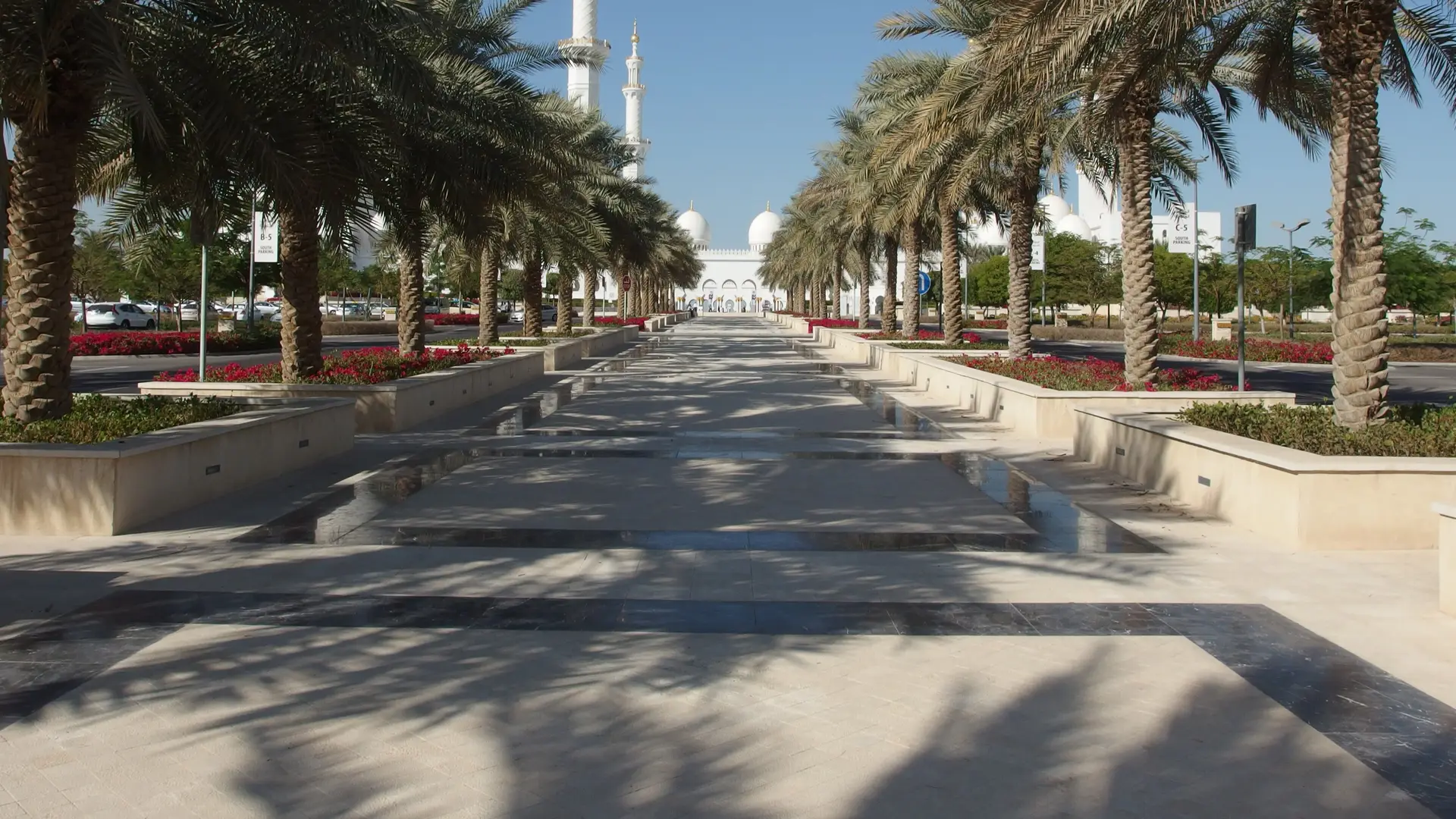
At about 5:30 in the evening, the white marble starts to change color.
All afternoon the Sheikh Zayed Grand Mosque has been almost too bright to look at, gleaming white under the desert sun. Now, as the sun sinks, it turns cream, then honey, then a soft rose-gold, reflected in long pools of still water. Then the sun is gone, and a new light comes on: a pale, cool blue that bathes the domes like moonlight.
It isn’t a coincidence. The mosque’s lighting system was designed to follow the phases of the moon, getting darker blue as the moon wanes and paler as it waxes.
A father’s dream
The mosque was the vision of Sheikh Zayed bin Sultan Al Nahyan, the founding president of the United Arab Emirates, who brought the seven emirates together in 1971. He wanted a mosque that would unite different Islamic architectural traditions, from Moorish to Mughal to Ottoman, and welcome people of all faiths.
Construction began in the late 1990s and the mosque opened in 2007, three years after his death. Sheikh Zayed is buried in a simple tomb beside the courtyard, where verses of the Quran are recited around the clock.
A mosque of records
- 82 domes, of white marble from Macedonia, and four minarets over 100 meters tall.
- A courtyard of around 17,000 square meters, inlaid with marble flowers in colored stone, one of the largest marble mosaics in the world.
- The main prayer hall holds one of the largest hand-knotted carpets in the world, more than 5,000 square meters, made by about 1,200 artisans in Iran and brought to Abu Dhabi in pieces.
- Seven huge chandeliers of gold-plated metal and Swarovski crystals, the largest weighing about 12 tonnes.
- More than 1,000 columns inlaid with semi-precious stones in flowing vines and flowers.
Altogether, the mosque and courtyard can hold over 40,000 worshippers.
Visiting
- Free entry, but you must register online in advance.
- Dress code: loose clothing covering arms and legs for everyone. Women must cover their hair. Clothing must not be tight or transparent. Arrive dressed correctly.
- Shoes off inside the prayer hall.
- Be respectful: speak quietly, no public displays of affection, and follow the photography guidelines.
- Friday mornings are for prayer, and tourists generally can’t visit then. Hours change during Ramadan.
- Free guided tours explain the architecture and Islamic traditions. They’re well worth joining.
The best time to visit is late afternoon, staying through sunset for the change from white to gold to blue. Walk around the reflecting pools as the lights come on.
Abu Dhabi beyond the mosque
- Louvre Abu Dhabi, on Saadiyat Island, a museum under a vast latticed dome by architect Jean Nouvel. Sunlight falls through it in a “rain of light” onto art from every civilization.
- Qasr Al Watan, the grand presidential palace, open to visitors.
- Mangrove kayaking at Jubail or the Eastern Mangroves, among herons and crabs.
- Abu Dhabi’s Corniche, a long seafront walk.
- Dubai is about 1.5 hours away, for the Burj Khalifa.
When to go
November to March is the best time, warm and sunny. Summer (June–September) is very hot, often above 40°C, with high humidity. Visit early or late in the day.
The honest bits
The mosque is a popular tourist sight, so the courtyard and main hall can get busy, especially at sunset. Rules on dress and behavior are strict, and staff will politely correct you. It’s a working place of worship, and some areas are reserved for prayer.
But stand under the arcade at dusk, as the white columns glow gold and the domes turn blue over the pools, with the call to prayer drifting across the courtyard. Sheikh Zayed wanted people of every background to feel welcome here. Most of them do.
Sheikh Zayed Grand Mosque: questions people ask
Is the Sheikh Zayed Grand Mosque free to visit?
Yes. Entry is free, but visitors must register online in advance and follow the dress code. Check the official website for current hours.
What is the dress code?
Loose, long clothing covering arms and legs for everyone. Women must also cover their hair. Clothing should not be tight or see-through.
When is the best time to visit?
Late afternoon, staying through sunset into the evening, when the white marble turns gold, then the lighting changes to blue and the reflecting pools glow.
When is the mosque closed to visitors?
Tourist visits are generally not possible on Friday mornings, during Friday prayers. Hours also change in Ramadan. Check before you go.