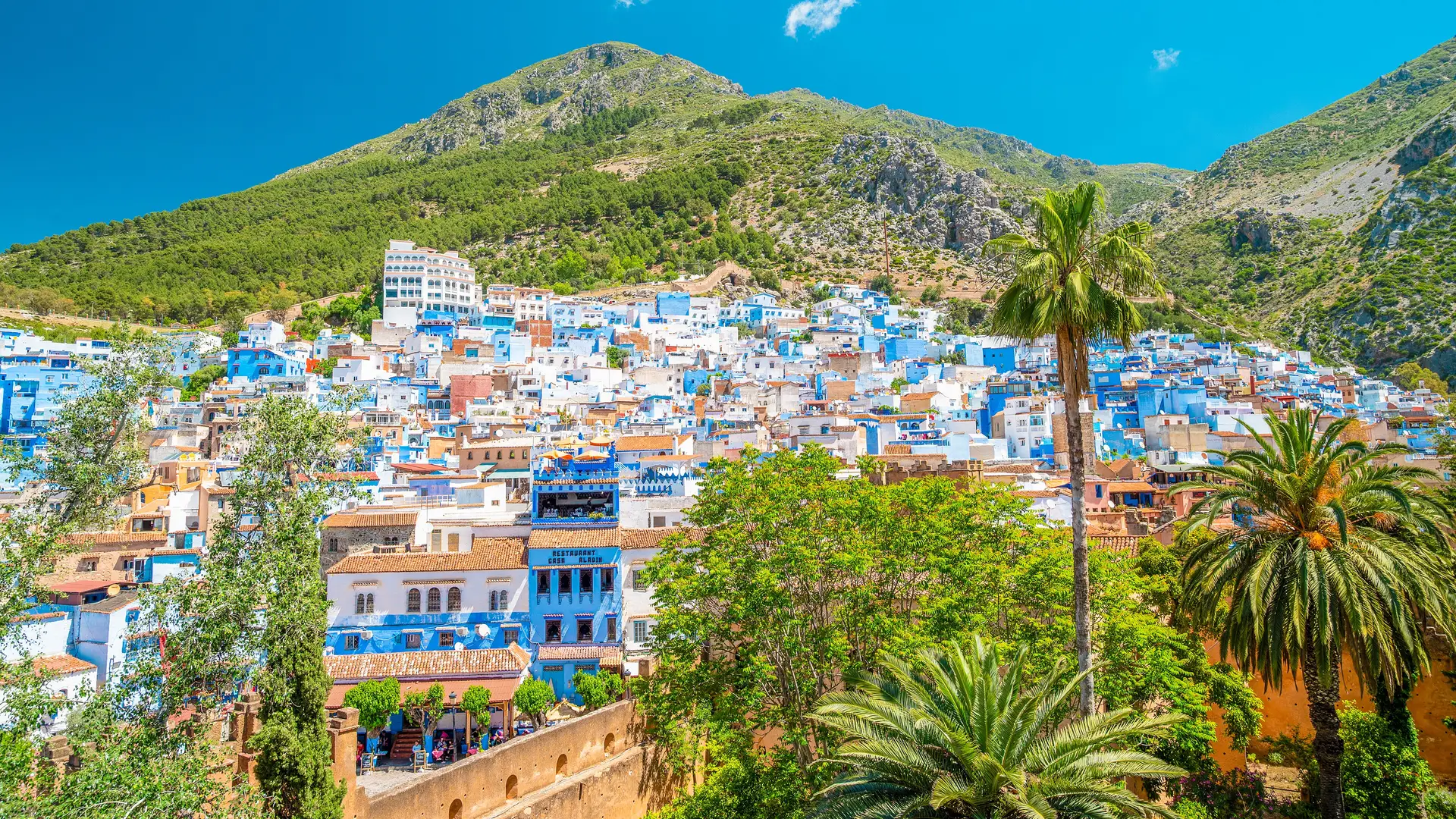
In the early morning, before the shops open, you can hear Chefchaouen being painted.
A man stands on a stool with a bucket and a brush on a long pole, slapping fresh blue onto the wall of his house. Further down the lane, a woman does the same around her doorway. Every spring, families repaint their homes, and the whole town glows in a hundred shades of blue: powder, indigo, turquoise, cobalt and something that’s almost lavender.
Walk up through the lanes as the sun rises and the blue changes with the light. It’s like walking through the sky.
The blue pearl
Chefchaouen (often just “Chaouen”) sits high in the Rif Mountains of northern Morocco, under two peaks that locals say look like goat horns. The name comes from the Berber for “look at the horns.” The town was founded in 1471 as a small fortress against Portuguese raids, and later became a refuge for Muslims and Jews expelled from Spain. For centuries it was so closed to outsiders that only a handful of Europeans managed to enter before the 20th century.
Why is it blue? Nobody knows for certain. One popular story credits the Jewish community, for whom blue represented the heavens. Others say it keeps mosquitoes away, or keeps houses cool. Whatever started it, the town kept it up, and now it’s the heart of its identity.
What to see
The medina. Simply wander. Steep stairways, archways, potted plants against blue walls, cats asleep in doorways, and small shops selling woven blankets, wool and leather. You’ll get a little lost, and that’s the point.
Plaza Uta el-Hammam. The main square, shaded by trees, with cafés facing the red-walled kasbah (fortress) and the octagonal minaret of the Grand Mosque. Climb the kasbah tower for views over the rooftops.
Ras el-Maa. At the edge of the medina, a spring tumbles down from the mountain, where locals have washed clothes in the stone basins for generations. It’s a lovely spot to sit and listen to the water.
The Spanish Mosque. A 20–30 minute walk up a hillside path leads to an abandoned mosque built during the Spanish colonial period. Come at sunset: the whole blue town glows below you as the call to prayer rises from the valley.
Into the mountains
The Rif is beautiful hiking country. A popular day trip is to Akchour, about an hour away, where trails lead up a river valley to waterfalls and pools, and to God’s Bridge, a natural rock arch over the gorge. Talassemtane National Park offers longer hikes through cedar and fir forest.
Food
Try goat cheese, a local specialty, fresh bread, tagines and the town’s own bissara (fava bean soup) on a cold morning, with endless mint tea in the square.
Visiting respectfully
- People live here. Chefchaouen’s lanes are residents’ homes, not a photo studio. Don’t sit on doorsteps or block narrow alleys for photos.
- Ask before photographing people, and accept a no gracefully.
- Dress modestly, especially away from the main square.
- In the Rif you may be offered hashish by touts. It’s illegal in Morocco. A polite “no, thank you” is enough.
Getting there and staying
Chefchaouen has no train station. Buses and private transfers run from Tangier (about 2–3 hours), Tetouan and Fes (about 3.5–4 hours). Stay in a riad or guesthouse in the medina, ideally one with a roof terrace for breakfast with mountain views. Staying overnight lets you enjoy the town in the quiet early morning and evening.
When to go
Spring (March–May) and autumn (September–November) are best. Summer is warm and busy with domestic tourists. Winter is cold and can be wet, with snow on the mountains.
The honest bits
Chefchaouen has become very popular on social media, and the most photogenic corners can feel crowded, with people queuing for pictures. Some streets are lined with souvenir stalls. But get up early, before the day-trippers arrive, wander the empty blue lanes as the light comes up, and you’ll have the town almost to yourself.
Chefchaouen: questions people ask
Why is Chefchaouen blue?
Nobody knows for certain. Popular explanations include Jewish tradition (blue as a symbol of the heavens), keeping mosquitoes away, keeping houses cool, and simply that it became the town's identity. Residents still repaint the walls regularly.
Can I take photos of people in Chefchaouen?
Always ask first, and accept a no. People live in these streets. Avoid standing on doorsteps or blocking narrow lanes for photos.
How do you get to Chefchaouen?
By bus or private transfer: about 2–3 hours from Tangier, 3.5–4 hours from Fes. There's no train station.