Sailors approaching Egypt in the third century BC faced a problem. The coast around the Nile delta is flat, low and featureless. Sandbanks, rocks and reefs lurk just under the water, and there’s nothing to steer by. Ships were wrecked all the time.
Then a tower rose on the little island of Pharos, just off the new city of Alexandria. By day its height and a giant statue on top could be seen from far out at sea. By night a great fire burned at its summit, and travelers said it could be seen from fifty kilometers away. For the first time, sailors coming home to Egypt had a light to aim for.
Built for a new city
Alexandria was founded by Alexander the Great in 331 BC. After his death it became the capital of the Greek dynasty that ruled Egypt, the Ptolemies, ending with Cleopatra. They made it the most brilliant city in the world. It had the famous Library, the Museum where scholars were paid to think, and a mixed population of Greeks, Egyptians and Jews.
The lighthouse, begun under Ptolemy I and completed under his son Ptolemy II around 280 BC, was its signature. It was designed by Sostratus of Cnidus. One story says he carved his own name into the stone and covered it with plaster praising the king, knowing the plaster would crumble in time and reveal his name instead.
The ancient skyscraper
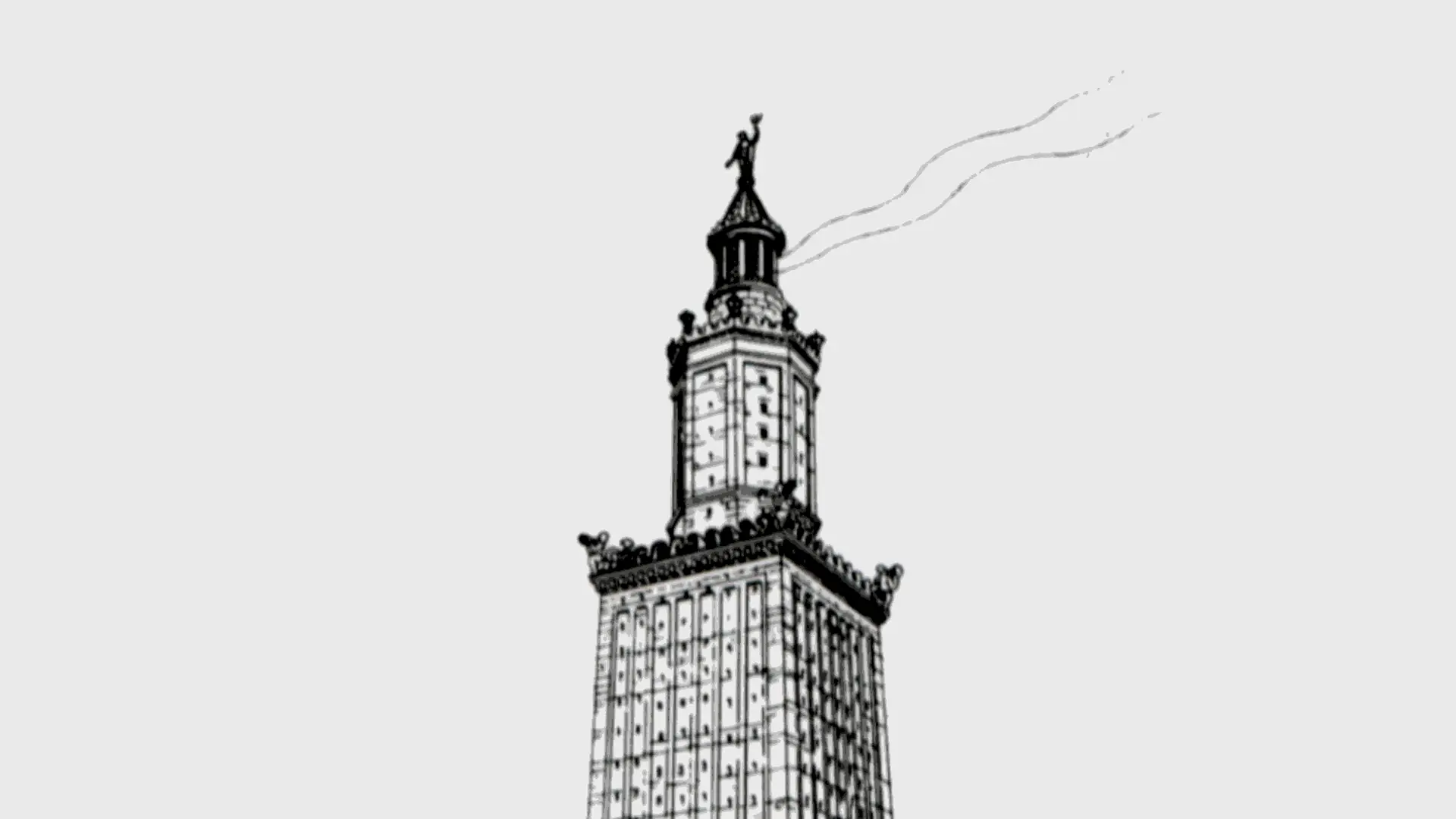
Ancient descriptions, and its image on Roman coins, suggest three stacked tiers:
- a huge square base, with rooms for workers and soldiers,
- an octagonal middle,
- and a round top where the fire burned, perhaps with a bronze mirror to throw the light out to sea.
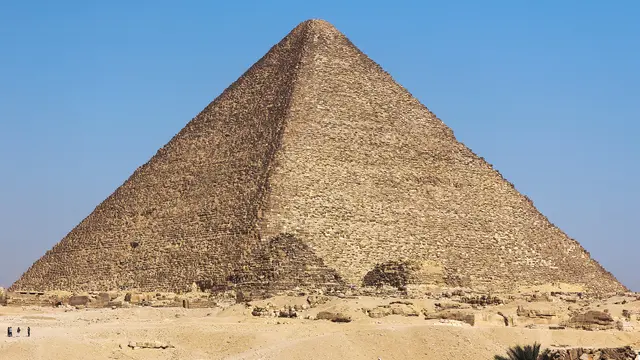
On the summit stood a statue, probably of Zeus or Poseidon. The total height was somewhere between 100 and 130 meters, which made it one of the tallest human-made structures in the world after the pyramids.
The lighthouse was so famous that it gave its name to lighthouses everywhere. The word for lighthouse is faro in Italian and Spanish, phare in French and farol in Portuguese. All of them come from Pharos.
A slow fall, and a rediscovery
It stood for well over a thousand years. Arab travelers in the Middle Ages still climbed it and wrote about its passages and rooms. But earthquakes cracked and damaged it again and again, and two in the 14th century finally brought it down.
In 1477, the Mamluk sultan Qaitbay built a fortress on the ruined base, reusing some of its stone. That fortress is still there.
Then, in 1994, a team of archaeologists led by Jean-Yves Empereur dived into the harbor next to the fort and found a jumble of enormous blocks, columns, sphinxes and colossal statues on the seabed. Some may have fallen from the lighthouse. Divers have been mapping them ever since, and a few pieces have been lifted and put on display.
Visiting Alexandria today
Alexandria isn’t a dusty ruin. It’s a lively, slightly faded Mediterranean city of nearly six million people, with a long sweeping seafront and great seafood.
The Citadel of Qaitbay. It sits right where the lighthouse stood, at the tip of the harbor. Walk the walls, look out to sea, and try to picture the tower rising here.
The Bibliotheca Alexandrina. A striking modern library opened in 2002 near the site of the ancient Library. It looks like a tilted sun disc with letters from the world’s alphabets carved into its granite walls. Inside are museums, manuscripts and one of the most beautiful reading rooms anywhere.
The Catacombs of Kom el Shoqafa. A strange, wonderful underground tomb complex where Egyptian gods wear Roman armor.
The Roman Amphitheatre at Kom el-Dikka, the only one in Egypt.
The Corniche. The seafront promenade, best at sunset with a grilled fish dinner and the sea crashing on the breakwater.
Diving the ruins. Local dive centers offer dives to the underwater lighthouse site. Visibility in the harbor is often poor, but swimming among sphinxes on the sea floor is an unforgettable thing.
The city of the Great Library
The lighthouse guided ships into the harbor. The Great Library guided the ancient world’s minds. They were two halves of one ambition: make Alexandria the center of everything.
The Ptolemies wanted a copy of every book ever written. Ships docking at Alexandria were reportedly searched for scrolls. The library kept the originals, made copies, and handed the copies back to the owners. These were known as the books “from the ships.”
Scholars working here did extraordinary things. Eratosthenes, the head librarian, worked out the circumference of the Earth by comparing the angle of the sun’s shadow at Alexandria and at Syene (Aswan) on the same day. He came remarkably close. Euclid wrote his geometry here. Centuries later, Hypatia, a philosopher and mathematician, taught in the city before she was murdered by a mob in AD 415.
How the library ended is still argued over. It wasn’t one great fire so much as a long decline across centuries. Its loss became a symbol of everything a civilization can forget.
Cleopatra’s city, under the waves
Alexandria was also Cleopatra’s city. She was the last of the Ptolemies, and the queen of Julius Caesar and Mark Antony. Her palaces stood on the eastern harbor, on a peninsula and a small island called Antirhodos.
Earthquakes and a slowly rising sea swallowed them. In the 1990s, the underwater archaeologist Franck Goddio and his team mapped the royal quarter on the seabed: paved floors, columns, a sphinx thought to bear the face of Cleopatra’s father, and the statue of a priest of Isis. Several pieces are now displayed in museums in Alexandria and have toured the world.
Eating in Alexandria
Come hungry. Alexandria is Egypt’s seafood capital. At the city’s fish restaurants you choose your catch from the ice, pay by weight, and decide how it’s cooked: grilled, fried, or baked in a clay pot with tomatoes and spices. Sides arrive unasked, with tahini, salads, pickles and bread. Afterwards, find one of the old Greek-era pastry shops and cafés along the seafront for coffee and something sweet, a reminder of the cosmopolitan city Alexandria was a century ago.
When to go and getting there
October to May is the most comfortable time. Winter is mild but can be stormy, with dramatic waves on the Corniche. Summer is humid and busy with Egyptian holidaymakers.
Alexandria is 2.5–3 hours from Cairo by train or road. Stay at least one night in a seafront hotel and walk the Corniche in the evening.
The honest bits
There’s no lighthouse to see, and the underwater ruins need a scuba certificate and some patience. Traffic is chaotic and the city’s grand old buildings are often crumbling. But that’s part of the romance. Stand on the walls of Qaitbay at dusk, as the fishing boats come home and the lights come on along the curve of the bay. A great fire once burned here to bring the sailors home, and the city is still lighting up the sea.
Lighthouse of Alexandria: questions people ask
What happened to the Lighthouse of Alexandria?
Earthquakes damaged it repeatedly from the 10th century onward, and two powerful quakes in the 14th century brought it down. In 1477 the Mamluk sultan Qaitbay built a fortress on the spot, partly using the lighthouse's stones.
How tall was the Lighthouse of Alexandria?
Estimates range from about 100 to 130 meters. That made it one of the tallest human-made structures in the world at the time, second only to the great pyramids.
Can you see the remains of the lighthouse?
Underwater, yes. Archaeologists have found huge blocks, statues and column fragments on the seabed near Qaitbay Citadel. Some have been raised and are on display in Alexandria, and divers can visit the site with local operators.
How do you get to Alexandria from Cairo?
About 2.5–3 hours by train or road. It works as a long day trip, but Alexandria rewards an overnight stay.