In the little chapel of St Michael, beside Hallstatt’s Catholic church, there’s a room full of skulls.
Hallstatt is squeezed between a mountain and a lake, so there was never room for a big graveyard. When the small churchyard filled up, the village dug up older bones after a decade or two to make space. The skulls were cleaned, bleached in the sun, and placed in the Beinhaus, the Bone House. Many were painted, decorated with wreaths of flowers, crosses and ivy, and inscribed with the name of the person and the date they died. Families could visit their ancestors.
There are hundreds of them, stacked on shelves, looking out at the visitors with flowers painted on their foreheads. It’s strange, moving and very beautiful.
A village built on salt
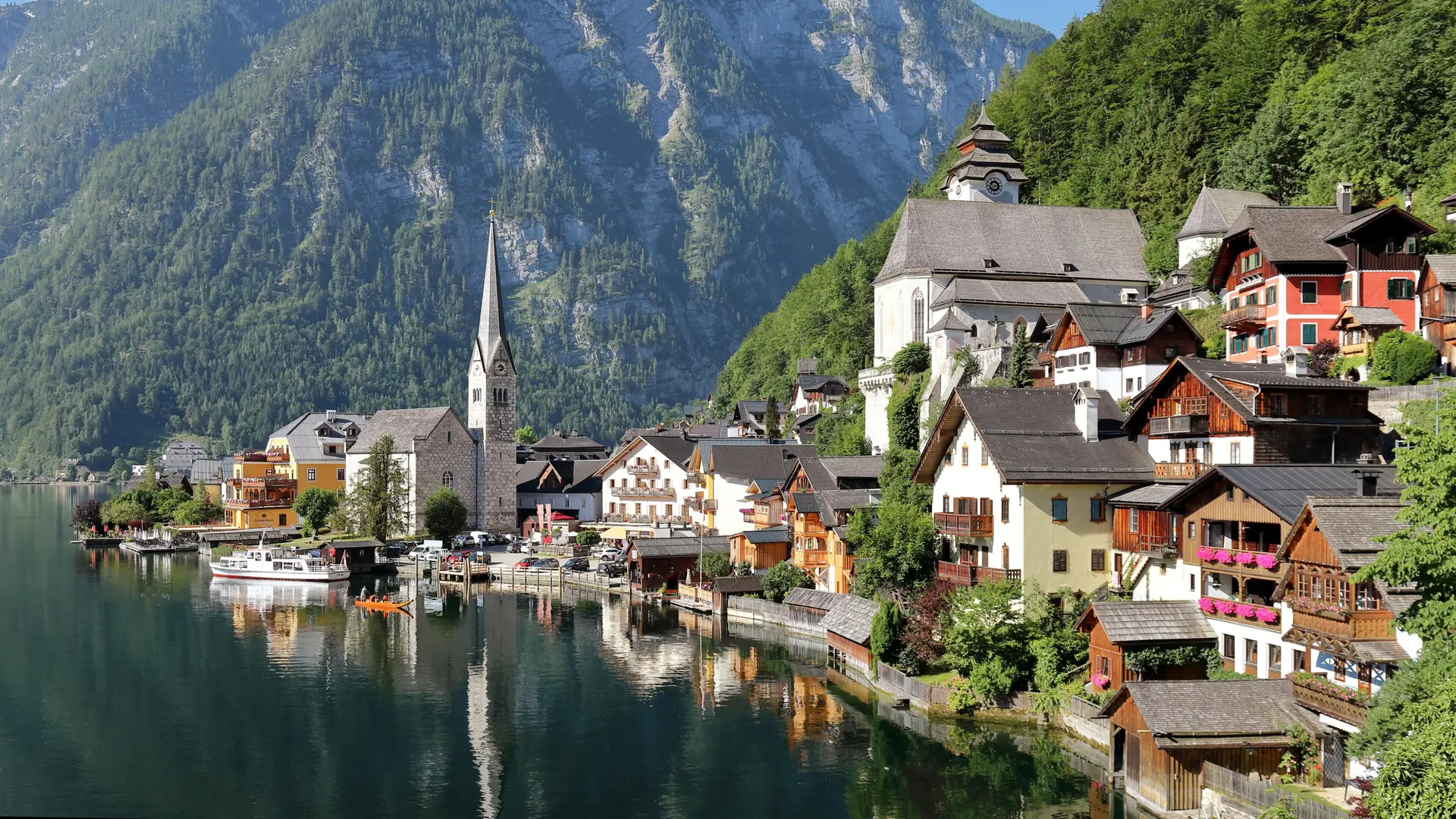
Hallstatt sits on the shore of the Hallstätter See, in Austria’s Salzkammergut lake district. Its pastel houses, church spires and wooden balconies rise in tiers between steep forested cliffs and the dark, still water. It looks almost too perfect to be real. In fact, a full-size copy of the village was built in China in 2012.
But Hallstatt’s wealth came from deep inside the mountain. People have been mining salt here for about 7,000 years, one of the longest-running salt mines in the world. In the 19th century, archaeologists discovered a huge prehistoric cemetery above the village, with graves full of bronze and iron objects. The finds were so important that an entire early European civilization, the Iron Age Hallstatt culture, is named after this tiny village. Together with the surrounding landscape, it’s a UNESCO World Heritage Site.
What to do
The Salt Mine (Salzwelten). Ride a funicular up the mountain, put on miners’ overalls, and go deep into the mountain. Slide down the miners’ wooden slides, see an underground lake, and learn about the “Man in Salt,” the body of a prehistoric miner found preserved in the salt in 1734.
The Skywalk. Near the top of the funicular, a viewing platform juts out over the cliff, high above the village and the lake.
The Bone House and the village’s two churches.
The lakeside. Walk the narrow streets, rent a rowing or electric boat on the lake, and look back at the village from the water.
Dachstein. Nearby, cable cars lead up the Dachstein massif to the Giant Ice Cave, the Mammoth Cave, and the 5 Fingers viewing platform, five steel fingers stretching out over a 400-meter drop.
Overtourism, and how to visit kindly
Hallstatt has fewer than 1,000 residents and, on busy days, far more visitors. In recent years, the village has struggled with crowds and tour buses, and it has introduced measures to manage them. A wooden fence once briefly blocked a famous photo spot.
To visit kindly:
- Stay overnight. Day-trippers leave by evening, and the village becomes peaceful.
- Arrive by train and ferry rather than by car or bus.
- Respect private property. Many of those picturesque houses are homes.
Getting there
Take the train to Hallstatt station, across the lake, and the small ferry across to the village. It’s a lovely way to arrive. By road, Hallstatt is about 1.5 hours from Salzburg. Combine it with other lakes in the Salzkammergut, such as Wolfgangsee and Traunsee.
When to go
May–June and September–October are best. Summer is busy. In winter, under snow, with the Christmas market and steam rising from the lake, it’s like a postcard. Some attractions close seasonally.
The honest bits
Hallstatt is tiny, and in the middle of the day it can feel crowded and touristy. Accommodation is limited and books up early. But stand on the lakeshore at dawn, with the mist lifting off the water, the church spire reflected perfectly and only the sound of a swan gliding past.
Hallstatt: questions people ask
How old is the Hallstatt salt mine?
Salt has been mined here for around 7,000 years, making it one of the oldest salt mines in the world. An entire early European culture, the Hallstatt culture, is named after finds made here.
Is Hallstatt too crowded?
It can be very busy in the middle of the day, especially in summer. The village has introduced measures to manage tour buses. Stay overnight to enjoy it in the early morning and evening, when it's peaceful.
How do you get to Hallstatt?
By train to Hallstatt station on the opposite shore, then a short ferry across the lake, or by road from Salzburg (about 1.5 hours).