In the 1520s, a Portuguese horse trader named Domingo Paes arrived at the capital of a great Hindu empire in southern India. He was stunned.
The city, he wrote, was as large as Rome, and “the best provided city in the world.” He described markets heaped with rubies, diamonds and pearls, streets crowded with people, palaces with walls of gold, and festivals where hundreds of dancing women and thousands of soldiers paraded before the king.
Forty years later, it was gone. After a defeat in battle in 1565, the city was sacked and burned for months. Its people fled, and the jungle and the boulders took it back.
Today we call it Hampi.
The city of victory
Vijayanagara, “the City of Victory,” was the capital of the Vijayanagara Empire, which ruled much of southern India from the 14th to the 16th century. At its height, it may have been one of the largest cities in the world, with a population that perhaps rivaled Beijing’s. It grew rich on trade in spices, cotton, gems and horses, and its kings filled it with temples, palaces, markets and huge water systems.
In 1565, a coalition of neighboring sultanates defeated the Vijayanagara army at the Battle of Talikota. The capital was abandoned and plundered.
Hampi is now a UNESCO World Heritage Site, with more than 1,600 surviving monuments scattered across a strange, beautiful landscape.
The boulders
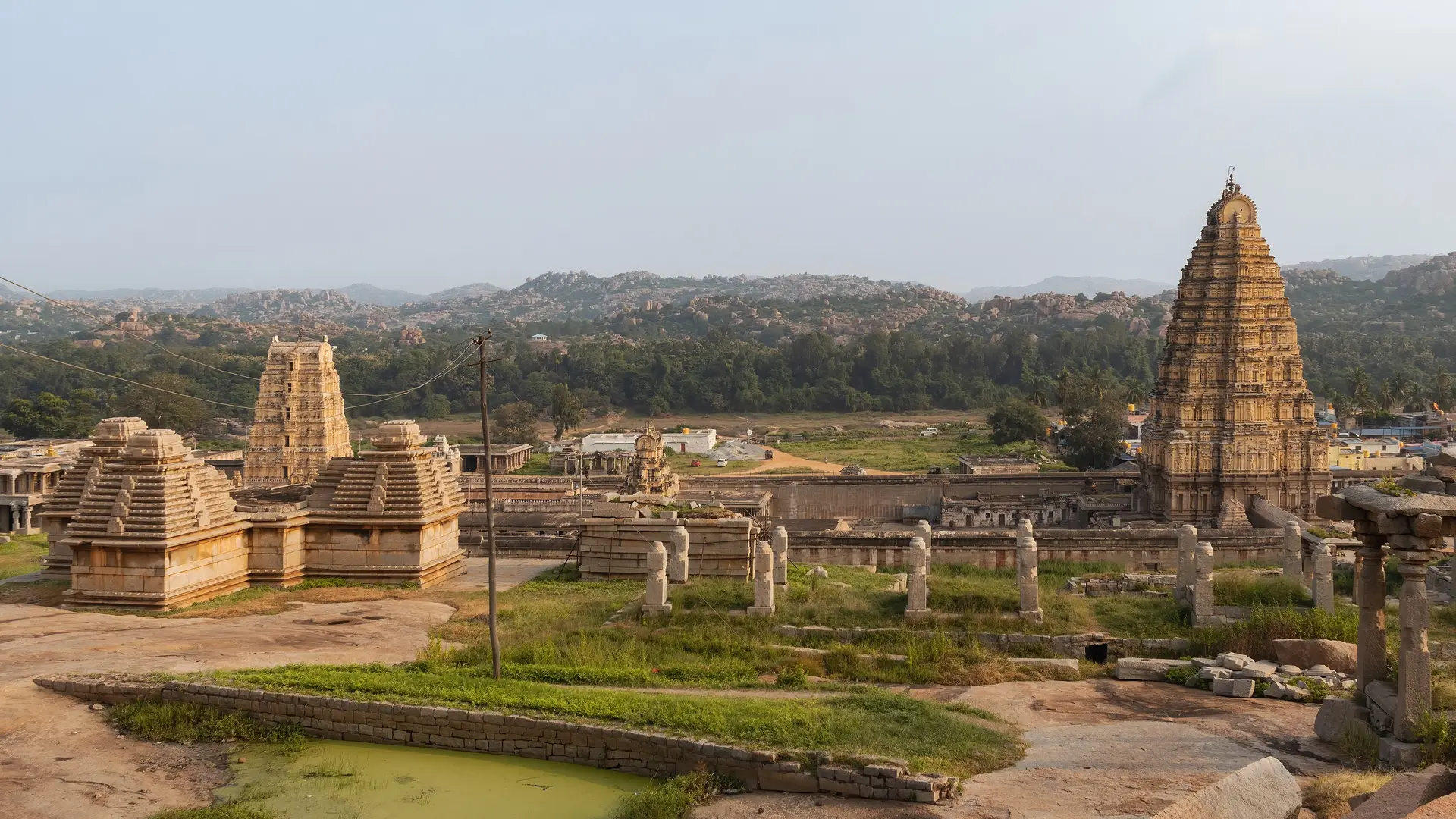
Hampi’s setting is extraordinary. The ruins sit among hills made of enormous granite boulders, some as big as houses, piled on top of each other and balanced in impossible-looking positions, as if a giant had been playing with marbles. The rock is billions of years old.
Between the boulders lie green banana plantations, sugarcane fields, coconut palms and the wide Tungabhadra River. In the early morning and late afternoon, the rocks glow orange and pink.
What to see
The Vittala Temple. The finest temple in Hampi, famous for its carved stone chariot, a small shrine shaped like a temple car with stone wheels. It’s one of the symbols of India, featured on the country’s 50-rupee note. The temple’s halls have musical pillars, slender columns that ring with different notes when tapped, though tapping them is no longer allowed, to protect them.
Virupaksha Temple. In the village of Hampi Bazaar, an active temple to Shiva that has been in continuous use since before the empire. Its huge tower dominates the village. Inside, a small hole in a wall projects an upside-down image of the tower, like a natural pinhole camera.
The Royal Enclosure: the Lotus Mahal, an elegant palace pavilion mixing Hindu and Islamic styles; the Elephant Stables, with eleven domed chambers for the royal elephants; the Queen’s Bath; and the Mahanavami Dibba, a great stone platform carved with scenes of festivals and hunts, from which the kings watched celebrations.
Hemakuta Hill: a hill of small, early temples, perfect for sunset.
Matanga Hill: the highest point, a short, steep climb to a viewpoint for sunrise over the ruins and boulders.
Anjanadri Hill, across the river, believed by many to be the birthplace of the monkey god Hanuman. Climb about 575 steps to the temple at the top for sunset.
On the river
Take a ride in a coracle, a round, basket-like boat that spins gently as it’s paddled across the river, past boulders and riverbank shrines. Across the Tungabhadra, the relaxed area around Virupapur Gaddi has guesthouses and cafés among the rice fields.
Getting there and around
The nearest station is Hosapete (Hospet), about 13 kilometers away, with overnight trains from Bengaluru and connections from Goa. From there, take an auto-rickshaw or taxi.
The site is large. Rent a bicycle or scooter, or hire an auto-rickshaw driver for the day. Start early to avoid the heat.
When to go
October to February is best: warm days and cooler mornings. March to May is extremely hot. The monsoon (June–September) brings rain, green fields and fewer visitors. The Hampi Utsav festival, usually in winter, brings music and dance to the ruins.
The honest bits
Hampi’s sites are spread out, and the heat can be draining. Facilities are basic, and some temples are crowded on weekends with domestic tourists. Monkeys are bold, so keep food hidden.
But climb Matanga Hill in the dark, and watch the sun come up over the ruins of a city once as large as Rome, the temple towers and boulders slowly glowing orange in every direction. Paes thought it was the best city in the world.
Hampi: questions people ask
How many days do you need in Hampi?
Two to three days lets you see the main temples and royal center, catch sunrise and sunset from the hills, and take a coracle ride, without rushing in the heat.
How do you get to Hampi?
The nearest railway station is Hosapete (Hospet), about 13 km away, with overnight trains from Bengaluru and connections from Goa. From there, take a taxi or auto-rickshaw.
What's the best way to get around Hampi?
By bicycle, scooter or auto-rickshaw. The site covers a large area. Starting early in the morning avoids the strongest heat.