In the year 477, a prince named Kashyapa seized the throne of Sri Lanka in the bloodiest way possible. He overthrew his father, King Dhatusena, and, according to the old chronicles, had him walled up alive.
But Kashyapa’s half-brother, Moggallana, the rightful heir, escaped to India and swore to come back with an army. So Kashyapa did what a frightened, guilty king might do: he moved his capital to the top of a 200-meter rock in the middle of the jungle, where no one could reach him.
He built a palace on the summit, gardens and pools at its feet, and an entrance through the mouth of a giant stone lion. For eighteen years he ruled from the sky. Then Moggallana came back.
The Lion Rock
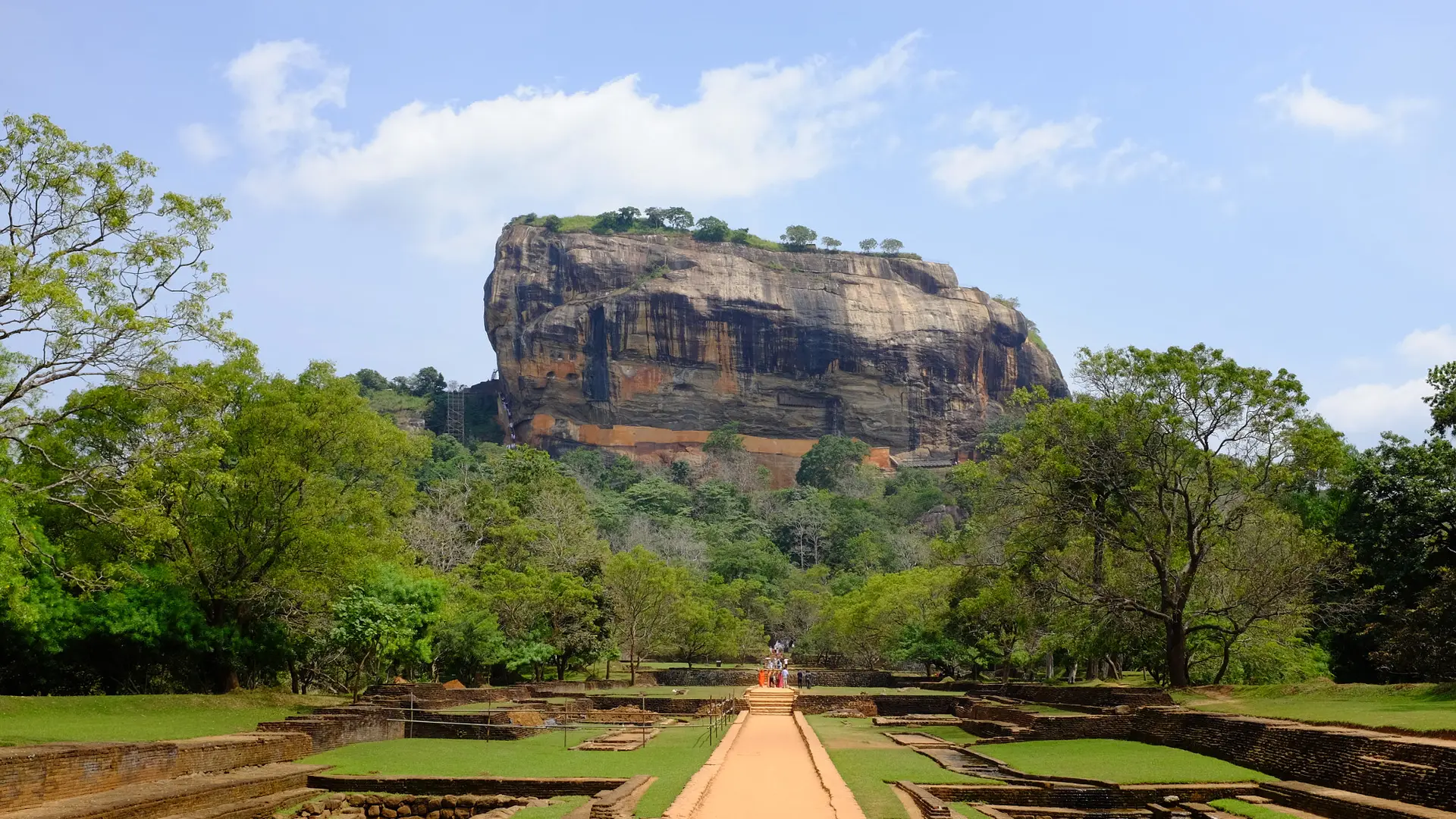
Sigiriya rises sheer out of the flat forest of central Sri Lanka, a great block of rock left behind by an ancient volcano. On top are the foundations of Kashyapa’s palace: terraces, cisterns, a throne and a huge rock-cut pool, with views over the jungle in every direction.
Halfway up, he built a gateway in the shape of an enormous crouching lion. You walked between its paws and up through its throat to reach the summit. That’s where the name comes from: Sinha-giri, Lion Rock. The head has long since crumbled, but the two massive paws are still there, with claws carved in stone, flanking the staircase.
After Kashyapa’s death, the rock became a Buddhist monastery for centuries. It’s now a UNESCO World Heritage Site and one of the great sights of Asia.
The climb
It’s about 1,200 steps to the top: stone stairways, ancient paths and, near the summit, narrow metal staircases bolted to the rock face. It’s steep, but not technical. Go slowly, carry water, and stop to look back.
On the way, you’ll pass:
- The water gardens: symmetrical pools, channels and fountains at the base, some of the oldest landscaped gardens in the world. After heavy rain, some of the ancient fountains still work.
- The frescoes: in a sheltered pocket of the cliff, reached by a spiral staircase, are paintings of graceful women, the Sigiriya maidens, scattering flowers. Once there may have been hundreds. About twenty survive, still vivid after 1,500 years. Photography isn’t allowed.
- The Mirror Wall: a wall once polished so smooth the king could see his reflection. For centuries, visitors scratched poems onto it, many about the painted maidens. It’s some of the oldest graffiti in the world.
- The Lion’s Paws, and the final climb to the summit.
Tip: there are sometimes wasp and hornet warnings on the rock. Stay calm, keep quiet, and follow staff instructions.
Pidurangala: the view of the rock
Right next door, Pidurangala Rock is a smaller climb, about 30–45 minutes, past a temple and a reclining Buddha, with a short scramble over boulders at the end. From the top, you get the classic view of Sigiriya itself rising out of the mist. Do it at sunrise, and climb Sigiriya later the same day.
The Cultural Triangle
Sigiriya sits in the middle of Sri Lanka’s Cultural Triangle:
- Dambulla Cave Temple: a series of caves filled with Buddha statues and painted ceilings.
- Polonnaruwa: a medieval royal capital with great carved Buddhas at Gal Vihara.
- Anuradhapura: the ancient capital, with huge stupas and a sacred bodhi tree said to grow from a cutting of the tree under which the Buddha was enlightened.
- Minneriya National Park: in the dry season, hundreds of wild elephants gather around the reservoir in “The Gathering.”
Tickets and timing
Foreign visitors pay about $35 for Sigiriya. Pidurangala is much cheaper. Arrive at opening, around 7 a.m., or come in the late afternoon, to avoid the heat and the tour groups. Wear proper shoes and bring water.
When to go
Sigiriya is in Sri Lanka’s dry zone. January to April is usually driest and best. May to September can be good too, while the north-east monsoon brings rain from about October to December.
The honest bits
The climb is hot and crowded in the middle of the day, especially on the metal stairs, and foreign ticket prices are high. Some find the summit ruins less dramatic than the climb.
But stand on the summit at 7:30 in the morning, where a paranoid king once looked out for his brother’s army, with the jungle stretching green to the horizon and the mist still in the valleys. You’ll understand why he thought he’d be safe up here.
Sigiriya: questions people ask
How long does it take to climb Sigiriya?
About 1–1.5 hours up and down, with roughly 1,200 steps, including metal staircases near the top. Allow 2–3 hours in total with the gardens and museum.
Is Pidurangala better than Sigiriya?
They're best together. Pidurangala, the rock next door, is cheaper and less crowded, and gives the classic view of Sigiriya at sunrise. Sigiriya itself has the frescoes, the Lion's Paws and the palace ruins.
When is the best time to climb Sigiriya?
At opening (around 7 a.m.) or late afternoon, to avoid the heat and crowds. January to April is usually driest in this part of the island.