In the early hours of 2 July 1950, a young Buddhist monk named Hayashi Yoken set fire to the temple where he lived and trained.
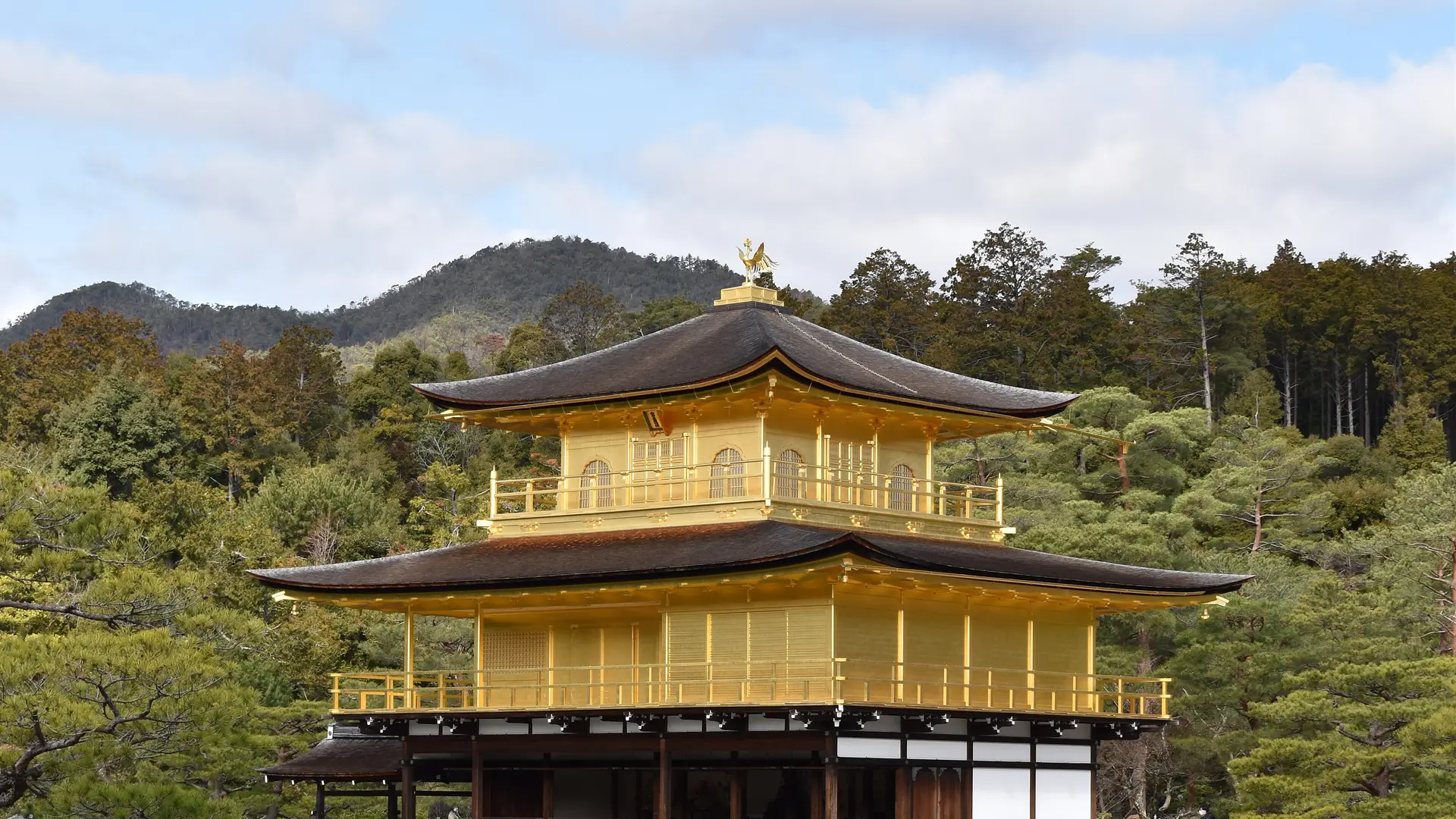
The temple was Kinkaku-ji, the Golden Pavilion, a three-story building covered in gold leaf, standing on the edge of a still pond in northern Kyoto. It had survived wars and earthquakes for more than five hundred years. In one night it burned to the ground. The monk was found on a hillside nearby. He reportedly said he had been obsessed with the pavilion’s beauty and could not bear it.
The novelist Yukio Mishima turned the story into one of Japan’s most famous books, The Temple of the Golden Pavilion. The temple was rebuilt in 1955, faithfully and more brilliantly gilded than before.
On a clear morning, the reflection in the pond is so perfect, you’ll understand how beauty can be almost unbearable.
A thousand years as capital
Kyoto was Japan’s imperial capital for over a thousand years, from 794 to 1868. In that time, emperors, shoguns and monks built more than 1,600 temples and hundreds of shrines, gardens and palaces. Seventeen of them are now listed together as a UNESCO World Heritage Site.
Kyoto was also, famously, spared by the US from bombing in the Second World War, partly because of its cultural importance. Walk its back streets of wooden townhouses, called machiya, and you can still feel the old city around you.
The essential temples and shrines
Fushimi Inari Taisha. The shrine of a thousand gates, actually about ten thousand: bright vermilion torii gates in tunnels winding up the wooded slopes of Mount Inari. Each gate is donated by a business or individual, with their name painted on the back. Inari is the god of rice and prosperity, and stone foxes, his messengers, guard the paths. The full walk to the top takes 2–3 hours. Go at dawn or after dark. It’s open 24 hours, and the upper paths at night are hauntingly quiet.
Kinkaku-ji, the Golden Pavilion. Beautiful, and busy. Come at opening time. The path takes you around the pond and up through the gardens.
Kiyomizu-dera. A great wooden temple on the hillside of eastern Kyoto, with a huge veranda built on a scaffold of wooden pillars, without a single nail, jutting out over the treetops. There’s a Japanese saying: “to jump off the stage of Kiyomizu” means to take a big leap of faith. Below, drink from the Otowa waterfall, whose three streams are said to bring long life, success in study or luck in love. Choose just one.
Ryoan-ji. The most famous Zen rock garden in Japan: fifteen stones placed on raked white gravel. From wherever you sit on the veranda, at least one stone is always hidden. Sit, look and don’t try too hard to understand it.
Ginkaku-ji, the Silver Pavilion. Never covered in silver, despite the name, but serene, with a sculpted sand garden and moss. From here, walk the Philosopher’s Path, a canal-side path lined with cherry trees, south toward Nanzen-ji.
Arashiyama. In the west of the city: the famous bamboo grove (go very early, as it’s swamped by mid-morning), Tenryu-ji’s beautiful garden, and the riverside Togetsukyo Bridge.
Saihō-ji (Koke-dera, the Moss Temple). A garden of more than a hundred kinds of moss, with visits by advance reservation only. You’ll copy a sutra before you’re allowed into the garden. It’s magical.
Gion and the geiko
The old entertainment district of Gion is a world of wooden teahouses, red lanterns and stone-paved lanes like Hanamikoji and Shirakawa. At dusk you may glimpse a geiko (Kyoto’s word for geisha) or a maiko (an apprentice) hurrying to an appointment.
Please be respectful. Some tourists have harassed them for photos, and parts of Gion’s private lanes have now been closed to visitors. Don’t follow, block or photograph them without permission.
When to go
- Cherry blossom season, usually late March to early April, stops people in the street, and is extremely busy.
- Autumn leaves, usually mid-November to early December, are just as beautiful, and just as busy.
- May and October are lovely and calmer. Summer is hot and humid but full of festivals, including the huge Gion Matsuri in July. Winter is cold, quiet and occasionally snowy, and a dusting of snow on the Golden Pavilion is a sight locals rush to photograph.
How to beat the crowds
- Go early. Be at the big sights as they open.
- Walk and take trains. City buses get packed.
- Visit smaller temples. For every famous temple there’s a quiet one nearby with a garden to yourself.
- Stay in a ryokan or a machiya. Sleeping in a traditional inn with tatami floors, futons, a hot bath and a seasonal kaiseki dinner is part of the Kyoto experience.
The honest bits
Kyoto has struggled with overtourism, especially in peak seasons, and the famous spots can be overwhelming in the middle of the day. Temple fees add up, and you’ll take your shoes off a hundred times.
But wake at dawn, walk up through the empty torii gates of Fushimi Inari as the light turns them to flame, and hear nothing but birdsong and your own footsteps. The old capital is still there, waiting for the people who come early.
Kyoto's Temples: questions people ask
How many days do you need in Kyoto?
Three to four days lets you see the main temples and shrines, Arashiyama, Gion and a couple of quieter places, without rushing. Kyoto rewards slow travel.
When is the best time to visit Fushimi Inari?
At dawn or after dark. The shrine is open 24 hours, and the gates are nearly empty early in the morning and at night. Climb past the first crowded section toward the summit and the crowds thin out fast.
When is cherry blossom season in Kyoto?
Usually late March to early April, though it varies year to year. Autumn leaves peak from mid-November to early December. Both are beautiful and very busy, so book hotels early.
Can I photograph geisha in Gion?
Please don't chase or photograph geiko and maiko without permission. Parts of Gion's private lanes have been closed to tourists after problems with harassment. Stick to public streets and be respectful.