On 24 October 1901, her 63rd birthday, a widowed schoolteacher named Annie Edson Taylor climbed into a wooden pickle barrel padded with a mattress, had it sealed, and was pushed out into the upper Niagara River.
She was broke and hoped to become rich and famous. A few days earlier, she’d tested the barrel by sending her cat over the falls in it. The cat survived.
The barrel bobbed down the rapids, picked up speed, and went over Horseshoe Falls. Nineteen minutes later, it was pulled out of the river below. Taylor climbed out, bleeding from a cut on her head but otherwise unharmed: the first person to go over Niagara Falls in a barrel and live. Her first words, reportedly: “Nobody ought ever to do that again.”
She never did get rich. But people never stopped coming to see the water she rode.
Three falls, two countries
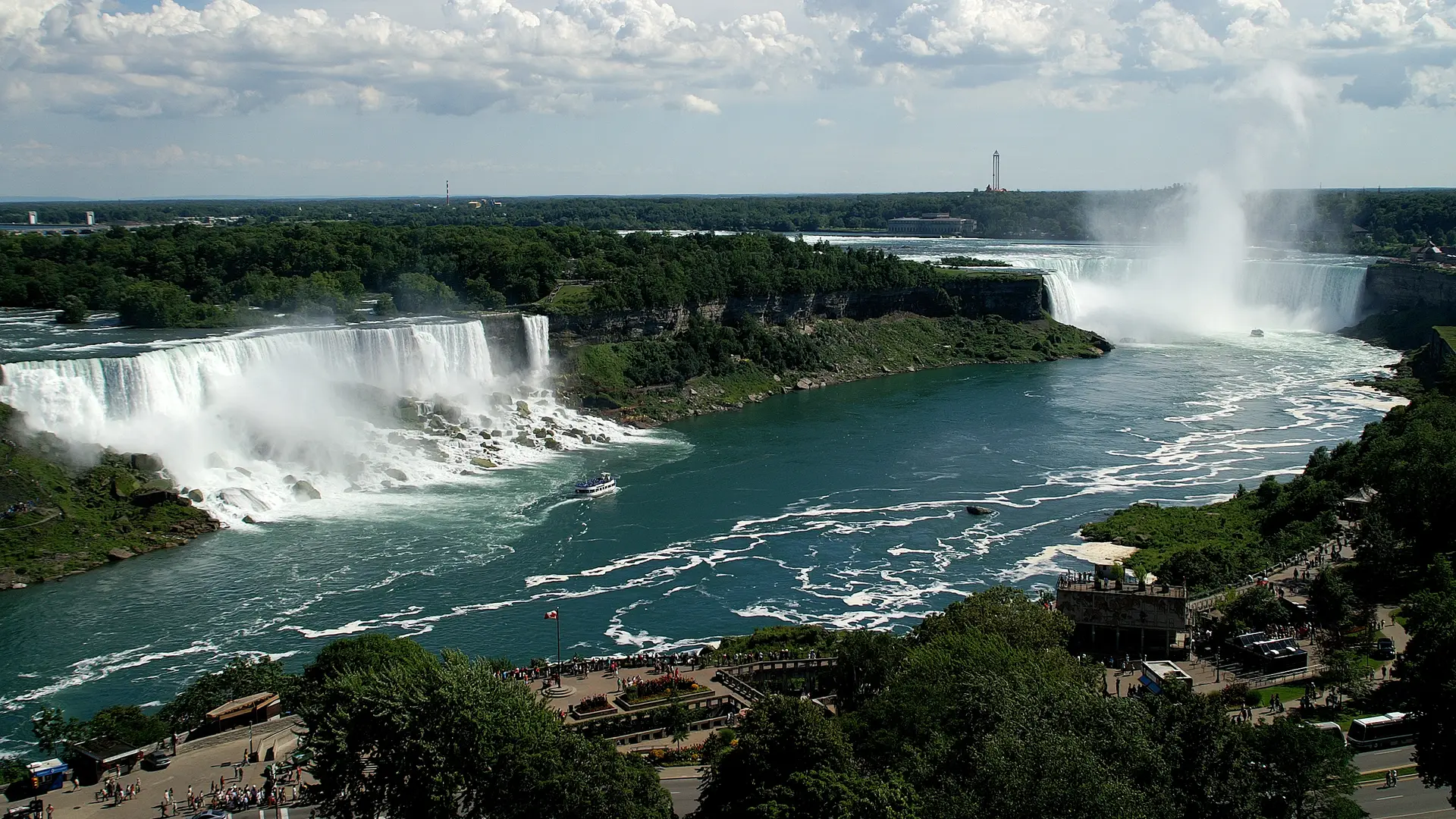
The Niagara River drains four of the Great Lakes into Lake Ontario, and on the way it drops off a cliff, right on the border between Canada and the United States.
There are three falls:
- Horseshoe Falls, the biggest, a huge curving wall of water about 50 meters high, mostly on the Canadian side.
- American Falls, straighter, with a tumble of fallen rocks at its foot.
- Bridal Veil Falls, small and delicate, next to it.
At peak, a vast amount of water goes over: more than 2,800 cubic meters every second at full flow. A lot of the river is diverted through tunnels to hydroelectric plants, especially at night, so the falls you see are actually turned down a bit. They used to be even bigger.
The honeymoon capital
In the 1800s, Niagara became America’s honeymoon destination. Legend has it that Jérôme Bonaparte, Napoleon’s brother, brought his bride here in 1804. By the mid-20th century, after the 1953 film Niagara with Marilyn Monroe, the town was full of heart-shaped bathtubs and newlywed specials. It’s still a classic for couples.
Getting close to the water
The boat ride. The most famous experience at Niagara. Boats, the Maid of the Mist from the US side and Niagara City Cruises from the Canadian side, sail right into the spray at the foot of Horseshoe Falls. It’s deafening and thrilling. You’ll get a poncho, and you’ll still get soaked.
Cave of the Winds (US side). Walk wooden decks right up beside Bridal Veil Falls to the “Hurricane Deck,” where the water pounds down around you.
Journey Behind the Falls (Canadian side). Tunnels through the rock take you behind Horseshoe Falls, to portals where you see the water thundering past from behind.
The Niagara Parks Power Station (Canadian side). A grand old hydroelectric station turned museum, with a tunnel that leads to a platform at the edge of the river below the falls.
The Whirlpool Aero Car, a cable car crossing a giant whirlpool in the gorge downstream.
At night
The falls are illuminated every night of the year in changing colors. In summer and on holidays, fireworks burst over them. Watch from Queen Victoria Park on the Canadian side, or from a hotel room facing the falls.
Winter
Niagara in winter is a different world. In deep cold, the spray freezes on every tree, railing and lamppost, and ice builds up in great mounds around the falls. The crowds disappear and hotels are cheaper. Some attractions close, but the views are magical.
Beyond the falls
- Niagara-on-the-Lake, a charming 19th-century town about 20 minutes away, surrounded by wineries famous for ice wine, made from grapes frozen on the vine.
- The Niagara Parkway, a scenic road along the river, perfect for cycling.
- Clifton Hill, the Canadian side’s neon strip of wax museums, haunted houses and arcades. Love it or avoid it.
Practical tips
- Bring your passport to walk or drive across the Rainbow Bridge between the two countries.
- Stay on the Canadian side for falls-view hotel rooms.
- Summer (June–September) is best for boat tours and warm weather, and busiest. Spring and autumn are calmer.
The honest bits
Niagara’s towns are touristy, with casinos, neon and tacky shops, and summer crowds are heavy. Prices for attractions add up quickly.
But stand at the brink of Horseshoe Falls in the early morning, with the green water curving over the edge just a few meters away and the mist rising so high it blocks out the sky. You’ll understand why Annie Taylor wanted to ride it, and why she told everyone not to.
Niagara Falls: questions people ask
Is the Canadian or American side of Niagara better?
The Canadian side has the best panoramic views of all three falls, especially Horseshoe Falls. The American side gets you closer to the water, with Cave of the Winds and Goat Island. Do both if you can; bring your passport for the Rainbow Bridge.
When are the falls illuminated?
Every night, all year round, the falls are lit with colored lights. In summer and on some holidays there are fireworks over the falls too.
Do the falls freeze in winter?
Not completely. But in very cold winters, huge ice formations build up around the falls and the gorge, and the spray freezes on every tree, which is beautiful.