There’s no engine. No sound at all, except the soft swish of the pole being pushed into the sandy bottom, and the trickle of water past the hull.
You’re lying low in a mokoro, a dugout canoe, barely above the waterline, gliding down a channel no wider than a footpath through tall papyrus and reeds. Water lilies float past at eye level, white and purple. A tiny reed frog clings to a stem. Your poler, standing tall at the back, stops and points with his chin. Thirty meters ahead, a group of elephants is wading across the channel, trunks raised, water up to their bellies.
He waits. You hold your breath. They cross. You glide on.
A river that drowns in the desert
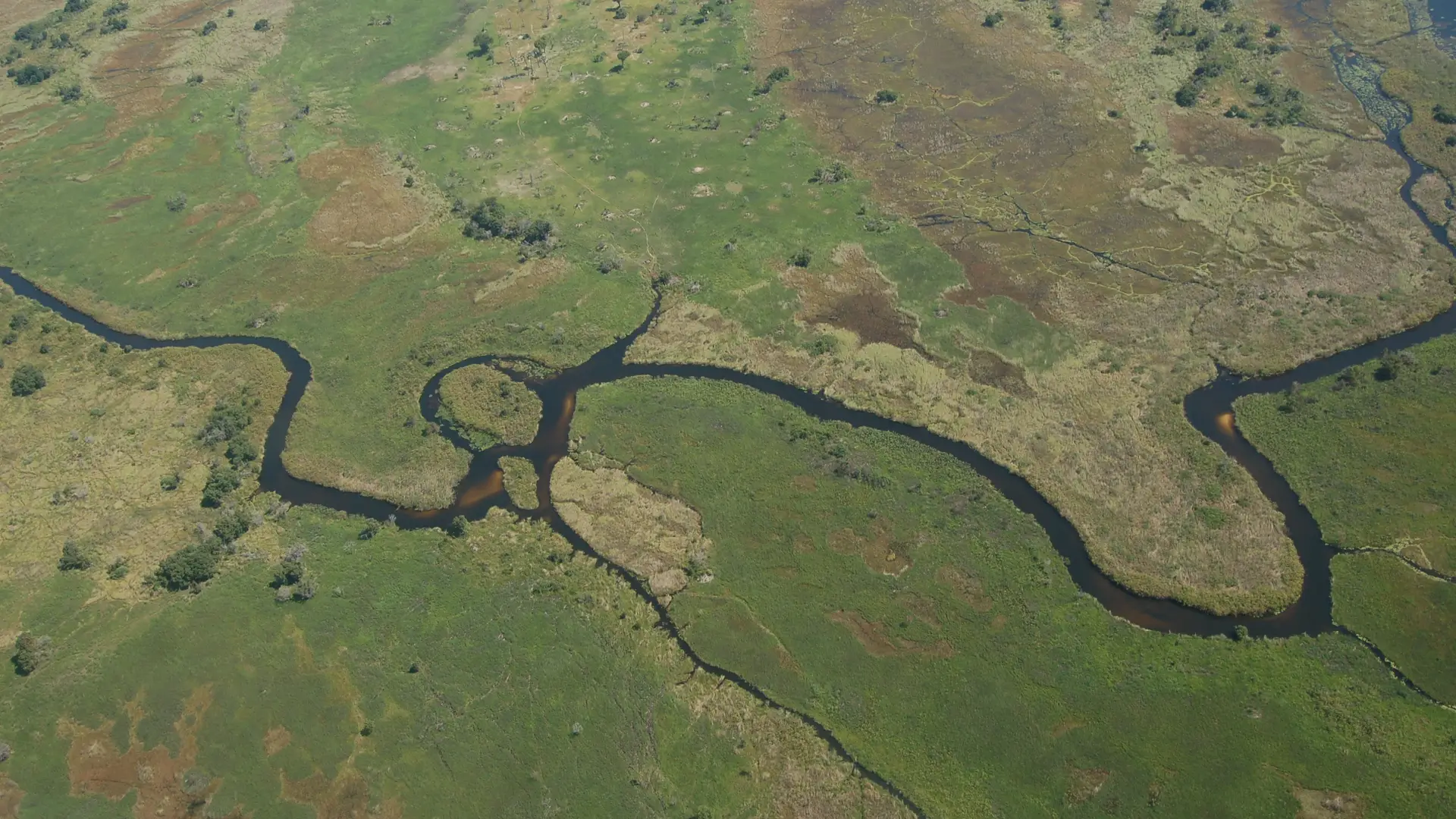
The Okavango River rises in the highlands of Angola and flows south-east for more than a thousand kilometers. But it never reaches the sea. Instead, it pours into the sands of the Kalahari Desert in Botswana and spreads out into a vast fan of channels, lagoons, islands and floodplains, before evaporating or soaking into the ground.
The result is the Okavango Delta: around 15,000 square kilometers of water and wilderness in the middle of a desert, one of the richest wildlife areas in Africa. In 2014 it became the 1,000th site on UNESCO’s World Heritage list.
The flood that arrives in the dry season
Here’s the magic trick: the Okavango floods in the dry season.
The rains fall in Angola in the southern summer, but the water takes months to travel down the river and spread slowly through the delta. It arrives from about May, and peaks around June to August, just when the surrounding land is at its driest. Animals from hundreds of kilometers around come to the water. It’s the best time for wildlife.
What you’ll see
- Elephants: Botswana has one of the largest elephant populations in the world.
- Lions, leopards and cheetahs.
- African wild dogs, one of Africa’s most endangered predators. The delta is one of their strongholds.
- Hippos and crocodiles in the channels.
- Red lechwe, an antelope that bounds through shallow water, and the rare sitatunga, which lives in the papyrus swamps.
- Hundreds of bird species, including African fish eagles, whose call is the sound of the delta.
How to experience it
Mokoro trips. The essential delta experience: silent, slow and intimate. Polers are often from local communities who have used these channels for generations.
Game drives on the larger islands and in Moremi Game Reserve, in the east of the delta, which has superb wildlife.
Walking safaris: on foot with an armed guide, learning to read tracks and droppings. Your senses go into overdrive.
Scenic flights in small planes or helicopters, to see the patterns of channels and islands, and herds of elephants splashing across the floodplains.
Fly-in camps
Most of the delta can only be reached by light aircraft. You’ll fly from Maun, the gateway town, to dirt airstrips in remote camps, often hopping between two or three camps in different areas.
- Botswana follows a “high value, low volume” approach to tourism: few, small, luxurious camps with limited guests, which keeps the delta wild but makes it expensive.
- Luggage is usually limited to about 20 kg, in soft bags with no wheels or frames.
- More affordable options include mobile camping safaris in Moremi, and day trips by mokoro from lodges near Maun.
When to go
- June to October: the flood is high and the land is dry, so wildlife concentrates near water. It’s the best game viewing, and the most expensive.
- November to April is the green season: hot, with afternoon storms, lush landscapes, baby animals, migrant birds and lower prices. Some areas dry out and mokoro trips may be limited.
Many trips combine the delta with Chobe National Park’s elephants and a visit to Victoria Falls, not far away.
The honest bits
The Okavango is one of the most expensive safari destinations in Africa. Reaching it involves small planes and strict luggage limits. It’s hot, and the mosquitoes come out at dusk. Water levels change year to year, which affects activities.
But glide silently down a channel at sunset in a mokoro, with the sky turning orange, a fish eagle calling, and hippos grunting somewhere in the reeds. It feels like the world before people.
Okavango Delta: questions people ask
What is a mokoro?
A traditional dugout canoe (today often made of fiberglass), poled through the shallow channels by a skilled local poler standing at the back. It's a silent, close-to-the-water way to see the delta.
When is the Okavango in flood?
Surprisingly, in the dry season. Rains in Angola take months to travel down the river, so the delta is fullest from about June to August, when the surrounding land is driest.
What luggage can I bring on the small planes?
Usually about 20 kg per person, including hand luggage, in soft bags without wheels or frames, so they fit in the small aircraft. Check your operator's limits.