Long ago, according to a Cape Town legend, a retired Dutch pirate named Jan van Hunks liked to climb the slopes of Devil’s Peak, beside Table Mountain, to smoke his pipe in peace.
One day, a stranger in black sat down beside him and asked for some tobacco. The two men began a smoking contest. They smoked for days, sending great clouds of smoke billowing over the mountain. In the end, Van Hunks won, and the stranger revealed himself as the devil. In a clap of thunder, both men vanished.
But whenever the south-easterly wind blows in summer and a thick white cloud spills over the top of Table Mountain and pours down its cliffs, Cape Town people still say: Van Hunks and the devil are at it again.
They call it the tablecloth.
The flat-topped mountain
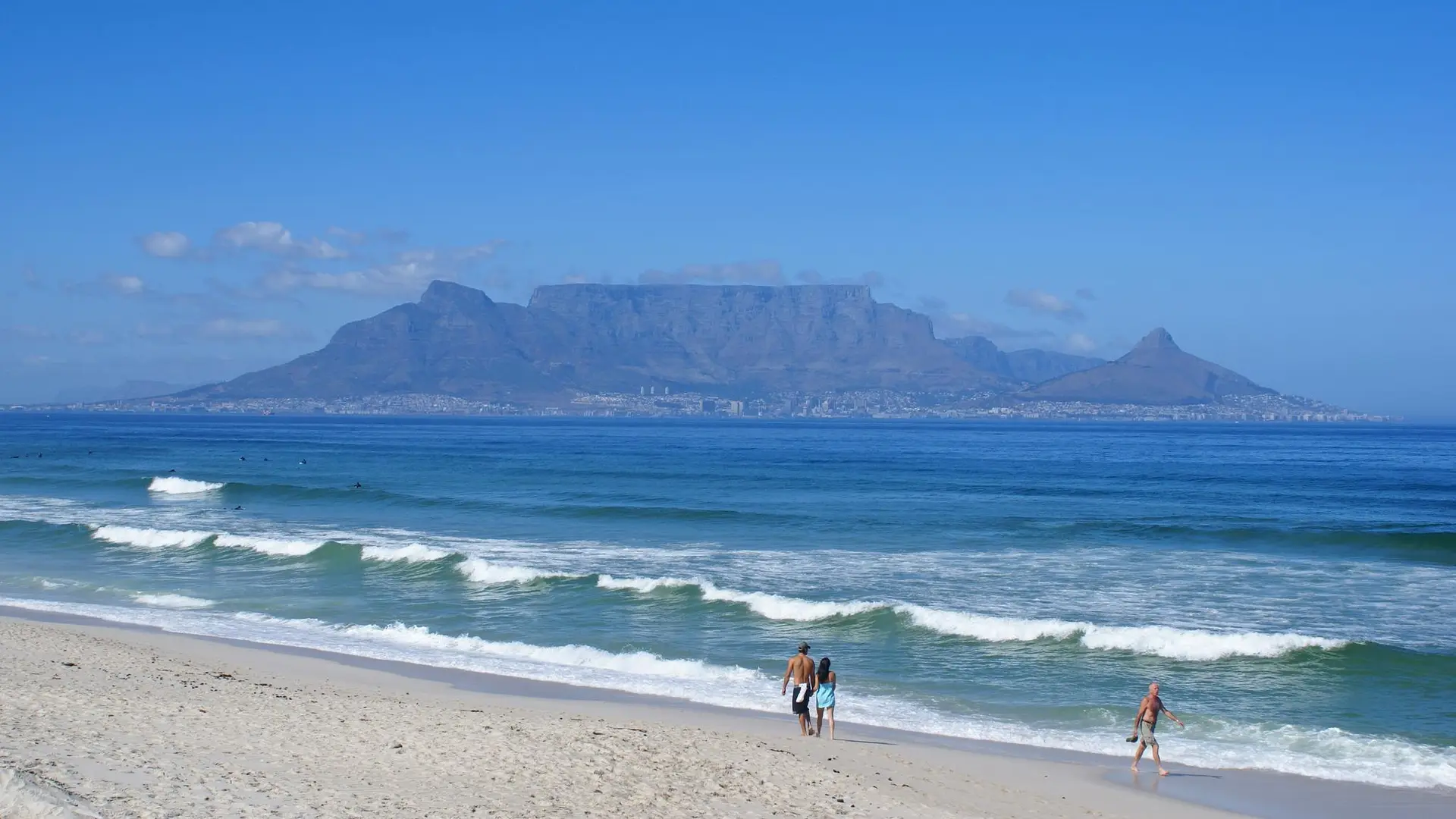
Table Mountain rises about 1,085 meters above Cape Town, with a nearly flat summit about three kilometers long, framed by Devil’s Peak on one side and Lion’s Head on the other. Its rock is sandstone hundreds of millions of years old, older than the Himalayas.
For the Khoe and San peoples, it was Hoerikwaggo, “the mountain in the sea.” For sailors rounding the Cape of Good Hope, it was a landmark visible far out at sea, a sign they’d almost reached safe harbor.
It’s also part of the Cape Floral Kingdom, the smallest and richest of the world’s six floral kingdoms. The mountain alone has a staggering number of plant species, many found nowhere else. The fynbos shrubland is full of proteas, ericas and restios, buzzing with sunbirds.
Going up
The cableway. The Table Mountain Aerial Cableway has carried visitors up since 1929. Today’s cars have rotating floors, turning a full 360 degrees during the five-minute ride, so everyone gets the view. The cableway closes in strong wind or low cloud, which is common. Check the status before you go, and book online to skip the ticket queue.
Hiking up. Many people walk:
- Platteklip Gorge: the most direct route, a steep stone staircase up a gully in the front of the mountain, about 2–3 hours.
- Skeleton Gorge: starts in Kirstenbosch Botanical Garden and climbs through forest and ladders up the back of the mountain. Beautiful.
- India Venster: a steep scramble with exposure. For experienced hikers only.
Many walk up and take the cableway down.
On top: walk the short paths around the summit plateau to viewpoints over the city, the Atlantic seaboard, the Twelve Apostles peaks, and Robben Island in the bay. Look out for dassies (rock hyraxes), small furry animals whose closest relatives are elephants.
Lion’s Head
Next door, Lion’s Head is a steep conical peak with a 360-degree view of the city and the ocean. The hike takes about 1–1.5 hours up, with chains and ladders near the top. It’s famous for sunrise and full-moon hikes, when locals climb in the evening to watch the sun set over the Atlantic and the moon rise over the city.
Safety
- Hike in groups, and don’t hike alone.
- Start early, and check the weather: cloud and wind can arrive quickly, and temperatures drop fast on top.
- Carry water, a warm layer and a charged phone.
- Stick to marked trails.
Around Cape Town
- Kirstenbosch Botanical Garden, at the foot of the mountain, with a treetop walkway.
- Robben Island, where Nelson Mandela was imprisoned for 18 years. Tours are led by former political prisoners.
- Boulders Beach, with its colony of African penguins.
- Chapman’s Peak Drive and Cape Point, at the tip of the Cape Peninsula.
- The Winelands of Stellenbosch and Franschhoek.
When to go
Summer (November–April) brings sunny days, but also the strong south-easterly wind, which sometimes closes the cableway. February and March are often ideal: warm and calmer. Winter (June–August) is cooler and wetter, but has clear, crisp days and fewer crowds.
The honest bits
The cableway often closes for wind or cloud, and the queues can be long in summer. The top can be cold and misty even on a hot day below. Hiking trails need care, and crime has occasionally been a problem on quieter routes.
But ride the cable car up on a clear evening, walk to the edge as the sun sinks into the Atlantic, and watch the lights of Cape Town come on far below.
Table Mountain: questions people ask
How do you get to the top of Table Mountain?
By the Table Mountain Aerial Cableway, whose cars rotate 360° on the way up, or on foot. Platteklip Gorge is the most direct hike, about 2–3 hours up. The cableway closes in strong wind, so check before you go.
What is the 'tablecloth' on Table Mountain?
A layer of cloud that forms over the flat top and pours down the cliffs when the south-easterly wind, the 'Cape Doctor', blows. Locals say the devil and a pirate are having a smoking contest.
Is it safe to hike Table Mountain?
Generally yes, with care. Hike in a group, start early, carry water and a warm layer, stick to marked trails, and check the weather. Mist can come down quickly.