About 600 to 700 years ago, a river in the Namib Desert changed its mind.
The Tsauchab River, which only flows after rare rains, had been watering a clay pan among the dunes, where camel-thorn trees grew. Then the dunes shifted and cut it off. The water stopped coming. The trees died.
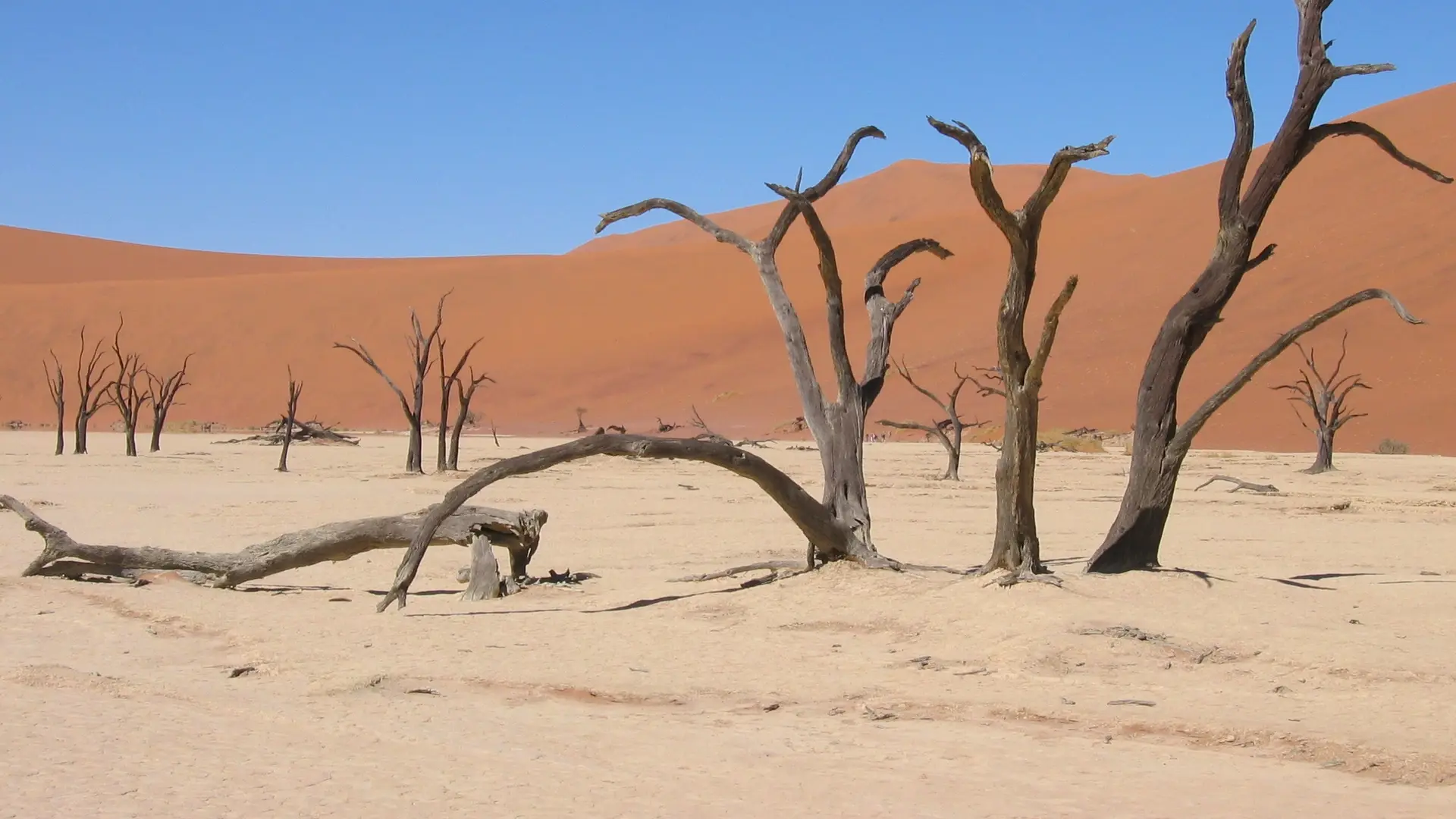
But the air here is so dry that they never rotted. The sun scorched them black, and there they still stand: a ghostly forest of dead trees on a cracked white floor, surrounded by orange dunes under a deep blue sky. The place is called Deadvlei, the dead marsh. It looks like a painting by Salvador Dalí, and it’s real.
The oldest desert
The Namib is thought to be the oldest desert in the world, dry for tens of millions of years. Its sand, blown in from far away and colored red and orange by iron oxide, has piled into some of the tallest dunes on Earth.
Sossusvlei is a salt and clay pan at the end of the dune valley. In some years, after heavy rain, it actually fills with water, a rare sight. Around it, the dunes rise more than 300 meters high.
What to see
Dune 45. Named for being 45 kilometers from the gate, this elegant curving dune is about 170 meters high, easy to climb, and the classic place for sunrise. Walk up the knife-edge ridge and watch the light pour over the dune sea, turning each ridge half orange and half shadow.
Big Daddy. One of the highest dunes in the area, towering over Deadvlei. The climb is long and hard, an hour or more in soft sand, but the view from the top is staggering. And the descent is pure joy: you run, or tumble, straight down the steep face into the white pan of Deadvlei below.
Deadvlei. Go early in the morning. The contrast of the black trees, white floor, orange dune and blue sky is at its most dramatic, and it’s quiet.
Sesriem Canyon. A narrow gorge near the gate, carved by the river. Its name comes from the six (ses) leather straps (riems) of rope early settlers needed to draw water from it.
Sunrise access
The park gate at Sesriem opens at sunrise, which is too late to reach the dunes for first light. But guests staying inside the gate, at the Sesriem campsite and the lodge inside the park, can enter about an hour before sunrise and stay later after sunset. That’s the best reason to book them.
The road is paved for about 60 kilometers to the 2x4 car park. The last 5 kilometers to Sossusvlei and Deadvlei are deep sand. Only drive it with a proper 4x4 and some experience. Otherwise, take the park shuttle.
Beyond the dunes
- Hot-air balloon flights at dawn over the dune sea, followed by a champagne breakfast.
- Stargazing. The nearby NamibRand Nature Reserve is an International Dark Sky Reserve, and the night sky here is among the clearest on Earth. The Milky Way casts shadows.
- Scenic flights over the dunes to the Skeleton Coast and shipwrecks.
Self-driving Namibia
Namibia is one of the best self-drive countries in Africa. Distances are long, mostly on gravel roads, and there’s a lot of empty space. Sossusvlei is about five hours from Windhoek. Fill up with fuel at every chance, carry water, drive slowly on gravel, and avoid driving at night.
Many trips combine Sossusvlei with the coastal town of Swakopmund, desert-adapted wildlife in Damaraland, and the game drives of Etosha National Park.
When to go
May to September (the southern winter) brings warm days, cold nights and clear skies, the most comfortable time. Summer (November–February) is very hot, often above 40°C in the dunes, so visit at dawn and dusk only. Rain is rare at any time.
The honest bits
Sossusvlei is remote, and getting there means long drives on dusty roads. Accommodation inside the gate books up early. Climbing dunes in soft sand is exhausting, and the midday heat is dangerous, so carry plenty of water.
But stand on the ridge of Dune 45 at sunrise, as the shadows pull back across a sea of red sand, and then walk out onto the silent floor of Deadvlei, among trees that died centuries ago and never fell. It’s a landscape that feels outside of time.
Sossusvlei: questions people ask
How do you get into Sossusvlei before sunrise?
The main gate at Sesriem opens at sunrise, but guests staying inside the park gate (at the Sesriem camp or the lodge inside) can leave about an hour earlier, reaching the dunes for first light.
Do you need a 4x4 for Sossusvlei?
The road to the 2x4 parking is paved. The last 5 km to Sossusvlei and Deadvlei is deep sand: drive only if you have a proper 4x4 and experience, or take the park shuttle.
Which dune should I climb?
Dune 45 is easy to reach and great for sunrise. Big Daddy, towering over Deadvlei, is a tough climb of an hour or more, followed by a wild run straight down into the white pan.