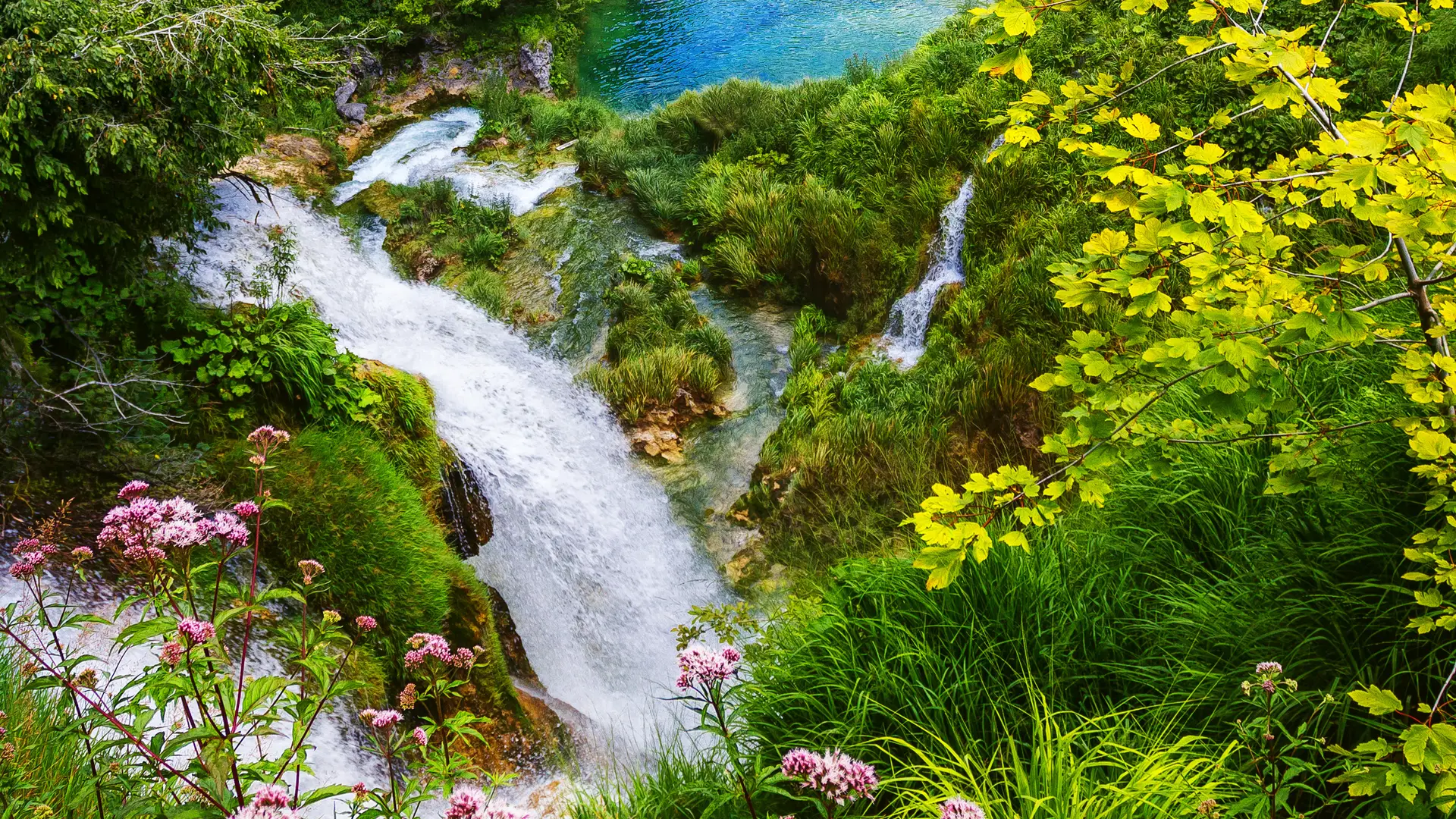
On a misty spring morning, the boardwalk at Plitvice feels like it’s floating.
Wooden planks wind just above the water, between lakes so clear you can see trout gliding over the bottom, and every few meters another waterfall spills over a ledge of moss beside you. The water isn’t one color. It shifts from turquoise to jade to deep blue to almost grey, changing with the light, the depth and the minerals.
It doesn’t look real. It looks like a fairy story about a lake.
Lakes built by moss
The Plitvice Lakes are a chain of 16 main lakes, stepping down a valley in the mountains of central Croatia, connected by more than 90 waterfalls and cascades.
What makes them special is how they were made, and are still being made. The water here is rich in dissolved calcium carbonate from the limestone hills. As it flows over moss, algae and bacteria, the minerals settle out and build up into a soft, porous rock called travertine. Over thousands of years, these living barriers have grown into natural dams, holding back the lakes and creating the waterfalls.
The barriers grow by around a centimeter a year. It’s a landscape that’s still alive and changing. That’s why swimming is banned, and why staying on the boardwalks matters.
Plitvice was one of the very first places in the world to be named a UNESCO World Heritage Site, in 1979.
The Upper and Lower Lakes
The park is divided in two:
The Upper Lakes are larger, set among forested slopes, with dozens of small waterfalls and cascades linking them. Boardwalks run right over and between the waterfalls. They’re the most magical part.
The Lower Lakes sit in a deep limestone canyon, with dramatic cliffs and caves. At the end is Veliki Slap (“the Great Waterfall”), about 78 meters, the tallest waterfall in Croatia.
In between lies Lake Kozjak, the largest lake, crossed by a quiet electric boat.
Choosing a route
The park offers several numbered routes from its two main entrances. A good, popular choice covers both halves in 4–6 hours, combining walking, the electric boat across Lake Kozjak, and the panoramic train along the top. Ask at the entrance for the latest route numbers.
Tips:
- Start at opening time. By late morning in summer, the narrow boardwalks become slow-moving lines.
- Walk against the flow if your route allows. Many people follow the same direction.
- Wear shoes with grip. The boardwalks can be slippery.
Tickets and seasons
Tickets are timed, with daily caps. Book online in advance in summer. Prices are highest in June to September (around €40 for adults) and much lower the rest of the year.
- Spring (April–June): waterfalls at their fullest after snowmelt, fresh green forest and fewer people. This is probably the best time.
- Summer: warm and lush, but crowded.
- Autumn (September–October): beech and maple forests turn gold and red, and the crowds thin.
- Winter: quiet and cold, and sometimes the waterfalls freeze into ice sculptures. Some routes close.
Where to stay
Stay overnight near the park, in guesthouses in the nearby villages or hotels at the entrance, so you can start early before the day-trippers arrive from Zagreb and the coast. Plitvice is about two hours from Zagreb and about one and a half to two hours from Zadar.
Nearby, the village of Rastoke, in Slunj, is a fairy-tale cluster of old watermills and wooden houses built over waterfalls where two rivers meet. It’s well worth a stop.
The honest bits
Plitvice is very popular, and in July and August the boardwalks can feel like a queue. Tickets are expensive in high season, and you can’t swim. Parts of the walk can be slippery and narrow.
But be there at opening on a cool spring morning, with mist hanging over the Upper Lakes and the sound of a hundred small waterfalls all around you. Walk slowly. This landscape takes thousands of years to build, a centimeter at a time.
Plitvice Lakes: questions people ask
Can you swim at Plitvice Lakes?
No. Swimming is banned to protect the fragile lakes and the living travertine barriers that hold them back. Stay on the boardwalks, too.
How long does it take to see Plitvice?
Most people spend 4–6 hours on a route that covers the Upper and Lower Lakes, with a boat across Lake Kozjak. Staying nearby lets you start at opening time.
Do I need to book Plitvice tickets in advance?
Yes, especially in summer. Tickets are timed with daily caps, and prices are highest from June to September.