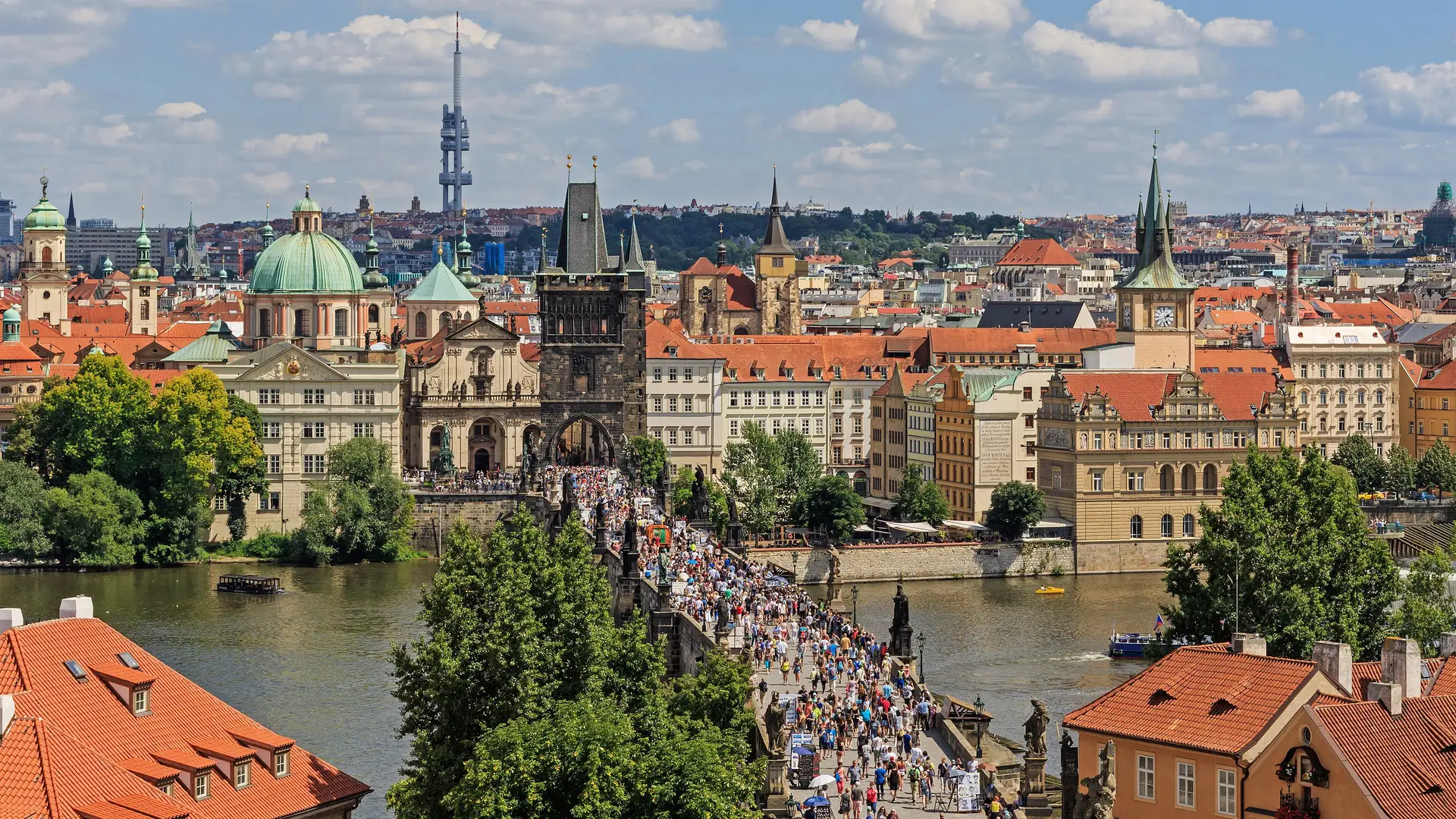
On 9 July 1357, at exactly 5:31 in the morning, the Holy Roman Emperor Charles IV is said to have laid the foundation stone of a new stone bridge across the Vltava river in Prague.
Why that exact moment? Some believe the emperor, who was fascinated by astrology, chose it for its numbers. Written out, the date and time make a palindrome: 1-3-5-7-9-7-5-3-1, rising and falling like a bridge itself.
Whatever the reason, it worked. Charles Bridge has stood for nearly seven centuries, through floods, wars and invasions. And at dawn, before the crowds arrive, it’s one of the most magical places in Europe.
The city of a hundred spires
Prague, the capital of Czechia, survived the 20th century’s wars with its historic center remarkably intact. Its Old Town, Lesser Town, Castle and Jewish Quarter form a UNESCO World Heritage Site: Gothic churches, baroque palaces, Art Nouveau facades and cobbled lanes, all crowded together along the river under a skyline of spires.
Charles Bridge
The bridge is lined with 30 statues of saints, mostly added in the baroque period. The originals have been moved to museums and replaced with copies. The most famous is St John of Nepomuk, a priest who, according to legend, was thrown from the bridge in 1393 on the orders of King Wenceslas IV for refusing to reveal the queen’s confession. Visitors touch the bronze plaque at the base of his statue for luck, and to make sure they’ll return to Prague. You’ll see it shining from millions of hands.
Go at dawn. By 9 a.m., the bridge fills with tourists, painters, musicians and souvenir sellers. At sunrise, it’s quiet, misty and beautiful.
The Astronomical Clock
In Old Town Square, on the side of the town hall, hangs the Prague Orloj, an astronomical clock first installed in 1410. It’s the oldest astronomical clock in the world still working. It shows the time, the positions of the sun and moon, the zodiac, and more.
Every hour, a small show begins: a skeleton, representing Death, rings a bell and turns an hourglass. Windows open above the clock, and the twelve apostles parade past. A rooster crows. Crowds gather to watch. It’s over in under a minute, and it’s charming.
Legend says the city’s leaders had the clockmaker, Hanuš, blinded so he could never build a better one anywhere else. In revenge, he climbed into the clock and stopped it. Historians say the story isn’t true, but in Prague, the legends are half the fun.
Old Town Square
Around the clock is one of Europe’s most beautiful squares, lined with colorful houses and the twin Gothic spires of the Týn Church, rising like something from a fairy tale. In December, it hosts a famous Christmas market with a huge tree, mulled wine and roasted ham.
Prague Castle
Across the river, on a hill above the Lesser Town (Malá Strana), stands Prague Castle, one of the largest ancient castle complexes in the world. Inside:
- St Vitus Cathedral, a soaring Gothic cathedral with a stained-glass window designed by the Art Nouveau artist Alfons Mucha.
- Golden Lane, a row of tiny colorful houses built into the castle walls. The writer Franz Kafka worked in No. 22 for a time.
- The view over the red rooftops and spires of the whole city.
The Jewish Quarter
Josefov holds some of the most important Jewish heritage sites in Europe, including the Old-New Synagogue, one of the oldest active synagogues in Europe, and the crowded, moving Old Jewish Cemetery, where headstones lean on one another in layers. Legend says the Golem, a clay giant created by Rabbi Loew to protect the community, still lies in the synagogue’s attic.
Food and beer
Czechs drink more beer per person than anyone else in the world, and it’s good. Try a Pilsner Urquell or local craft beer in a traditional pub, or in a beer garden like Letná, with views over the river and bridges. Eat svíčková (beef in cream sauce), goulash with dumplings, and trdelník, a sweet pastry sold everywhere, though Czechs will tell you it isn’t really a Czech tradition.
When to go
April–June and September–October are lovely. Summer is busy. December, with its Christmas markets, is magical but cold.
The honest bits
Prague’s Old Town can be very crowded, especially around the clock and on Charles Bridge. Some restaurants on the main squares are overpriced tourist traps, and currency exchange booths can be a scam: use ATMs or cards.
But walk across Charles Bridge at dawn, with mist rising from the river and the statues dark against a pink sky, and touch St John’s plaque for luck. You’ll be coming back.
Prague's Old Town: questions people ask
When is the best time to see Charles Bridge?
At dawn, when it's nearly empty and the statues stand silhouetted against the sky. By mid-morning it's crowded with tourists, artists and musicians.
When does the Astronomical Clock show happen?
Every hour, from morning until late evening, the twelve apostles appear in the windows above the clock and the skeleton rings its bell. It's short, so get there a few minutes early.
How many days do you need in Prague?
Three days lets you see the Old Town, Prague Castle, the Jewish Quarter and Malá Strana, with time for beer gardens and a river cruise.