On 13 June 1886, the body of King Ludwig II of Bavaria was found floating in the shallow water of Lake Starnberg, beside the body of his doctor. Three days earlier, his government had declared him insane and removed him from the throne. Nobody knows exactly how he died: suicide, accident, or murder. It’s still one of Europe’s great royal mysteries.
He left behind debts, rumors and three unfinished dream palaces. The most famous one was opened to the public just seven weeks after his death. He had lived in it for only about 172 days.
The fairy-tale king
Ludwig became king at 18. He was tall, handsome and shy, and he hated politics. He loved swans, the night, and above all the operas of Richard Wagner, whose career he rescued and paid for.
After Bavaria lost real power to the new German Empire in 1871, Ludwig retreated into a private world of fantasy. He went sleigh-riding through the mountains at night in a golden sleigh, and he poured his personal fortune into building castles that brought Wagner’s legends to life.
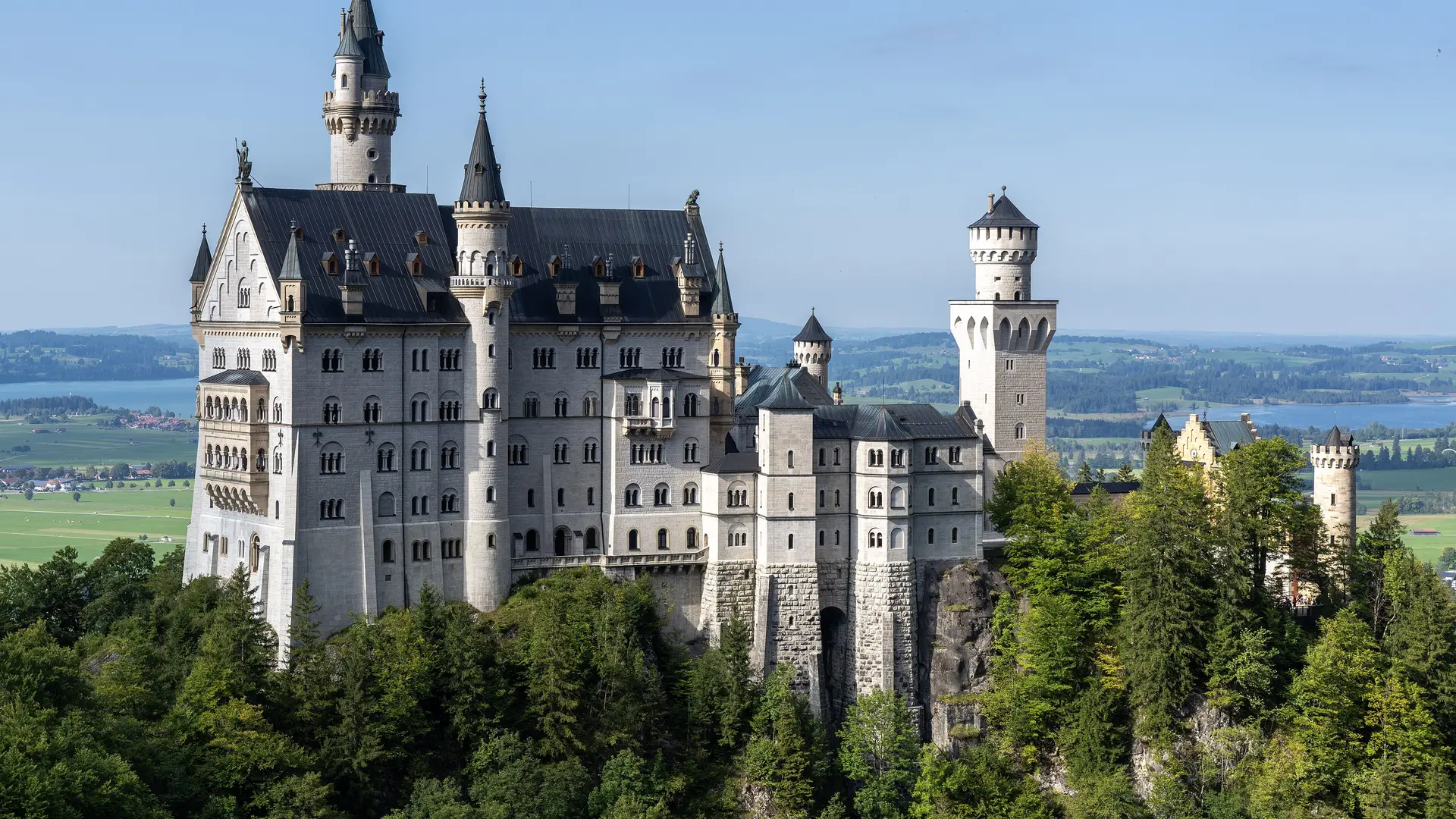
Neuschwanstein (“New Swan Stone”) was the greatest. Begun in 1869 on a rocky crag above the gorge where he’d played as a child, it was designed with the help of a theater set designer. It looks medieval, but it had central heating, running water, flushing toilets and telephone lines. Inside, the walls are painted with scenes of knights, swans and Wagner’s heroes: Lohengrin, Tannhäuser and Parsifal.
A castle the world knows
You’ve seen it before, even if you’ve never been. Neuschwanstein inspired Sleeping Beauty Castle at Disneyland, which opened in 1955, and from there a whole world of storybook castles.
In 2025, Neuschwanstein and Ludwig’s other palaces, Linderhof, Herrenchiemsee and the King’s House on Schachen, were added to the UNESCO World Heritage list.
Inside
The guided tour lasts only about 30–35 minutes and takes you through the finished rooms:
- The Throne Room, two stories high, painted like a Byzantine church, with a huge golden chandelier, but no throne. It was never delivered before Ludwig died.
- The Singers’ Hall, inspired by the Wartburg castle of Wagner’s Tannhäuser. Ludwig never heard a concert in it.
- Ludwig’s bedroom, with a bed carved like a Gothic cathedral, which took carvers years to make.
- The Grotto, an artificial cave with a waterfall, inside the castle.
Many rooms were never finished. Stairways lead to nowhere.
The view from Mary’s Bridge
The famous view is from Marienbrücke (Mary’s Bridge), an iron footbridge over the Pöllat Gorge behind the castle, with a waterfall below and the castle rising from the forest. It gets very crowded. Go early or late, and check if it’s open; it sometimes closes in winter or for maintenance.
Getting there and tickets
- Book a timed tour online through the official ticket center in advance, especially for summer. Tickets cost about €20. Collect them in the village of Hohenschwangau below.
- From Hohenschwangau, walk uphill about 30–40 minutes, take a shuttle bus (to near Marienbrücke), or ride a horse-drawn carriage.
- From Munich: about 2 hours by regional train to Füssen, then a short bus. Many day tours run from Munich.
Nearby
- Hohenschwangau Castle, the yellow castle where Ludwig grew up, facing Neuschwanstein across the valley. You can tour it too.
- The Alpsee, a clear mountain lake perfect for a walk or a boat.
- Füssen, a pretty old town.
- Linderhof, Ludwig’s smaller, more finished palace, with a grotto where he was rowed in a golden shell boat. It’s the only one of his palaces he saw completed.
When to go
Autumn brings golden forests and fewer crowds. Winter, with snow on the towers, looks like a postcard, though bridges and paths may close. Summer is busy, with long queues. Book ahead.
The honest bits
Neuschwanstein is one of Europe’s most visited sights, and in summer it shows: crowded buses, a packed bridge, and a short, quick tour. The inside is smaller than you might imagine, and it’s unfinished.
But stand on Mary’s Bridge on a misty autumn morning, as the white towers rise from the golden forest and the valley falls away behind them. A lonely king built his dreams in stone here, and you can see why he never wanted to leave.
Neuschwanstein Castle: questions people ask
Do I need to book Neuschwanstein tickets in advance?
Yes. Entry is by guided tour at a set time, and tickets often sell out, especially in summer. Book online through the official ticket centre and collect them in Hohenschwangau.
Where is the best view of Neuschwanstein?
From Marienbrücke (Mary's Bridge), a footbridge over a gorge behind the castle. It can close in winter or for repairs; check before you go.
Can you visit Neuschwanstein as a day trip from Munich?
Yes. It's about 2 hours by train to Füssen plus a short bus ride, or a little less by car. Leave early to make your tour time.