On 7 June 1926, an old man in shabby clothes stepped off a pavement in Barcelona and was hit by a tram. He had no identification. Taxi drivers refused to take him to hospital, and he was finally taken to a hospital for the poor, believed to be a beggar.
He was Antoni Gaudí, the most famous architect in Spain. By the time a priest recognized him the next day, it was too late. He died on 10 June. Thousands lined the streets for his funeral, and he was buried in the crypt of the church he had spent 43 years building and never saw finished.
He wasn’t worried. “My client,” he used to say, “is not in a hurry.”
A church built by donations
The Sagrada Família, the Expiatory Temple of the Holy Family, was begun in 1882 to a fairly ordinary Gothic design. A year later, the young Gaudí took over, and he tore up the rulebook.
He imagined a church like a forest, with columns branching like trees, light falling through leaves of colored glass, and walls covered in carved stories. He spent the last years of his life on almost nothing else, living in his workshop on site.
As an “expiatory” church, it has always been paid for by donations, and now by ticket sales. That’s one reason it has taken so long. So did the Spanish Civil War, when anarchists burned Gaudí’s workshop and smashed many of his plaster models. Architects have spent decades piecing the fragments back together.
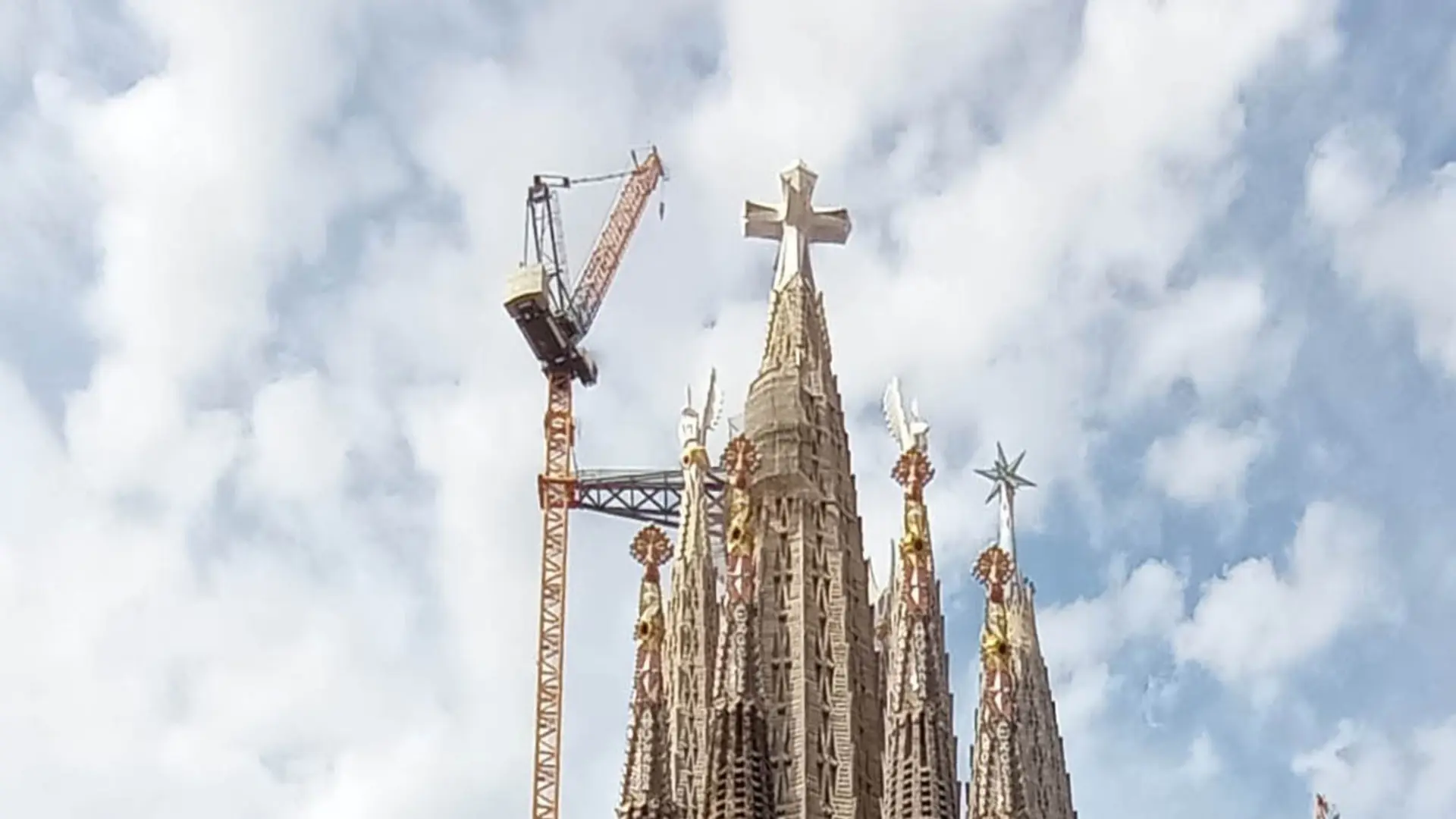
In 2010, Pope Benedict XVI consecrated it as a basilica. In recent years, the great central towers have finally been rising: towers for the four Evangelists and the Virgin Mary, and the central Tower of Jesus Christ, planned at 172.5 meters. That will make it the tallest church in the world, just a little lower than Barcelona’s hill of Montjuïc, because Gaudí said his work should not surpass the work of God. Its completion was timed for 2026, a century after his death.
Outside: three facades
The Nativity Facade faces east, toward the sunrise. It’s the part Gaudí himself saw completed, an explosion of carved life: the birth of Christ surrounded by angels, animals, plants and stars, so dense it looks like it’s melting. Look for the turtles holding up the columns: one from the land, one from the sea.
The Passion Facade faces west, toward the sunset. Built from the 1950s on and sculpted by Josep Maria Subirachs, it’s stark, angular and bony, showing the suffering of the crucifixion. Many people find it shocking at first. Look for the “magic square,” a grid of numbers that always adds up to 33, Christ’s age at his death.
The Glory Facade, the main entrance, is still being built.
Inside: the forest of light
Walk in and look up. Tall, slanting columns branch like trees into a canopy of star-shaped vaults high above. There are no flying buttresses. Gaudí’s clever geometry lets the columns carry the weight.
Then there’s the light. The stained-glass windows by Joan Vila-Grau are cool blues and greens on the east side and blazing reds, oranges and yellows on the west. In the late afternoon, the low sun pours through the western windows and the whole interior glows like a forest on fire. It’s one of the most beautiful sights in Europe.
Tickets and the towers
- Book online on the official website. Tickets are timed and frequently sell out. A basic ticket is about €26. Audio guides and tower access cost more.
- Towers: a lift takes you up, and you walk down a narrow spiral staircase. Choose the Nativity towers for Gaudí’s original carving up close, or the Passion towers for views toward the sea.
- Shoulders and knees should be covered. It’s a working church.
- For the best light, book a slot about two hours before sunset.
More Gaudí in Barcelona
- Casa Batlló, a house with a roof like a dragon’s back and balconies like masks.
- Casa Milà (La Pedrera), a rippling stone apartment block with a rooftop of warrior-like chimneys.
- Park Güell, a hillside park with mosaic benches, gingerbread gatehouses and a famous dragon. Book the monumental zone in advance.
- Palau Güell, an early mansion near the Ramblas.
The honest bits
There’s often scaffolding and cranes. The area around the basilica is crowded with tour groups and souvenir shops, and Barcelona is notorious for pickpockets. Keep bags zipped. Tickets are expensive and can sell out.
But step inside in the late afternoon, stand under the columns as the western windows set the room alight, and you’ll understand why Gaudí didn’t mind that he’d never see it finished.
Sagrada Família: questions people ask
When will the Sagrada Família be finished?
The central Tower of Jesus Christ was scheduled to be topped out in 2026, the centenary of Gaudí's death, which makes the basilica the tallest church in the world. Decorative work and the main Glory facade are expected to continue into the 2030s.
What's the best time of day to visit the Sagrada Família?
Late afternoon, when the sun shines through the western stained-glass windows and floods the interior with red and orange light. Morning brings cool blue and green light through the eastern windows.
Should I go up the towers?
If you don't mind narrow spiral stairs and heights, yes. You get close-up views of the stonework and city views. Choose the Nativity side for Gaudí's original work or the Passion side for sea views.
Do I need to book Sagrada Família tickets in advance?
Yes. Tickets are timed, often sell out days ahead, and are cheaper online. Buy from the official website.