On 2 January 1492, Muhammad XII, the last Muslim king of Granada, rode out of his palace for the last time. He handed the keys of the city to Ferdinand and Isabella, the Catholic Monarchs of Spain. Almost eight centuries of Muslim rule in Iberia were over.
The Spanish called him Boabdil. Legend says that as he and his family rode south into exile, he stopped on a mountain pass, turned for a last look at the red palace on its hill, and wept. His mother, the story goes, turned to him and said: “You weep like a woman for what you could not defend as a man.”
That pass is still called El Suspiro del Moro, the Moor’s Sigh. Stand inside the Alhambra for an hour, and you understand why he cried.
A fortress outside, a poem inside
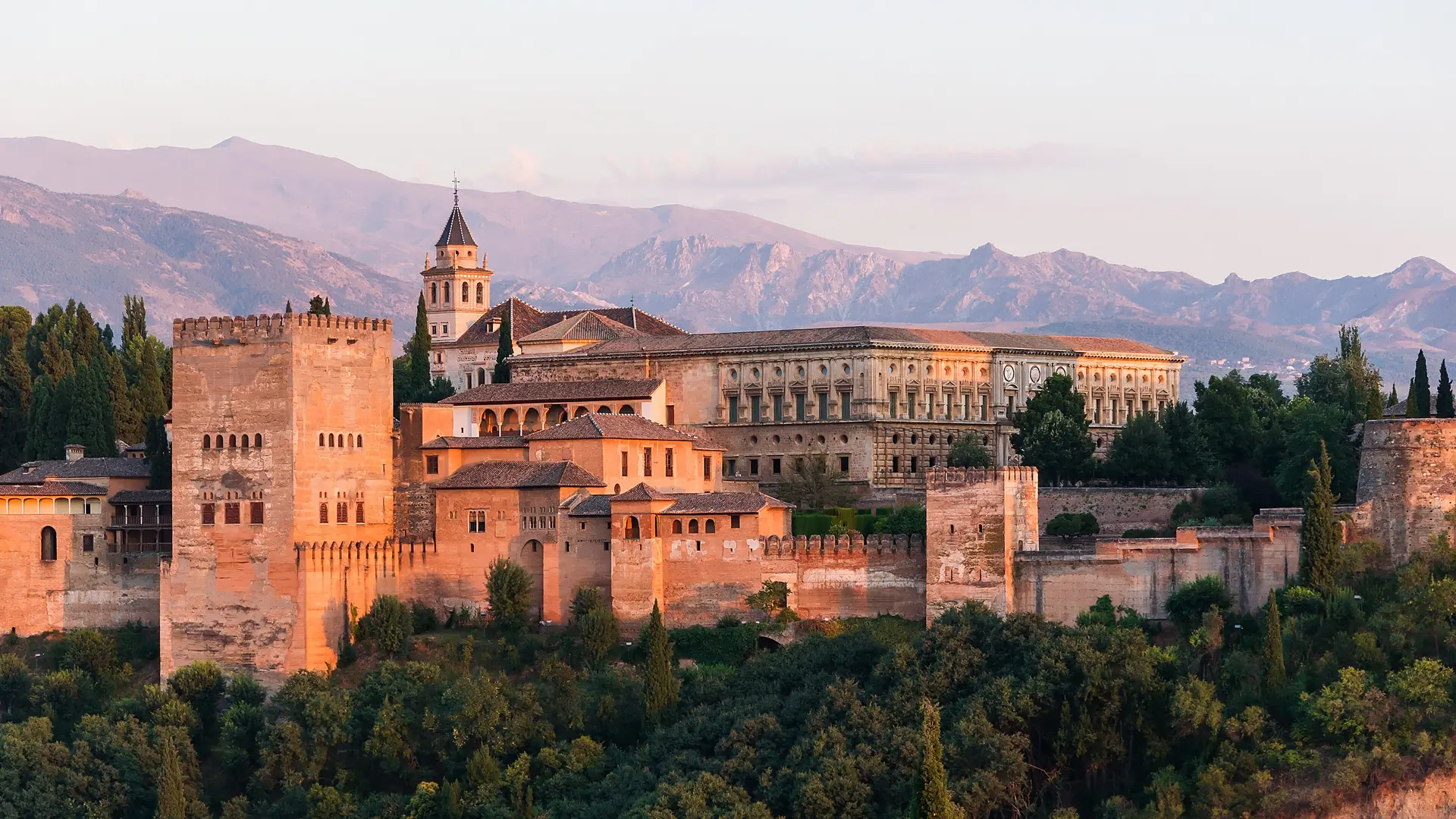
From below, the Alhambra looks like what it was built to be: a fortress. Its name comes from the Arabic for “the red one,” for the color of its walls. It sits on a hill above the city of Granada, with the snow-capped peaks of the Sierra Nevada behind it.
But step inside the Nasrid Palaces and everything changes. These were built by the Nasrid dynasty, the last Muslim rulers in Spain, mostly in the 14th century. Outside, Christian armies were closing in. Inside, the Nasrids built a paradise.
Every surface is decorated: carved plaster as fine as lace, glazed tiles in geometric patterns, cedar ceilings and honeycomb domes. Water is everywhere, in long still pools, channels and fountains. And everywhere, carved into the walls, is writing: verses from the Quran, the dynasty’s motto “There is no victor but God,” repeated thousands of times, and poems by the court poet Ibn Zamrak, praising the very rooms they’re written in.
What to see
The Nasrid Palaces. Visited in a strict timed slot. You move through three palaces:
- The Mexuar, where the sultan held court and judged cases.
- The Comares Palace, around the Court of the Myrtles, a long reflecting pool lined with myrtle hedges. The tall tower beyond holds the Hall of the Ambassadors, the throne room, under a cedar dome inlaid with more than 8,000 pieces representing the seven heavens.
- The Palace of the Lions, built around the famous Court of the Lions, a forest of slender marble columns around a fountain supported by twelve stone lions. Off it lie the Hall of the Two Sisters, whose ceiling is a dome of thousands of tiny carved honeycomb cells like a star-filled sky, and the Hall of the Abencerrajes. Legend says the sultan had the leaders of a rival family murdered here, and the rusty stains in the fountain are their blood.
The Generalife. The sultans’ summer palace and gardens, on the hillside next door. It’s all terraces of roses, cypresses, and the Patio de la Acequia, a long water channel lined with arching fountains. In spring it smells of orange blossom and jasmine.
The Alcazaba. The old military fortress. Climb the Torre de la Vela for a 360-degree view over Granada and the mountains. It was on this tower that the Christian banners were raised in 1492.
The Palace of Charles V. A huge Renaissance palace with a circular courtyard, built right in the middle of the complex by the Holy Roman Emperor. It’s impressive, but most people agree it’s oddly out of place.
The American who saved it
After 1492 the Alhambra slowly decayed. By the early 1800s it was home to beggars, smugglers and stray cats, and Napoleon’s troops had blown up some of its towers.
In 1829, the American writer Washington Irving moved in. He lived in some of the old rooms for a few months, collecting local stories of buried treasure, enchanted princesses and Moorish ghosts. His book Tales of the Alhambra (1832) became an international bestseller and made the palace famous across Europe and America. It helped spark its rescue and restoration. You can still see the rooms he stayed in, marked with a plaque. Read the book before you go.
Tickets: the most important thing
The Alhambra limits daily visitors, and tickets sell out weeks ahead, especially in spring and autumn.
- Buy only from the official Alhambra website or authorized partners.
- A general ticket costs roughly €20, with a timed entry to the Nasrid Palaces. That time is strictly enforced. Arrive early.
- Bring the ID you booked with.
- If everything’s sold out, look for guided tours that include tickets, or the night visits, which have their own allocation.
The best views: the Albaicín
Across the valley is the Albaicín, Granada’s old Moorish quarter, a maze of white houses, steep cobbled lanes and hidden gardens called cármenes.
Climb up to the Mirador de San Nicolás for sunset, with the Alhambra glowing deep red against the snow of the Sierra Nevada. It’s busy, with street musicians and tourists, but magical. For a quieter view, try the Mirador de San Cristóbal, or wander up into Sacromonte, where families have lived in caves for generations and you can see flamenco in a whitewashed cave at night.
When to go and where to stay
Spring (March–May) and autumn (October–November) are ideal: mild days, flowers or golden light. Summer in Granada is very hot. Winter is cool and quiet, sometimes with snow on the mountains, and a lovely time to visit.
Stay in the Albaicín for romance and views, in the center around the cathedral for convenience, or up on the Alhambra hill itself, where a couple of historic hotels sit inside the walls.
In Granada, many bars still give you a free tapa with every drink. An evening of bar-hopping, followed by a late walk under the floodlit walls, is part of the experience.
The honest bits
Getting tickets can be stressful. The Nasrid Palaces are busy even with timed entry, and their famous rooms can feel crowded. There’s a lot of walking up hills. But once you’re standing by the long pool in the Court of the Myrtles, with the tower reflected upside down in the water and the light moving across the carved walls, you’ll understand that last king’s sigh.
The Alhambra: questions people ask
How far in advance should I book Alhambra tickets?
As far ahead as you can, especially for spring, autumn and weekends. Tickets often sell out weeks in advance. Buy only from the official Alhambra website or authorized sellers, and note your timed entry for the Nasrid Palaces.
What happens if I miss my Nasrid Palaces time slot?
You won't be let in to the palaces. The time printed on your ticket is strictly enforced. The rest of the complex can be visited throughout your ticket's morning or afternoon session, but the palaces only at that time.
Where is the best view of the Alhambra?
From the Mirador de San Nicolás in the Albaicín quarter at sunset, when the palace glows red against the Sierra Nevada. The Mirador de San Cristóbal and the Sacromonte hillside are quieter alternatives.
Can you visit the Alhambra at night?
Yes. Night visits to the Nasrid Palaces and to the Generalife run on set evenings. They're shorter, quieter and very atmospheric. They need a separate ticket.