In the language of Madagascar, tsingy is often said to mean “where one cannot walk barefoot.”
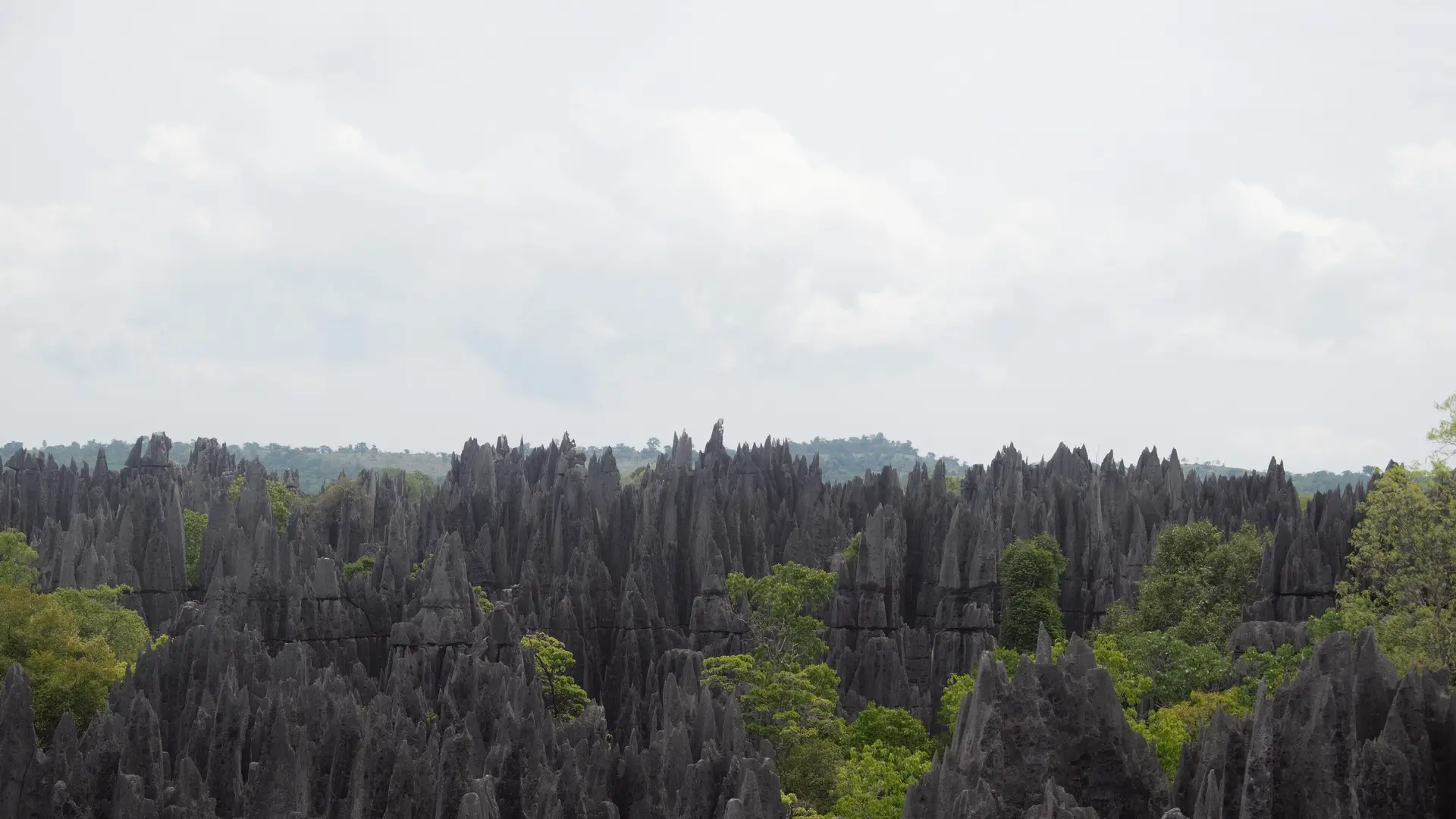
Stand at the top of a ladder in the Grand Tsingy and you’ll understand why. All around you, as far as you can see, rises a forest of stone: thousands of jagged, grey limestone needles and blades, some taller than houses, so sharp that their edges could slice your skin. Between them lie deep, dark canyons, some just a shoulder’s width across, with trees and ferns growing at the bottom in the shade.
A rope bridge sways across a chasm in front of you. On the far side, a white-furred lemur stares at you, then leaps from one razor peak to another as if they were made of foam.
A stone forest
Tsingy de Bemaraha National Park, in western Madagascar, is one of the strangest landscapes on Earth. Millions of years ago, this area was a seabed, where thick layers of limestone built up. After it rose above the sea, rain slowly dissolved the rock, carving it into deep cracks, caves and canyons, and sharpening the tops into needle-like pinnacles.
The result is a vast labyrinth of grey stone spires, some reaching up to around 100 meters, which humans and most large animals simply can’t cross. That isolation created a refuge for wildlife. Many plants and animals here exist nowhere else.
It’s a UNESCO World Heritage Site.
The wildlife
Madagascar split away from Africa and India tens of millions of years ago, and almost everything that lives there evolved in isolation. The Tsingy is home to:
- Decken’s sifaka, a beautiful white lemur that bounds sideways across the ground and leaps between rocks and trees.
- Red-fronted brown lemurs, and tiny nocturnal mouse lemurs.
- Many birds, chameleons, geckos and reptiles found only here.
Exploring the Tsingy
The Grand Tsingy. The most spectacular part, about an hour’s drive from the village of Bekopaka. Guided circuits take several hours, with ladders, rope bridges, narrow passages squeezed between rock walls, and viewing platforms high on the pinnacles. You’ll wear a harness and clip onto steel cables in the exposed sections. No climbing experience is needed, but you need a head for heights and reasonable fitness.
The Petit Tsingy. Closer to Bekopaka, with smaller but still impressive formations, caves and canyons. It’s easier and great for a first look.
The Manambolo River. A pirogue (dugout canoe) trip on the river, through a gorge with caves and ancient burial sites in the cliffs.
Guides are required. Wear sturdy shoes with good grip, bring gloves for the sharp rock, and carry plenty of water.
Getting there
The Tsingy is remote, and getting there is part of the adventure.
- Fly or drive to Morondava, on Madagascar’s west coast.
- From there, hire a 4x4 with a driver. The drive north to Bekopaka takes about a day or more on rough dirt roads, with river crossings by small ferries.
- It’s only possible in the dry season.
Near Morondava, don’t miss the Avenue of the Baobabs: a dirt road lined with giant Grandidier’s baobabs, some hundreds of years old and around 30 meters tall. At sunset, as the sky turns orange and the trees stand in silhouette, it’s one of the most photographed scenes in Africa. Nearby, look for the “Baobabs Amoureux”, two baobabs twisted around each other like lovers.
When to go
The park and roads are only accessible in the dry season, roughly May to October or November. In the rainy season (around December to April), the roads flood and the park closes.
Travel advice
Madagascar has seen periods of political unrest. Before you book, check your government’s current travel advice for Madagascar, and travel with an experienced local operator who can adapt your route if conditions change.
The honest bits
The Tsingy is hard to reach: long, bumpy drives, ferry crossings, basic lodges and limited facilities. Infrastructure in Madagascar is limited, and travel needs time and patience. The heat on the rocks can be intense.
But stand on a platform high above the Grand Tsingy, with a sea of stone blades stretching away to the horizon and a sifaka watching you from the next pinnacle, and you’ll feel like you’ve found the edge of the known world.
Tsingy de Bemaraha: questions people ask
When can you visit Tsingy de Bemaraha?
Only in the dry season, roughly May to October or November. During the rainy season the roads become impassable and the park closes.
How hard are the Tsingy circuits?
The Grand Tsingy circuit involves ladders, narrow passages, rope bridges and cables, using a harness. It's adventurous but doesn't require climbing experience; you do need reasonable fitness and a head for heights. The Petit Tsingy is easier.
How do you get to Tsingy de Bemaraha?
Usually by 4x4 with a driver from Morondava, on the west coast. The rough road takes about a day or more, with ferry crossings on the way, passing the Avenue of the Baobabs.