On the evening of 26 September 1687, a Venetian army was besieging Athens, which was then held by the Ottoman Turks. The Ottomans had turned the Parthenon, a temple more than two thousand years old, into a gunpowder store, thinking the Venetians would never fire on such a famous building.
They were wrong. A Venetian mortar shell arched over the walls, crashed through the roof, and hit the powder.
The explosion blew out the middle of the Parthenon. Walls collapsed, columns toppled, sculptures were smashed, and fires burned for two days. A building that had survived as a temple, a church and a mosque was reduced to the broken shell we see today.
And even so, it’s still the most beautiful building in the world, to many people’s eyes. Walk up through the gateway on a spring morning and see for yourself.
The golden age
In the 5th century BC, Athens was the richest city in Greece, flush with silver and with the treasury of an alliance it had come to dominate. Its leader, Pericles, decided to spend it on the Acropolis, the rocky “high city” at the center of Athens, where earlier temples had been burned by the Persians.
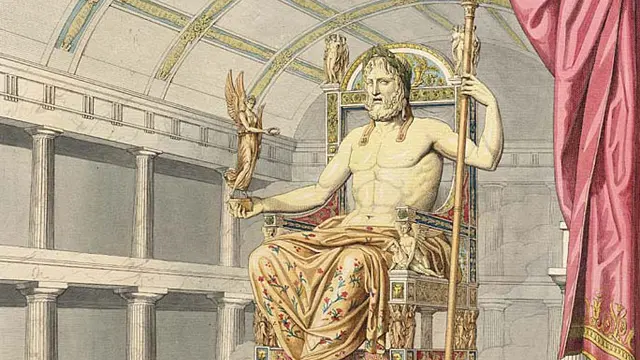
The result was a building program that still sets the standard for Western architecture. The Parthenon was built between 447 and 432 BC by the architects Ictinus and Callicrates, with sculpture overseen by Phidias, the same genius who made the Statue of Zeus at Olympia. It was dedicated to Athena, the city’s patron goddess. Inside stood her giant gold-and-ivory statue.
At the same time, down below, Athens was inventing democracy, and in the theater carved into the slope of the Acropolis, tragedy and comedy.
No straight lines
The Parthenon looks perfectly straight and regular. It’s an illusion.
The builders knew that long straight lines look like they sag. So they curved the floor slightly upward in the middle. The columns swell gently in the middle (an effect called entasis), lean slightly inward, and the corner columns are a little thicker. If you extended the columns upward, they’d meet about two kilometers in the sky. There’s barely a truly straight line in the building, and that’s why it looks so perfectly balanced.
What to see on the hill
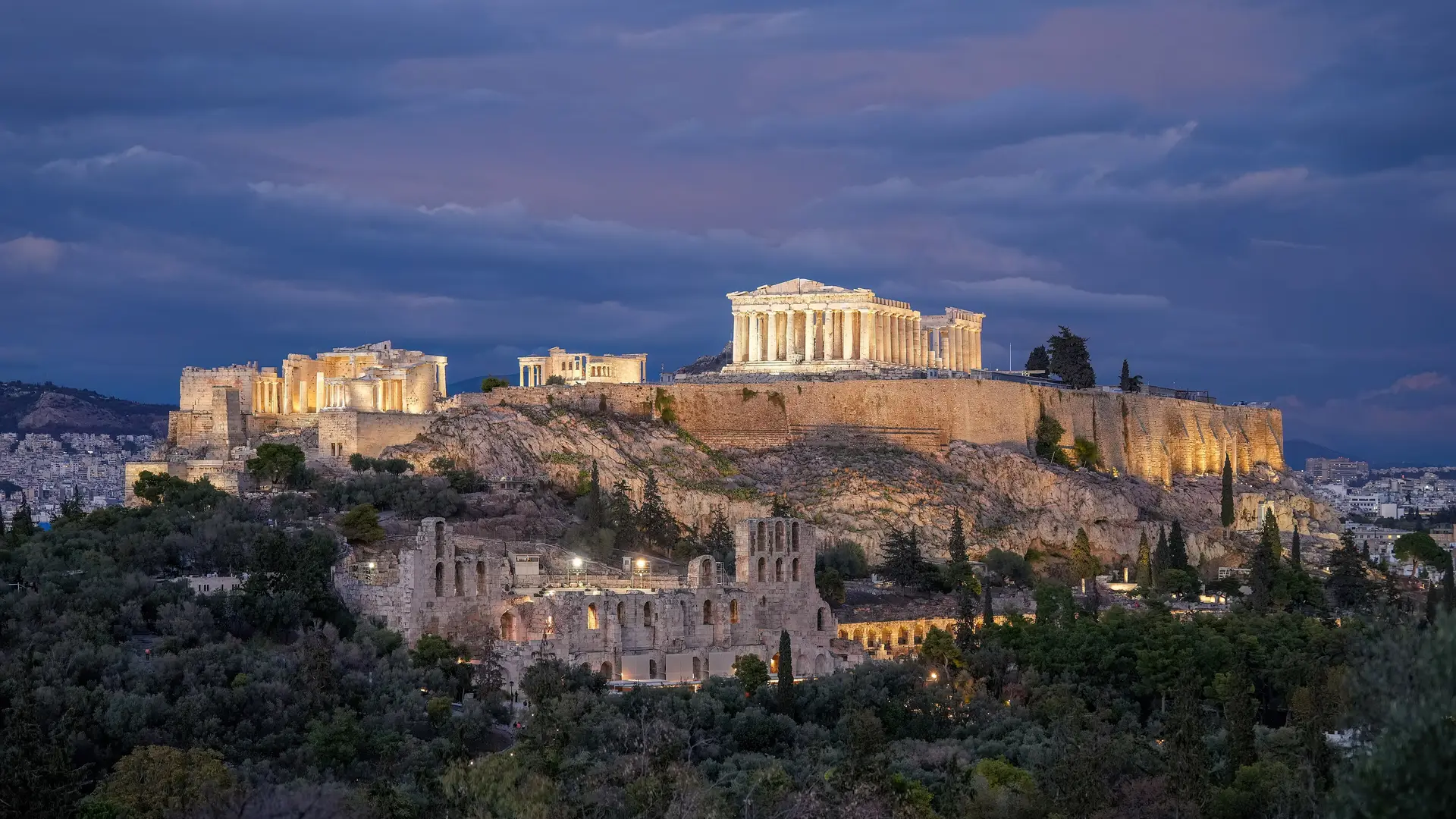
The Propylaea. The monumental gateway you walk through, as ancient processions did.
The Temple of Athena Nike. A small, elegant temple to the goddess of victory, perched on a bastion to the right of the entrance.
The Parthenon. It’s often wrapped in scaffolding as restoration goes on, because Greece has been carefully repairing it for decades. Walk all the way around it.
The Erechtheion. An unusual, asymmetrical temple linked to the city’s oldest legends, where Athena and Poseidon competed to be the city’s patron. Its famous porch is held up by six marble maidens, the Caryatids. Those on the building today are copies.
The views. From the edge of the hill you can see across the whole city to the sea at Piraeus.
On the slopes below, the Theatre of Dionysus, where the plays of Sophocles and Aristophanes were first performed, and the Odeon of Herodes Atticus, which still hosts summer concerts, are worth a visit.
The Acropolis Museum
Down at the foot of the hill, the Acropolis Museum (opened in 2009) is one of the finest museums in Europe. You walk in over glass floors, looking down into an excavated ancient neighborhood. Inside are the original statues from the hill, including five of the six Caryatids. The sixth is in the British Museum.
On the top floor, the Parthenon Gallery is aligned exactly with the temple, which you can see through the glass walls. It displays the surviving sculptures of the Parthenon’s frieze in their original order. Many pieces are originals. Others are plaster casts of the sculptures removed by Lord Elgin in the early 1800s, which are still in London. The gaps are deliberately obvious. Greece has long campaigned for their return.
Tickets and timing
- Entry is by timed ticket, with a daily limit. Book ahead on the official site.
- A high-season ticket now costs about €30, with lower prices in winter. Combined tickets cover other ancient sites in Athens.
- Go at opening (usually 8 a.m.) or in the late afternoon. Midday in summer means heat, glare off the marble and big groups. The site sometimes closes during heatwaves.
- The marble paths are polished and slippery. Wear shoes with grip.
Around the Acropolis
- The Areopagus, a bare rock just below the entrance, where Athens’ ancient court met and Saint Paul preached. It’s popular at sunset.
- Philopappos Hill, a pine-covered hill opposite, with the best photo of the Acropolis.
- Anafiotika, a tiny cluster of whitewashed houses on the slope, built by stonemasons from the island of Anafi who came to work in Athens in the 1800s. It feels like a Cycladic village in the middle of the city.
- Plaka, the old quarter at the foot of the hill, with tavernas and lanes.
The honest bits
The Acropolis can be crowded, hot and glaring. There’s usually scaffolding somewhere. And you can’t go inside the Parthenon. But come at 8 a.m. in April, walk through the gateway as the sun lights up the marble, and you’ll understand why people have been making this climb for two and a half thousand years.
Acropolis of Athens: questions people ask
Do I need to book Acropolis tickets in advance?
Yes, it's strongly recommended. Entry is by timed slot with a daily cap, and popular morning slots sell out in high season. Book on the official Greek ministry ticket site.
What's the best time to visit the Acropolis?
At opening time (usually 8 a.m.) or in the last couple of hours before closing. Midday in summer is very hot and crowded, and the site sometimes closes in extreme heat.
Is the Acropolis Museum worth it?
Absolutely. It holds the original sculptures from the hill, including five of the six Caryatids, and its top floor recreates the Parthenon frieze at full scale, with a view of the temple itself through the glass.
Where can I see the Acropolis at sunset?
From Philopappos Hill, the Areopagus rock just below the entrance, or Lycabettus Hill for a wider city view. Many rooftop bars in Plaka and Monastiraki also face it.