For centuries, the only way into the Monastery of Varlaam was in a net.
Visitors and supplies were hauled hundreds of meters up the sheer cliff in a rope net, swinging in the wind, by monks turning a wooden winch at the top. There’s a well-known story about a nervous visitor who, dangling halfway up, asked a monk how often they replaced the rope.
“Whenever the Lord lets it break,” the monk replied.
Today there are stairs cut into the rock. But you can still see the old winch tower, the ropes and the net. And when you look out from the monastery’s terrace across the drop, you’ll be very glad of the stairs.
Suspended in the air
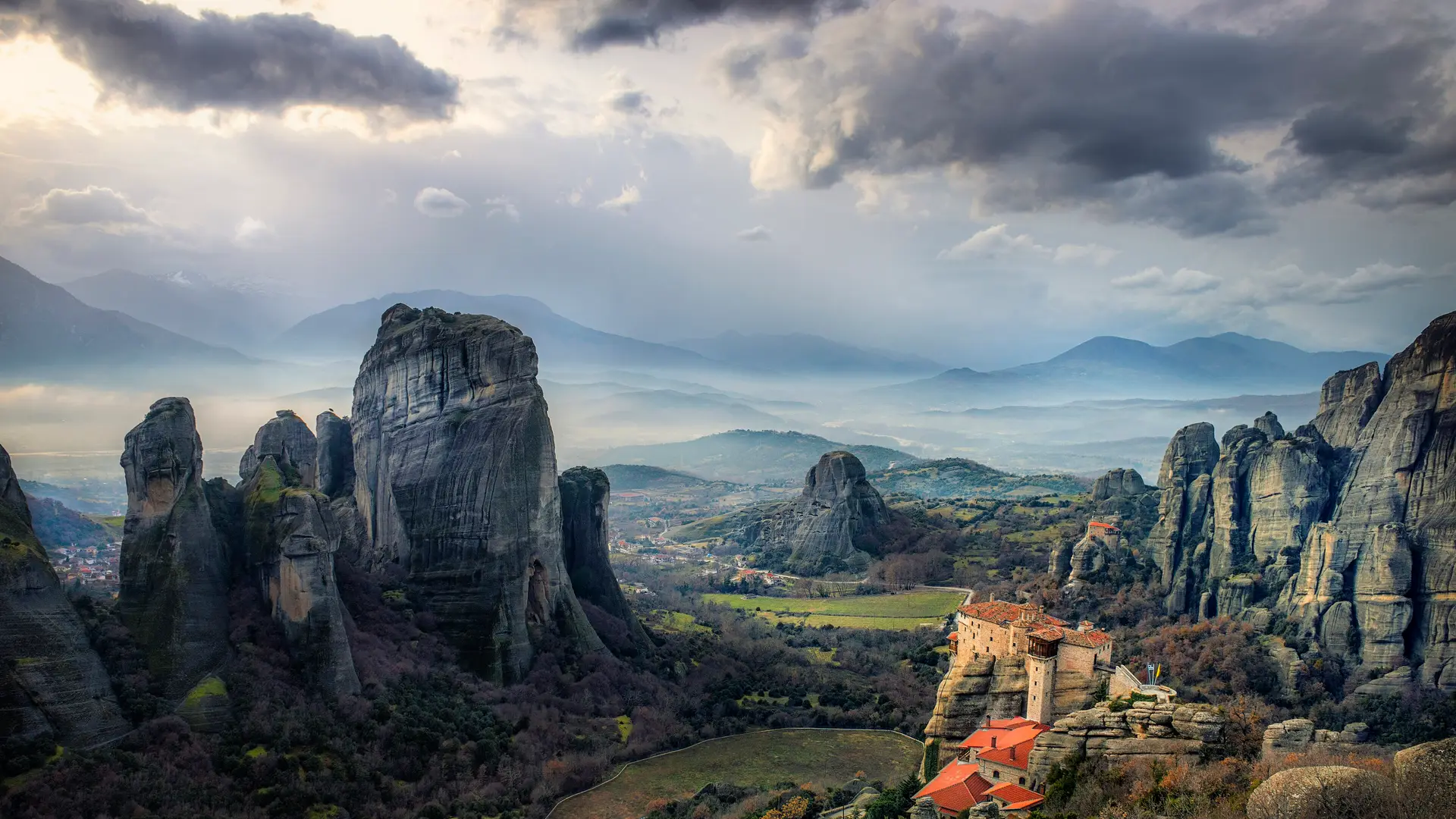
Meteora means “suspended in the air.” Above the small town of Kalambaka, in central Greece, a cluster of giant rock pillars rise straight up from the plain, some over 400 meters high. They’re made of sandstone and conglomerate, deposited by rivers millions of years ago, then pushed up and eroded into towers.
Hermits came to live in the caves and cracks of these rocks as early as the 11th century, seeking solitude closer to God. In the 14th century, a monk named Athanasios founded the first great monastery on top of one of the pillars, the Great Meteoron. As the Ottoman Empire spread through Greece, more monks came, looking for a place no one could reach. At its height, more than twenty monasteries crowned the rocks.
Six are still active today. Meteora is a UNESCO World Heritage Site, and one of the most important places in Greek Orthodox Christianity.
The six monasteries
- The Great Meteoron: the largest and oldest, on the highest rock, with a museum, an old kitchen, and a chilling room lined with the skulls of monks.
- Varlaam: beautiful frescoes, and the old net tower.
- Rousanou: a nunnery perched on a lower rock, reached by a bridge, with vivid frescoes.
- St Nicholas Anapafsas: small, with frescoes by the Cretan painter Theophanes.
- St Stephen: a nunnery easily reached from the road, with lovely views over Kalambaka.
- Holy Trinity: the most dramatically perched, reached by about 140 steps cut into the rock. It appeared in the James Bond film For Your Eyes Only (1981).
Each monastery closes on one day a week, on different days. Check the schedule before you plan. There’s a small entry fee at each.
Dress code: men in long trousers, women in skirts below the knee, shoulders covered. Wraps are often lent at the door.
Walking the old paths
Before the roads were built, monks and villagers walked between the monasteries on footpaths through the forests and gorges. Many of these old trails are still there. Hike from Kastraki village up to the monasteries, or take a guided walk to hidden caves and hermitages, some still with faded frescoes, in the rock faces. It’s the best way to understand how isolated these places once were.
Sunrise and sunset
The rocks glow gold and pink at the start and end of the day. Popular sunset spots include the rocks near the Holy Trinity monastery and the viewpoints along the road between the monasteries. They’re busy in summer, but you can find a quiet rock if you walk a little. Sunrise over the valley with mist below the pillars is even more magical.
Getting there and staying
Trains run from Athens (about 4–5 hours, sometimes with a change) and Thessaloniki (about 3 hours) to Kalambaka. Buses and car hire also work. Stay in Kalambaka or in the smaller village of Kastraki, right at the foot of the rocks, with views of the pillars from your window.
When to go
Spring (April–June), with wildflowers, and autumn (September–October) are best. Summer is hot and busy with tour buses. Winter is quiet and cold, sometimes with snow on the rocks, very atmospheric.
The honest bits
Meteora is popular, and the roads between monasteries get crowded with tour buses in the middle of the day. The monasteries are working religious places with strict rules, short opening hours and busy little rooms. You’ll climb a lot of steps.
But stand on a quiet ledge at sunset, with the monasteries glowing on their rock towers, the bells ringing for evening prayer, and the valley falling into shadow below. You’ll understand why people came here looking for heaven.
Meteora: questions people ask
How many monasteries are there at Meteora?
Six monasteries are active and open to visitors today, out of more than twenty that once existed. Each closes one day a week, on different days, so check the schedule.
What is the dress code at Meteora?
Men should wear long trousers and cover their shoulders. Women should wear skirts below the knee and cover their shoulders. Wraps are often available at the entrance.
How do you get to Meteora?
By train or bus from Athens (about 4–5 hours) or Thessaloniki (about 3 hours) to Kalambaka. From there, taxis, buses and walking trails lead up to the monasteries.