Around 1600 BC, the island exploded.
Back then it was a round island called Strongyle (the Round One), home to a sophisticated Bronze Age town with three-story houses, painted walls and running water. The ground began to shake. The people must have fled, because archaeologists have found almost no bodies. Then came one of the largest volcanic eruptions in human history. It blew the heart out of the island, buried what was left under meters of ash, and sent waves racing across the Aegean toward Crete.
What remained is the island you see today: a broken crescent of cliffs around a great flooded crater, the caldera, with a smoking volcanic island in the middle. Some think the memory of that lost island inspired Plato’s story of Atlantis.
And on the rim of that ancient catastrophe, three and a half thousand years later, people now come to watch the sun go down and fall in love.
The famous view
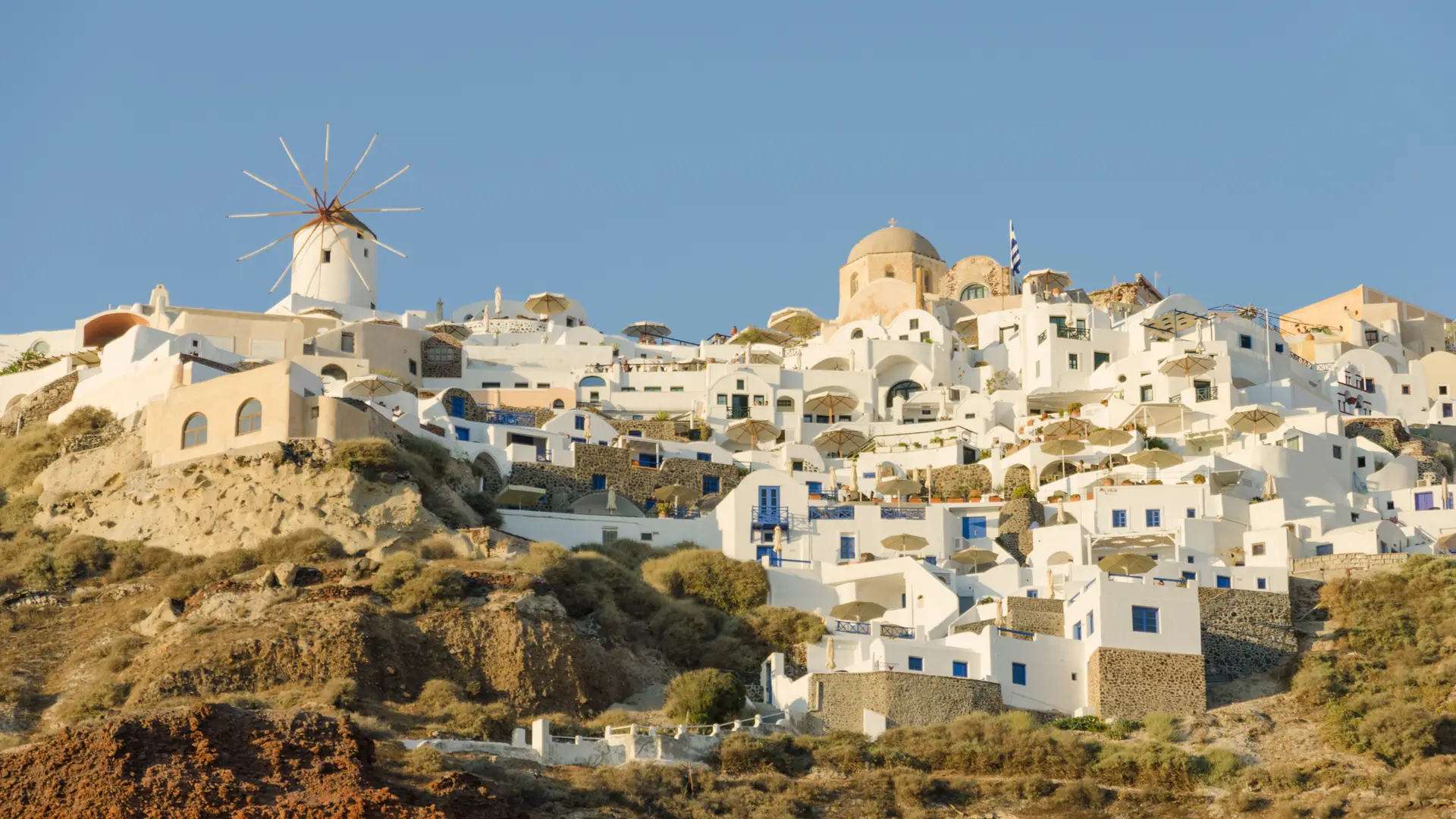
The villages of Santorini cling to the inside of the caldera cliff, three hundred meters above the sea. Whitewashed houses are dug into the volcanic rock, blue-domed churches tumble down the slope, and terraces and infinity pools seem to hang in the air. Below, the sea is deep blue and cruise ships look like toys.
Oia, at the island’s northern tip, is the famous one, with its windmills, blue domes and the sunset that draws crowds of thousands every summer evening. Fira, the capital, is busier and livelier. In between, Firostefani and Imerovigli sit higher on the cliff, quieter and, many think, even more beautiful. Imerovigli looks out at Skaros Rock, a rocky headland that once held a medieval castle.
The lost city of Akrotiri
At the southern end of the island, under a great modern roof, lies Akrotiri, the Bronze Age town buried by the eruption. It’s sometimes called the “Minoan Pompeii.” Its streets, staircases, two- and three-story houses and storage jars are preserved in the ash. The vivid frescoes found here, of fishermen, antelopes, swallows and young boxers, are some of the most beautiful paintings of the ancient world. Many are now in Athens and at the Museum of Prehistoric Thera in Fira. Visit both.
Beyond the sunset
The caldera hike. A path runs along the rim from Fira through Firostefani and Imerovigli to Oia, about 10 kilometers. It passes chapels, viewpoints and a stretch of wild hillside. Go early in the morning and finish with breakfast in Oia before the crowds arrive.
The volcano. Boats take you to Nea Kameni, the young volcanic island in the middle of the caldera, where you can walk up to steaming vents across black lava. Many trips stop at the hot springs of Palea Kameni, where you swim into warm, orange, iron-rich water.
The beaches. Santorini’s beaches are volcanic: Perissa and Kamari have long black-sand beaches and relaxed tavernas. Red Beach is backed by red cliffs. Check whether it’s open, as rockfalls have closed it at times.
Wine. Santorini’s vines grow in a strange way: woven into low baskets (kouloura) on the ground to protect the grapes from the wind. The island’s crisp white Assyrtiko is excellent. Visit a few wineries in the late afternoon, then catch the sunset from one with a view.
Pyrgos. A medieval hill village in the middle of the island, with winding lanes and a castle at the top. It’s much quieter than the caldera towns, and its sunset view is wonderful.
When to go
May–June and September–October are ideal. July and August are hot, very crowded and very expensive, especially when several cruise ships arrive at once and thousands of people take the cable car up to Fira at the same time. Greece has introduced a fee on cruise passengers to help manage this. Winter is quiet and windy. Many hotels close, but the island has a calm, local feel.
In early 2025, a long swarm of earthquakes rattled the island, and many residents and workers temporarily left. The island reopened fully for the season, but it’s a reminder that you’re staying on a living volcano. Check the latest news before you travel.
Where to stay
For romance, stay on the caldera: a cave suite with a private terrace in Imerovigli, Firostefani or Oia. Book months ahead. For lower prices and beaches, stay at Kamari or Perissa and visit the caldera by bus. Many caldera hotels involve a lot of steps, so pack light.
The honest bits
Santorini is beautiful and very busy. Oia at sunset in August is shoulder-to-shoulder. Prices are high, and the cliffside paths fill with cruise passengers in the middle of the day. Donkeys and mules still carry visitors up the steep steps from the old port. Many travelers choose the cable car or walk instead.
So be smart: travel in the shoulder season, stay on the caldera away from Oia, start early and wander late. On an evening in Imerovigli, with a glass of Assyrtiko and the sun sliding into the sea behind the volcano, the island will still take your breath away.
Santorini: questions people ask
Where is the best place to watch the sunset in Santorini?
Oia is the famous one, but it's packed. For a calmer view, try Imerovigli (looking toward Skaros Rock), the village of Pyrgos, or the Akrotiri lighthouse at the island's southwestern tip.
Which village should I stay in?
Imerovigli and Firostefani for romantic caldera views with fewer crowds, Oia for the classic postcard (and prices to match), Fira for convenience and nightlife, and Kamari or Perissa for beaches and lower costs.
Can you hike from Fira to Oia?
Yes. The caldera trail is about 10 km and takes 3–4 hours, past churches and viewpoints with the volcano below. Start early in the morning, carry water, and take the bus back.
When is the best time to visit Santorini?
May–June and September–October bring warm weather and swimmable seas without the worst of the July–August crowds and prices. Winter is quiet, and many hotels and restaurants close.