Walk through the stone tunnel at Olympia, under the low vaulted arch where athletes once waited for their names to be called, and you come out into the stadium: a long, flat strip of earth between grassy banks. There are no seats. Spectators, up to 45,000 of them, sat on the slopes. The original starting line is still there, a row of stone slabs with grooves for the runners’ toes.
Almost everyone does the same thing next. They look around a bit sheepishly, then run. You will too.
The workshop of a genius
A few hundred meters away, among the pine trees and the fallen columns, is a plain brick building that once held the workshop of the greatest sculptor of ancient Greece.
Phidias had already designed the sculptures of the Parthenon and the giant gold-and-ivory Athena inside it. Around 435 BC the people of Elis hired him to make a statue of Zeus for the god’s temple at Olympia. It needed to be grand enough to match the most important sanctuary in the Greek world, the home of the Olympic Games.
He built a workshop with exactly the same dimensions as the temple’s inner chamber, so he could work at full scale. Archaeologists excavating it in the 1950s found tools, molds for glass and gold decoration, and a small clay cup with the words scratched on the base: “I belong to Phidias.”
What the statue looked like
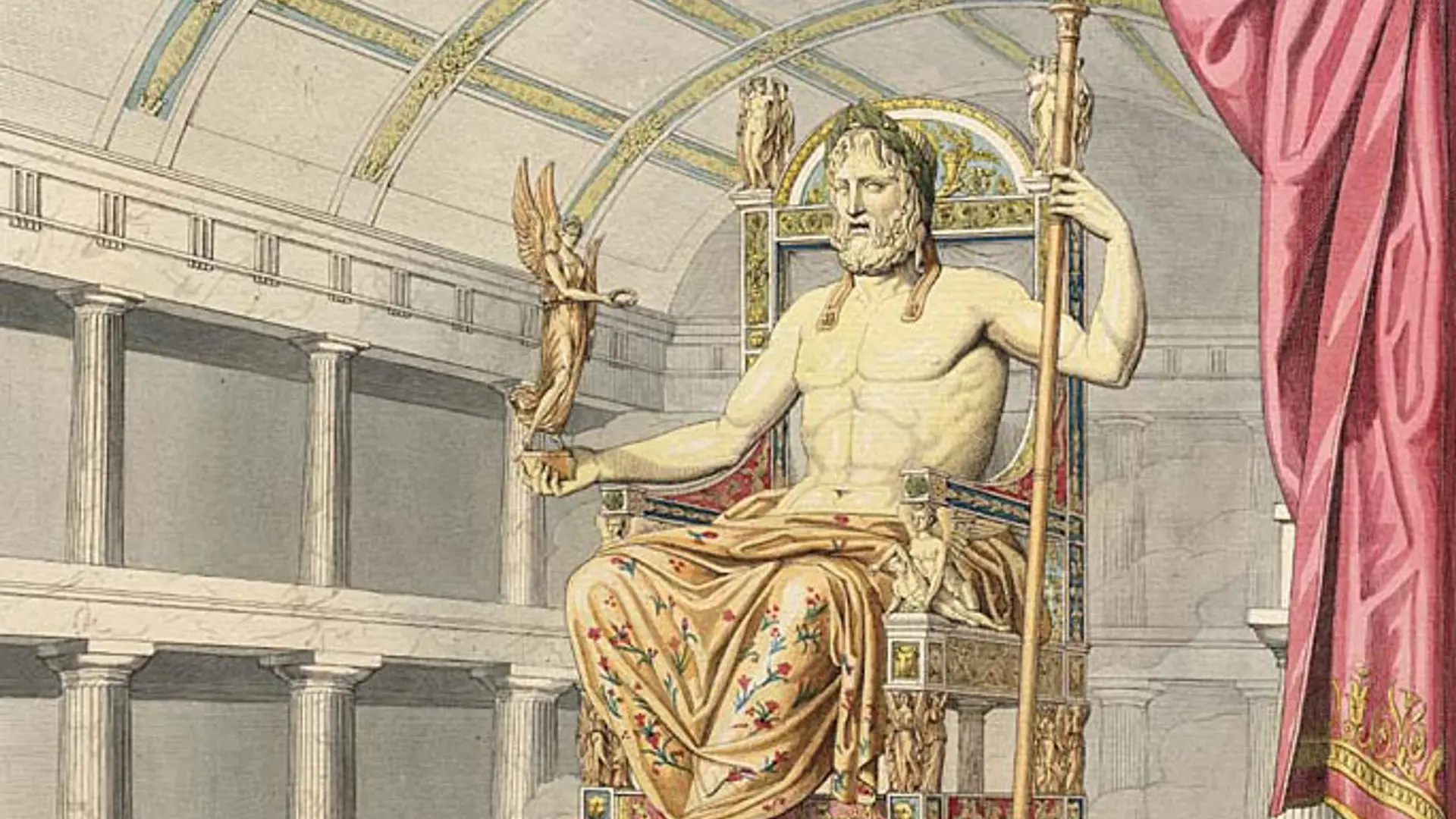
The finished Zeus sat on a great throne of cedar, ebony, ivory and gold, about 12–13 meters tall. His skin was ivory. His robe and sandals were beaten gold, decorated with lilies and animals. In his right hand stood a figure of Nike, goddess of victory. In his left he held a scepter topped with an eagle.
The geographer Strabo wrote that the statue was so huge that if Zeus stood up he would lift off the roof of the temple. A shallow pool of olive oil lay before it. The oil kept the ivory from cracking in the dry air and reflected a golden glow onto the god’s face.
Visitors traveled from all over the Greek world to see it. Some said that seeing it could make you forget your sorrows. Others thought it was the best image of the gods ever made.
How it vanished
The Olympic Games were banned by the Christian emperor Theodosius I in the 390s. The sanctuary slowly emptied. The temple was damaged by fire, then shaken apart by earthquakes in the 6th century, and finally buried under meters of silt by floods.
The statue itself seems to have been gone by then. One account says it was moved to Constantinople and lost when the palace that held it burned in AD 475. No piece of it has ever been found.
Visiting Olympia today
Ancient Olympia sits in a green, gentle valley in the western Peloponnese, beside the Alpheios and Kladeos rivers. It’s a lovely, shady place to wander.
- The Temple of Zeus. Giant column drums lie where earthquakes toppled them, like stacks of fallen coins. One column has been re-erected so you can see the scale.
- The Workshop of Phidias, later turned into a Byzantine church.
- The Temple of Hera, one of the oldest Doric temples in Greece. In front of it, the Olympic flame is still lit by the sun’s rays before every Games.
- The stadium. Run it.
- The Archaeological Museum. The sculptures from the Temple of Zeus’s pediments are superb. So is the Hermes of Praxiteles and the soaring Nike of Paionios.
A combined ticket covers the site and museums, roughly €12, with reduced prices in winter.
The first Olympics
The ancient Games were traditionally dated to 776 BC and held every four years for over a thousand years. Before each Games, heralds traveled across Greece announcing a sacred truce, so that athletes and spectators could travel to Olympia safely even if their cities were at war.
The prize was not gold. It was a simple wreath of wild olive, cut with a golden knife from a sacred tree behind the Temple of Zeus. But winners went home as heroes. Some cities knocked down part of their own walls to welcome a champion through, as if to say a city with such men needed no walls.
The athletes competed naked. There’s a famous story about why. Married women were banned from even watching the Games on pain of death. But a widow named Kallipateira, whose son was competing, disguised herself as his trainer and slipped in. When he won, she leapt the barrier to embrace him, and her disguise fell away. The judges spared her, because her father, brothers and son were all Olympic champions. But after that, it’s said, trainers had to attend naked too.
Cheats were fined, and the money paid for bronze statues of Zeus lined up near the stadium entrance, each inscribed with the cheater’s name. You can still see the row of their stone bases as you walk into the tunnel. It’s a 2,000-year-old wall of shame.
A Peloponnese road trip
Olympia sits at one corner of the Peloponnese, a region packed with places worth the drive:
- Nafplio, Greece’s first capital, a pretty harbor town of Venetian mansions and bougainvillea, with a fortress on the hill above.
- Mycenae, the fortress city of King Agamemnon, entered through the massive Lion Gate.
- Epidaurus, an ancient theatre so acoustically perfect that a coin dropped on the stage can be heard in the top row. Try it.
- Monemvasia, a medieval town hidden on the far side of a rock island, reached by a causeway. It’s car-free, candlelit at night and deeply romantic.
Five or six days is enough to drive a loop from Athens and see them all.
When to go
April to June and September to October are perfect: warm, green or golden, and pleasant for walking. July and August are very hot and busy, especially on days when cruise ships come in from Katakolo. Arrive at opening or late afternoon.
Getting there and staying
Olympia is about 3.5–4 hours by road from Athens. It fits beautifully into a Peloponnese road trip with Nafplio, Mycenae, Epidaurus and the hill towns of Arcadia. The modern village of Olympia has simple, friendly hotels. Stay the night and visit the site early before the tour buses.
The honest bits
There’s no Zeus here, not even a fragment, and the temple is a field of fallen stones. You’ll need your imagination, a good guide, or at least a good reconstruction on your phone. But stand in the empty temple, picture that golden god filling the space above you, then walk out into the stadium and sprint for the line. It’s one of the few ancient wonders you can actually join in with.
Statue of Zeus at Olympia: questions people ask
What happened to the Statue of Zeus at Olympia?
Its fate isn't certain. One later account says it was carried to Constantinople and destroyed when a palace there burned in AD 475. Others suggest it was lost when the temple at Olympia was damaged by fire and earthquakes in the 5th and 6th centuries.
How big was the Statue of Zeus?
About 12–13 meters tall, seated on a throne that nearly touched the temple roof. It was made of ivory plates and gold sheets fixed over a wooden core.
Can you run on the ancient Olympic stadium?
Yes. You walk into the stadium through the original stone tunnel, and you can run the 192-meter track on the same ground used by athletes nearly 2,800 years ago.
How do you get to Olympia from Athens?
It's about 3.5–4 hours by car or bus. Many visitors combine it with a Peloponnese road trip. Cruise ships dock nearby at Katakolo.