In the year 708, the story goes, the Archangel Michael appeared in a dream to Aubert, the bishop of Avranches, and told him to build a church on a rocky island in the bay.
Aubert ignored him. Michael appeared again. Aubert ignored him again. On the third visit, the archangel lost patience and pressed his finger into the bishop’s skull, burning a hole.
Aubert built the church.
You can still see a skull with a hole in it, said to be Aubert’s, in the basilica at Avranches across the bay. And on the rock out in the sea, more than thirteen hundred years later, the church he started has grown into one of the most magical sights in Europe.
A rock, an abbey, and the sea
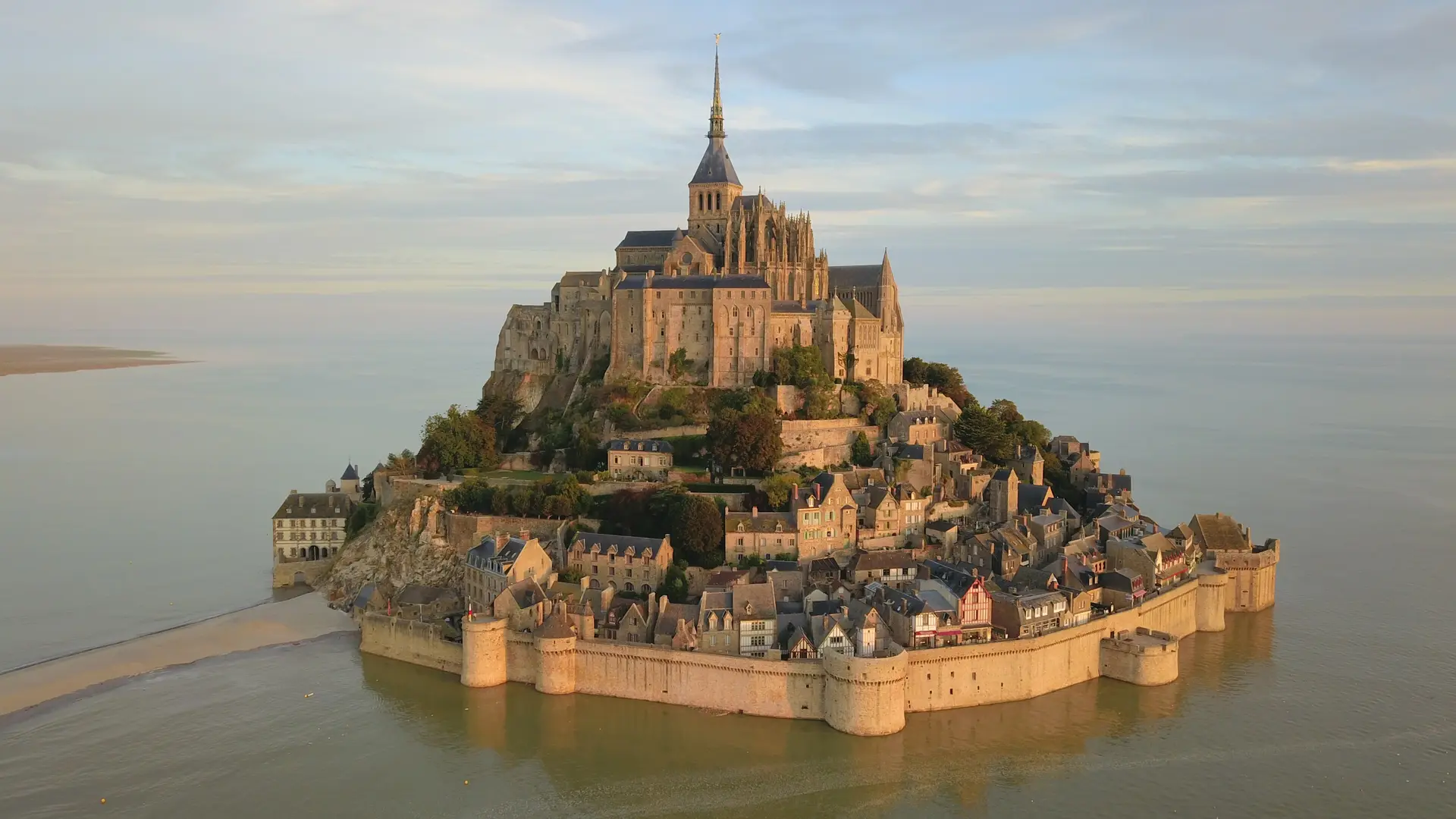
Mont-Saint-Michel rises out of a vast tidal bay on the border of Normandy and Brittany. It’s a granite island about 80 meters high, crowned by a great abbey. A tiny walled village spirals up its slopes.
Benedictine monks settled here in 966, and over the next five centuries they built upward, stacking churches, crypts, halls and cloisters on top of each other around the rock. The great Gothic monastery on the north side, built in the 13th century, is so beautiful it’s called La Merveille, “the Marvel.”
During the Hundred Years’ War, the English besieged the Mont for years but never took it. After the French Revolution, the abbey was turned into a prison, nicknamed the “Bastille of the sea.” Writers like Victor Hugo campaigned to save it, and it was restored. Monks and nuns live and pray here again today.
The tides
The bay has some of the strongest tides in Europe. The difference between low and high water can reach around 14 meters. At low tide, the sea pulls back many kilometers, leaving a shimmering desert of wet sand and channels. Then the tide comes back, and fast. People have long said it comes in “at the speed of a galloping horse.” It doesn’t quite, but it moves faster than you can comfortably walk, and it fills the channels around you before you notice.
For years, a raised causeway and car parks meant the Mont was rarely surrounded by water. In 2014, they were replaced by a light footbridge, which lets the sea flow freely again. Now, on the biggest tides, a few days a month and especially around the equinoxes, the Mont becomes a true island again for a little while. Check the tide calendar and be there for it.
What to see
The village. One main street, the Grande Rue, climbs steeply through the medieval village. It’s lined with souvenir shops, crêperies and old half-timbered houses. It’s packed at midday. Escape up the side stairs and along the ramparts for views across the bay.
The abbey. Climb to the top of the rock. The abbey church sits on the very summit, its spire topped by a gilded statue of Saint Michael slaying a dragon. Beside it, La Merveille holds the cloister, a garden hanging in the sky, surrounded by delicate double columns, with a view out over the sea. Below, explore the knights’ hall, the refectory and the great wheel that prisoners once walked inside to haul supplies up the rock.
The omelette. In 1888, Annette Poulard began serving huge, fluffy omelettes cooked over a wood fire to pilgrims arriving hungry with the tide. Her restaurant, La Mère Poulard, is still there. It’s famous and very expensive. Try it once if you’re curious.
Walking across the bay
At low tide, you can walk across the sands to the Mont barefoot, the way pilgrims did for centuries. But only with a licensed guide. The tide comes in quickly, there are hidden channels, and there are patches of quicksand. Guided walks leave from the shore, cross streams and sinking mud, and may include demonstrations of the quicksand.
Getting there and staying
From Paris, it’s about 4–5 hours. Take a train to Rennes and a direct bus, or drive. You’ll park on the mainland. Free shuttle buses run to the Mont, or you can walk the 2.5 kilometers along the bridge. The walk is lovely, with the Mont growing bigger with every step.
Stay the night. Hotels on the Mont itself are simple and pricey, but staying there is magical. When the day crowds leave around 6 p.m., the lanes empty, the abbey is lit up, and you can walk the ramparts under the stars. More hotels are on the mainland near the shuttle stop.
When to go
April to June and September to October are best: mild weather, fewer crowds and the big equinox tides. July and August are very busy. Winter is cold and windy, but the Mont is quiet, and wrapped in fog it’s very atmospheric.
The honest bits
At midday in summer, the Grande Rue is a slow-moving crowd. Food and drink inside the walls are expensive, and the village can feel like a theme park. The weather in Normandy changes fast.
But come back in the evening, after the coaches have gone. Walk the ramparts as the tide creeps silently in across the sand, the light fades, and the abbey glows gold above you. Bishop Aubert should have listened the first time.
Mont-Saint-Michel: questions people ask
When does Mont-Saint-Michel become an island?
Only during the biggest spring tides, a few days a month around the new and full moon, and especially around the equinoxes. Then the sea surrounds the Mont for a short time. Check the official tide calendar to plan.
Can you walk across the bay to Mont-Saint-Michel?
Yes, but only with a licensed guide. The tide comes in very fast and there are patches of quicksand. Guided barefoot walks across the sand at low tide are a wonderful experience.
Is it worth staying overnight on Mont-Saint-Michel?
Very much. Most visitors are day-trippers who leave by late afternoon. In the evening and early morning the lanes are almost empty, and the floodlit abbey is magical.
How do you get to Mont-Saint-Michel from Paris?
It's about 4–5 hours. Take a train to Rennes (or Pontorson) and then a bus, or drive. You park on the mainland and take a free shuttle or walk about 2.5 km across the bridge.