On 22 July 1452, so the story goes, two fishermen from Perast found an icon of the Virgin Mary lying on a small rock in the middle of the bay.
They took it home. The next day, it was back on the rock. They took it home again, and again it returned. So they decided the Virgin wanted to stay there, and made a vow: every time a sailor returned safely from a voyage, he would drop a stone onto the reef.
For centuries, the people of Perast did exactly that. They dropped rocks, then sank old ships loaded with stones, until the reef became an island. On it they built a church: Our Lady of the Rocks. And every year on 22 July, local people still row out at sunset and throw stones into the water around it, in a ceremony called the Fašinada, to keep the island growing.
A fjord in the Mediterranean
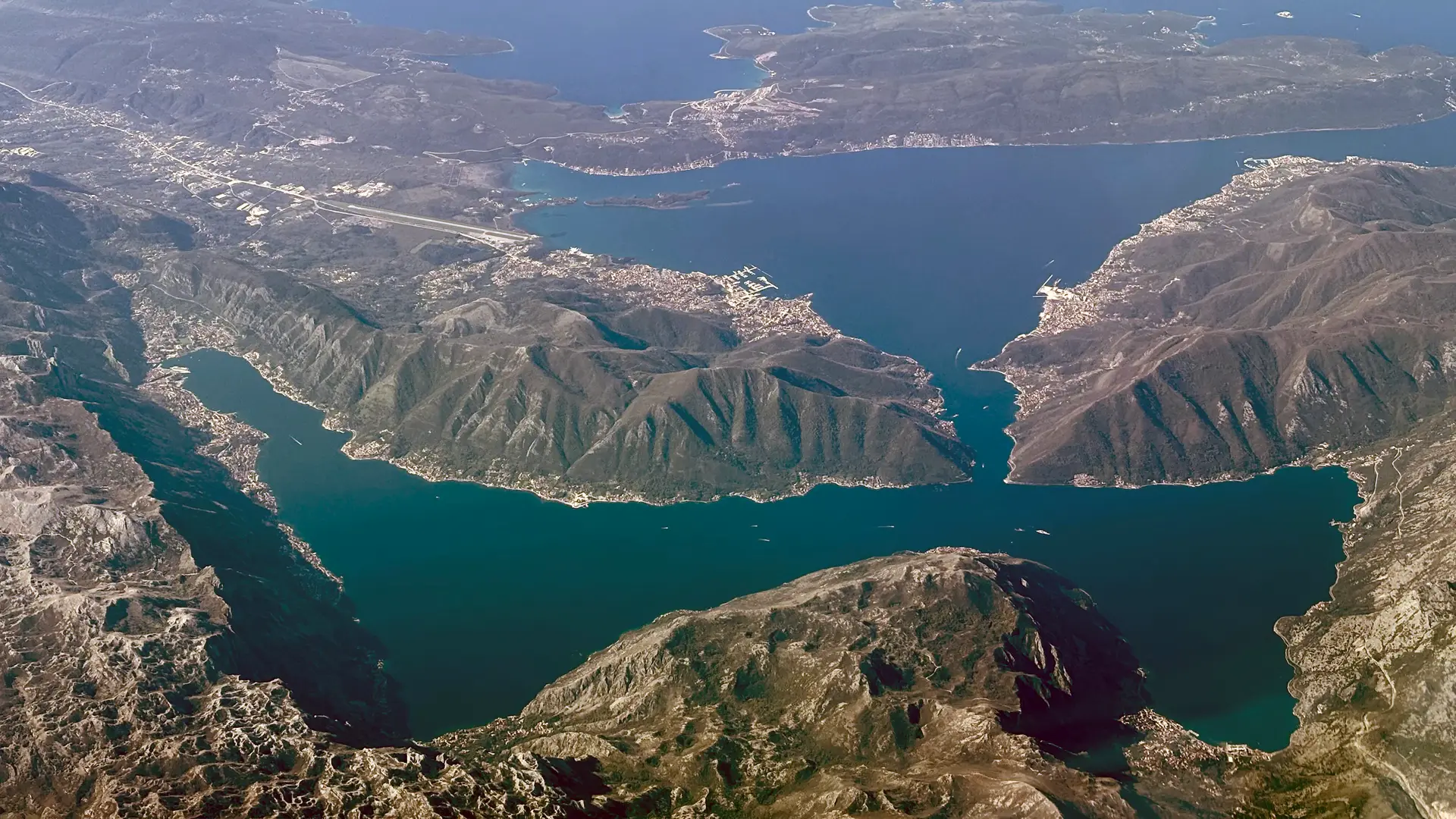
The Bay of Kotor (Boka Kotorska), in Montenegro, winds about 30 kilometers inland from the Adriatic, a maze of inner bays surrounded by mountains that rise straight out of the water up to 1,500 meters. It’s often called Europe’s southernmost fjord, though it’s actually a ria, a river canyon flooded by the sea.
For centuries the bay was ruled by Venice, which left behind stone towns, palaces and churches along the shore. The old town of Kotor and its surrounding landscape are a UNESCO World Heritage Site.
Kotor
Kotor’s Old Town is a tight maze of marble lanes, squares, churches and Venetian palaces, wrapped in massive city walls that climb straight up the mountain behind it.
Climb the walls to the Fortress of St John: about 1,350 steps zigzag up the mountainside, past the little Church of Our Lady of Remedy, to the ruined fortress at the top, 260 meters above the town. The view of the old town’s red roofs and the deep blue bay below is one of the finest in the Balkans. Start early. It’s hot and exposed.
Kotor is also famous for its cats, who wander the lanes, sleep in shop doorways and are cared for by residents. There’s even a small cat museum.
Perast
Fifteen minutes up the bay, Perast is a tiny, elegant town of baroque palaces and churches along a single waterfront street, with a tall bell tower. It was once home to a famous school of sea captains. Take a small boat from the waterfront to Our Lady of the Rocks, with its painted interior and votive silver plaques, and to the neighboring natural islet of St George, with its monastery among cypress trees.
Around the bay
- The Kotor serpentine: a road with 25 hairpin bends climbing the mountain behind Kotor toward Lovćen National Park, with spectacular views. At the top is the Mausoleum of Njegoš, a poet-prince of Montenegro.
- Kayaking and boat trips around the bay.
- Herceg Novi and the Luštica peninsula, near the entrance to the bay.
- Budva and Sveti Stefan, a fortified island village, on the coast nearby.
Crowds
Kotor is a popular cruise port. On busy days, thousands of passengers fill the old town in the middle of the day. Check the cruise schedule and plan around it: climb the fortress early, visit Perast or take a boat at midday, and wander the old town in the evening.
When to go
May–June and September–October are ideal. July and August are hot and crowded. Winter is quiet and rainy, but mild.
The honest bits
Kotor’s old town can be overwhelmed by cruise crowds, and the fortress climb is hot and tiring. Parking around the bay is difficult in summer.
But row out to Our Lady of the Rocks in the evening light, with the mountains turning gold around the still water, and think about all those sailors, coming home one at a time, each carrying a stone.
The Bay of Kotor: questions people ask
How long does the climb to Kotor's fortress take?
About 1–1.5 hours up roughly 1,350 steps. Start early in the morning to avoid the heat, and bring water.
What is Our Lady of the Rocks?
A small man-made island off Perast, built up over centuries by sailors dropping rocks and sinking old ships, after fishermen found an icon of the Virgin on a reef there in 1452. A church stands on it.
How do I avoid the cruise ship crowds in Kotor?
Check the cruise schedule, explore the old town early and late, and spend the middle of the day in Perast, on the water or up in the mountains.