Walk out onto the restored section of the arena floor and turn slowly in a circle.
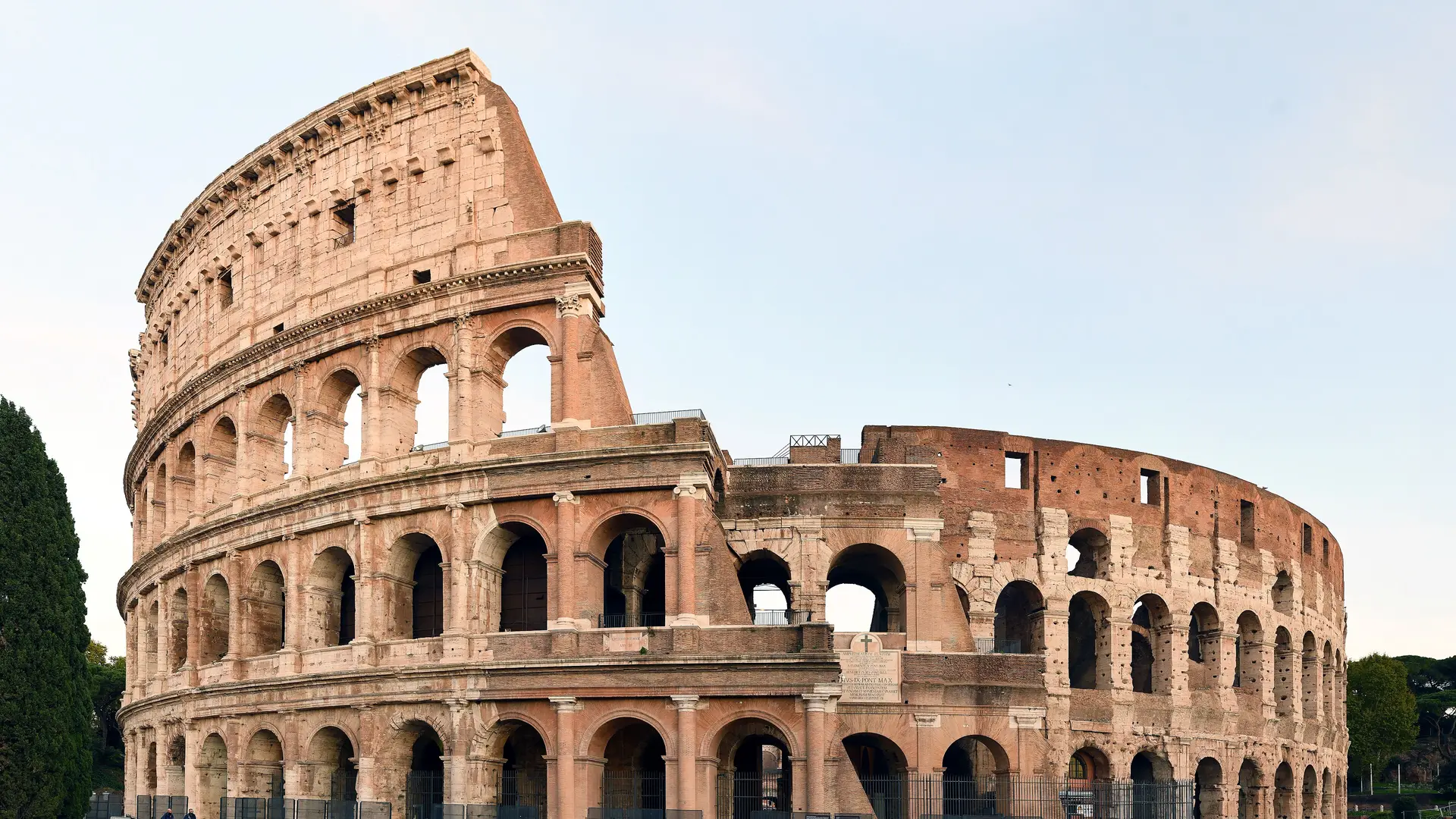
Above you, the broken tiers rise in great curved bands of travertine, brick and empty arches. Below the boards at your feet lies the maze of the hypogeum: corridors, cells and lift shafts where animals and fighters waited in the dark. Swallows dip across the open sky. A guide somewhere is describing a hunt with forty bears.
Nearly two thousand years ago, around fifty thousand people sat on those tiers, sorted by rank from the senators at the front to the women and the poor at the very top. They came for a whole day. It was terrible and spectacular, and the building still holds on to some of that.
Built on Nero’s lake
The Colosseum’s real name is the Flavian Amphitheatre, after the dynasty that built it. The emperor Vespasian began it around AD 70–72 on the site of an artificial lake in the private pleasure gardens of Nero, the hated emperor who had killed himself a few years earlier. Giving that land back to the people as a public arena was a brilliant piece of politics.
His son Titus opened it in AD 80 with a hundred days of games. Thousands of animals are said to have died in those opening celebrations.
The nickname “Colosseum” probably came later, from a colossal bronze statue of Nero that stood next door. It’s the same word used for the Colossus of Rhodes.
What really happened here
Gladiator fights were the headline act, but they weren’t fights to the death every time. Gladiators were expensive to train, and many bouts ended with one man appealing for mercy and being sent off alive. Mornings were for animal hunts with lions, leopards, bears, elephants and ostriches, shipped from every corner of the empire. Midday was for public executions.
The machinery was astonishing. Animals and scenery rose through trapdoors into the arena on lifts worked by ropes and counterweights, so a whole forest or a pack of wolves could appear out of the sand. A huge canvas awning, the velarium, was worked by sailors from the imperial fleet to shade the crowd.
Games faded out in the 6th century. After that the Colosseum was a fortress, a quarry, a workshop, a shrine and a place where people grew vegetables. Earthquakes brought down the southern side. Its stone ended up in palaces and churches across Rome. Those pockmarks all over the walls? They’re where people dug out the iron clamps that held the blocks together, to melt them down.
Which ticket to buy
Buy online, in advance, from the official Colosseum Archaeological Park site or an authorized tour operator. Tickets are timed and in your name, and ID is checked.
- Standard ticket (about €18): the Colosseum’s main levels, plus the Roman Forum and Palatine Hill on the same ticket.
- Full Experience (about €24): adds restricted areas such as the arena floor and the underground, and sometimes the upper tiers. The underground is the best part of the visit, and worth booking early.
- Guided tours often include restricted areas and help a lot with the story.
On the first Sunday of some months entry may be free, which means huge queues.
When to go
April–May and October offer the best weather. Summer is hot and packed, with little shade inside.
Take the first entry slot of the morning or one of the last of the afternoon. In the evening the stone turns honey-colored and the crowds thin. In summer there are sometimes night tours, which are beautiful and atmospheric.
Allow a separate hour, or a whole morning, for the Roman Forum and the Palatine Hill. The Palatine is where the emperors lived and where Rome’s founding legend says Romulus built the first walls. It has the best views of the Colosseum and the Forum, with far fewer people.
The Forum and the Palatine, in brief
Your ticket includes them, and they’re the part of the visit most people rush. Don’t.
The Roman Forum was the heart of the city for a thousand years: its marketplace, law courts, temples and political arena. Walk the Via Sacra, the Sacred Way, along which victorious generals rode in triumph. Find the Temple of Caesar, built on the spot where Julius Caesar’s body was cremated after his murder in 44 BC. People still leave flowers there every March. Look into the Curia, the Senate house, where Rome’s senators argued for centuries. And stand beneath the Arch of Titus, whose carvings show Roman soldiers carrying away treasures from the Temple in Jerusalem, looted in the war whose profits helped build the Colosseum.
Above it all rises the Palatine Hill, the most exclusive address in ancient Rome. Augustus lived here, and later emperors built huge palaces across the hilltop. Our word palace comes from the Palatine. It’s leafy and quiet, full of umbrella pines and orange trees, with the best views of the Forum and the Circus Maximus below.
Right outside the Colosseum stands the Arch of Constantine, built around AD 315 to celebrate the emperor’s victory at the Milvian Bridge. Look closely: many of its carvings were taken from older monuments, which makes it a kind of Roman scrapbook.
Eat nearby
Avoid the restaurants with photo menus facing the Colosseum. Walk five minutes into Monti instead. Roman cooking is simple and wonderful: cacio e pepe (pecorino and black pepper), carbonara made with egg yolk and guanciale, amatriciana, and in spring, carciofi alla romana, braised artichokes. Order a carafe of house wine and take your time. After a morning among the ruins, this is how the Romans would want you to recover.
Where to see it from
- Via dei Fori Imperiali, especially at night when the arches are lit.
- Colle Oppio park, the hill just east, for an elevated view with the umbrella pines.
- The terrace at the Palatine Hill.
- An aperitivo at one of the rooftop bars nearby, with the Colosseum lit up across the rooftops.
Where to stay
Monti is the neighborhood right behind the Colosseum: cobbled lanes, wine bars, vintage shops and good trattorias, all walkable. Waking up close enough for a first-slot visit makes everything easier.
The honest bits
Queues outside can be long even with tickets, for security. In summer the interior is an oven. Around the entrance you’ll find costumed “gladiators” who charge for photos and unofficial guides who may oversell their tickets. Stick to the official site or a reputable operator.
Still, stand on the arena floor, look up at those tiers of stone, and listen. Underneath the traffic and the tour groups, Rome’s oldest crowd is still there somewhere.
The Colosseum: questions people ask
Which Colosseum ticket should I buy?
The standard ticket covers the Colosseum, the Roman Forum and the Palatine Hill. The 'Full Experience' tickets add access to restricted areas such as the arena floor and the underground (hypogeum). If you only buy one upgrade, choose the underground.
Do I need to book Colosseum tickets in advance?
Yes. Tickets are timed and named, they sell out often in high season, and ID is checked at the entrance. Buy from the official Colosseum Archaeological Park site or an authorized tour.
How long do you need at the Colosseum?
About 1.5–2 hours inside the Colosseum, plus 2–3 hours for the Roman Forum and Palatine Hill. Most people need half a day for all three.
Were Christians really killed in the Colosseum?
Probably far less often than legend suggests. Christians were executed in Rome, but historians have found little firm evidence of martyrdoms in the Colosseum itself. The tradition grew mostly in later centuries.