In 305 BC, one of the most feared generals of the ancient world arrived at Rhodes with forty thousand men and the most terrifying siege machines ever seen.
His name was Demetrius, and they called him Poliorcetes, “the Besieger.” His great siege tower, the Helepolis, the “Taker of Cities,” was about nine stories of timber and iron on wheels, armored with metal plates and packed with catapults. He rolled it up to the walls of Rhodes and waited for the city to give in.
It didn’t. For a whole year the Rhodians held out, and at last Demetrius gave up and sailed away. He left much of his siege equipment behind.
The Rhodians sold it all. With the money they built a giant statue to their protector, the sun god Helios, to say thank you.
Twelve years of bronze
The sculptor was Chares of Lindos, a local man and a student of the great Lysippus. The work took about twelve years. He built the figure in layers, a framework of iron and stone with bronze plates hammered over it, raising earth ramps around the statue as it grew.
When it was finished, around 280 BC, the Colossus stood about 33 meters high. That’s roughly the height of the Statue of Liberty from heel to head, and the Statue of Liberty was partly inspired by it. Its base carried a dedication to Helios, “for the freedom of the city.”
It didn’t stand across the harbor
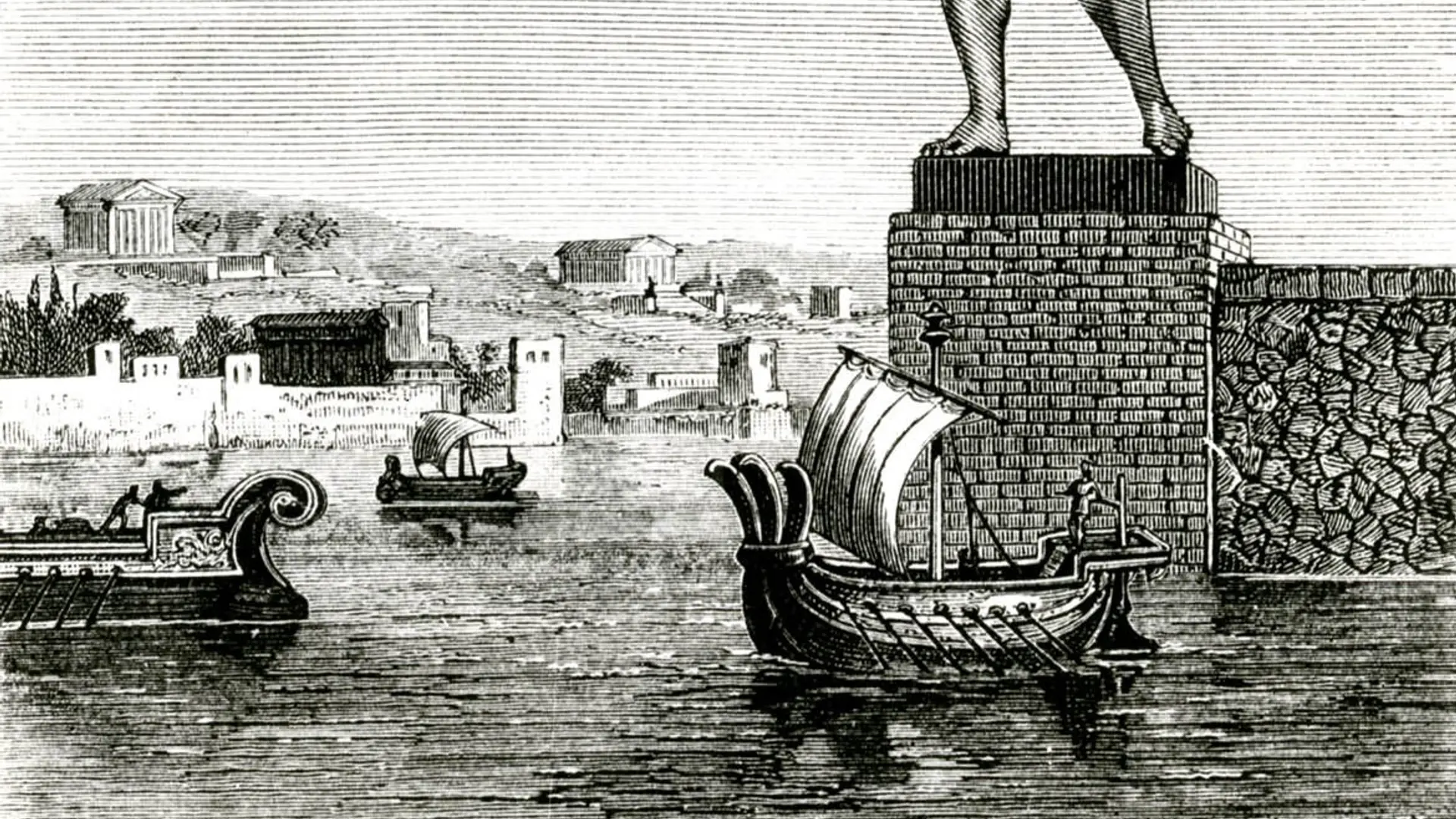
The famous image is of a giant with one foot on each side of the harbor mouth while ships sail between its legs. It appears in medieval engravings, on modern postcards and on the tourist mugs. It’s almost certainly wrong.
A bronze statue in that pose would have needed impossible engineering, and the harbor would have had to close for the twelve years it took to build. When it fell, it would have blocked the port. Ancient writers describe it lying broken on land.
Most historians now think the Colossus stood on land, perhaps near the harbor or on the hill of the city’s acropolis. Nobody knows exactly where.
Fifty-four years, then 800 years on the ground
Around 226 BC, an earthquake struck Rhodes and the Colossus snapped at the knees and crashed down. The King of Egypt offered to pay for it to be rebuilt. The Rhodians consulted an oracle, which warned them that they had offended Helios, so they left it where it fell.
And there it lay for nearly 800 years. Travelers came to see the fallen wonder. The Roman writer Pliny the Elder said few people could get their arms around its thumb, and that its broken limbs were like caves, full of the rocks that had weighted it.
In the 7th century, after an Arab force took Rhodes, the bronze was reportedly sold to a merchant and carried away. Later writers claimed it took 900 camels to move. That’s probably an exaggeration, but it’s a great way to end a wonder.
Visiting Rhodes today
There’s nothing left of the Colossus. But Rhodes is one of the loveliest islands in Greece, and it’s full of things that would have been familiar to the people who built it.
Mandraki Harbour. At the entrance, two columns carry bronze statues of a stag and a doe, the island’s symbols. This is where legend places the feet of the Colossus. Walk out along the mole to the three old windmills at sunset.
Rhodes Old Town. One of the best-preserved medieval towns in Europe and a UNESCO site, built by the same Knights of St John who later took apart the Mausoleum at Halicarnassus. Walk the Street of the Knights, visit the Palace of the Grand Master, and get lost in the cobbled lanes after the day-trippers leave.
The Acropolis of Rhodes, on Monte Smith hill, with its stadium and Temple of Apollo. Some think the Colossus might have stood around here.
Lindos. The hometown of Chares, the sculptor. It’s a white village under a cliff-top acropolis with views over a turquoise bay. Walk up early before the heat and crowds.
The Colossus in New York
When the French sculptor Frédéric Auguste Bartholdi designed a giant copper statue for New York harbor in the 1870s, he had the Colossus in mind. Liberty is about the same size, holds a torch high like Helios, and wears a crown of rays like the sun god.
In 1883, the poet Emma Lazarus wrote a sonnet to help raise money for the statue’s pedestal. She called it “The New Colossus.” Its opening line contrasts Liberty with the old giant: “Not like the brazen giant of Greek fame.” The poem’s later lines, welcoming the “huddled masses yearning to breathe free,” are now on a plaque inside the statue’s pedestal.
So in a way, the Colossus of Rhodes still stands: green, holding a torch, at the entrance to a harbor on the other side of the world.
A slow day in Rhodes Old Town
Morning. Enter through the Gate of Amboise and walk the Street of the Knights before the day-trippers arrive. It’s a perfectly preserved medieval lane lined with the “inns” where knights from each nation lodged. Then visit the Palace of the Grand Master, rebuilt in the 1930s and filled with ancient mosaics.
Midday. The Archaeological Museum, in the old knights’ hospital, holds a beautiful marble Aphrodite, crouching after her bath.
Afternoon. Get lost. Rhodes Old Town is a maze of pebble-mosaic alleys, flying buttresses, little squares with fig trees, and old mosques and churches side by side. Walk the moat, a green, peaceful path under the walls.
Evening. Out along the harbor mole to the windmills and the stag and doe. Then dinner in a tucked-away taverna in the Old Town, with grilled fish, horta and a carafe of white wine.
Beyond town: in summer, the Valley of the Butterflies (Petaloudes) fills with thousands of moths resting in the shade. In the hills, the abandoned medieval castles of Kritinia and Monolithos stand alone above the sea.
When to go
May–June and September–October are best: warm sea, long days, fewer crowds. July and August are hot and very busy, especially in Lindos. Rhodes has a long season and some winter sun, but many beach places close from November.
The honest bits
Don’t come expecting to see the Colossus. There’s no ruin, no fragment, and not even a confirmed location. Rhodes can be crowded and resort-heavy in high summer. But wander the Old Town at night, step out onto the harbor wall, and look at the empty spot between the stag and the doe. The ancient world built a god of bronze to thank the sun for its freedom.
Colossus of Rhodes: questions people ask
Did the Colossus of Rhodes really stand across the harbor?
Almost certainly not. The famous image of the statue straddling the harbor mouth comes from medieval and later artists. A bronze statue that size couldn't have been built that way, and it would have blocked the harbor when it fell. Most historians think it stood on land near the harbor.
How tall was the Colossus of Rhodes?
About 33 meters (around 108 feet), roughly the height of the Statue of Liberty from heel to head. It was the tallest statue of the ancient world.
How long did the Colossus stand?
Only about 54 years. It was finished around 280 BC and toppled by an earthquake around 226 BC. The broken pieces lay where they fell for roughly 800 years.
What is there to see on Rhodes today?
There's no trace of the Colossus itself, but Rhodes Old Town is a superb walled medieval city and UNESCO site. Add the cliff-top acropolis of Lindos, good beaches and the deer statues at Mandraki Harbour, where legend puts the Colossus.