When Mausolus died in 353 BC, his widow is said to have mixed his ashes into her wine, and drunk them.
Her name was Artemisia, and she was also his sister. That was normal for the royal family of Caria, on the south-west coast of what is now Türkiye. Whatever we think of it now, the ancient writers all agree on one thing: her grief was enormous. She held contests of poets and orators to praise him. She governed the kingdom herself. And she poured a fortune into finishing his tomb.
She died two years later, before it was complete. The architects and sculptors are said to have kept working without pay, because they knew it would make them famous. They were right.
A tomb like nothing before
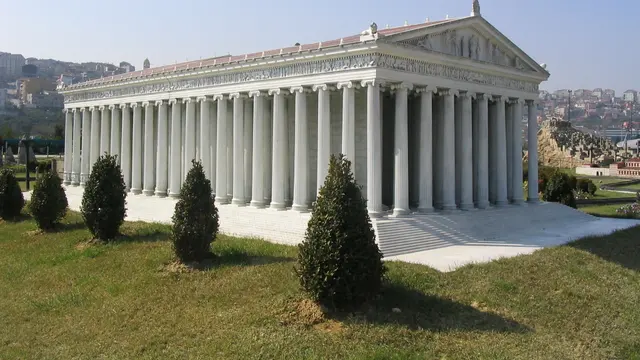
The Mausoleum rose about 45 meters above Halicarnassus, the city we now call Bodrum. It mixed every style the builders knew. There was a tall stone base, a ring of Greek columns, a stepped pyramid roof, and on top a marble chariot pulled by four horses.
The most famous sculptors of the age each took a side: Scopas, Bryaxis, Timotheus and Leochares. They covered it in friezes of battles between Greeks and Amazons, and with statues of lions, horsemen and the royal family.
It was a bold mix of Greek, Egyptian and Near Eastern ideas, and visitors were overwhelmed. It became one of the Seven Wonders, and so famous that Mausolus’s name became our word for every grand tomb that followed. Every mausoleum in the world, including the Taj Mahal, carries a little of his name.
How the knights took it apart
The Mausoleum stood for more than 1,500 years, through Alexander’s conquest, Roman rule and the coming of Christianity. Earthquakes in the medieval centuries brought down its upper parts.
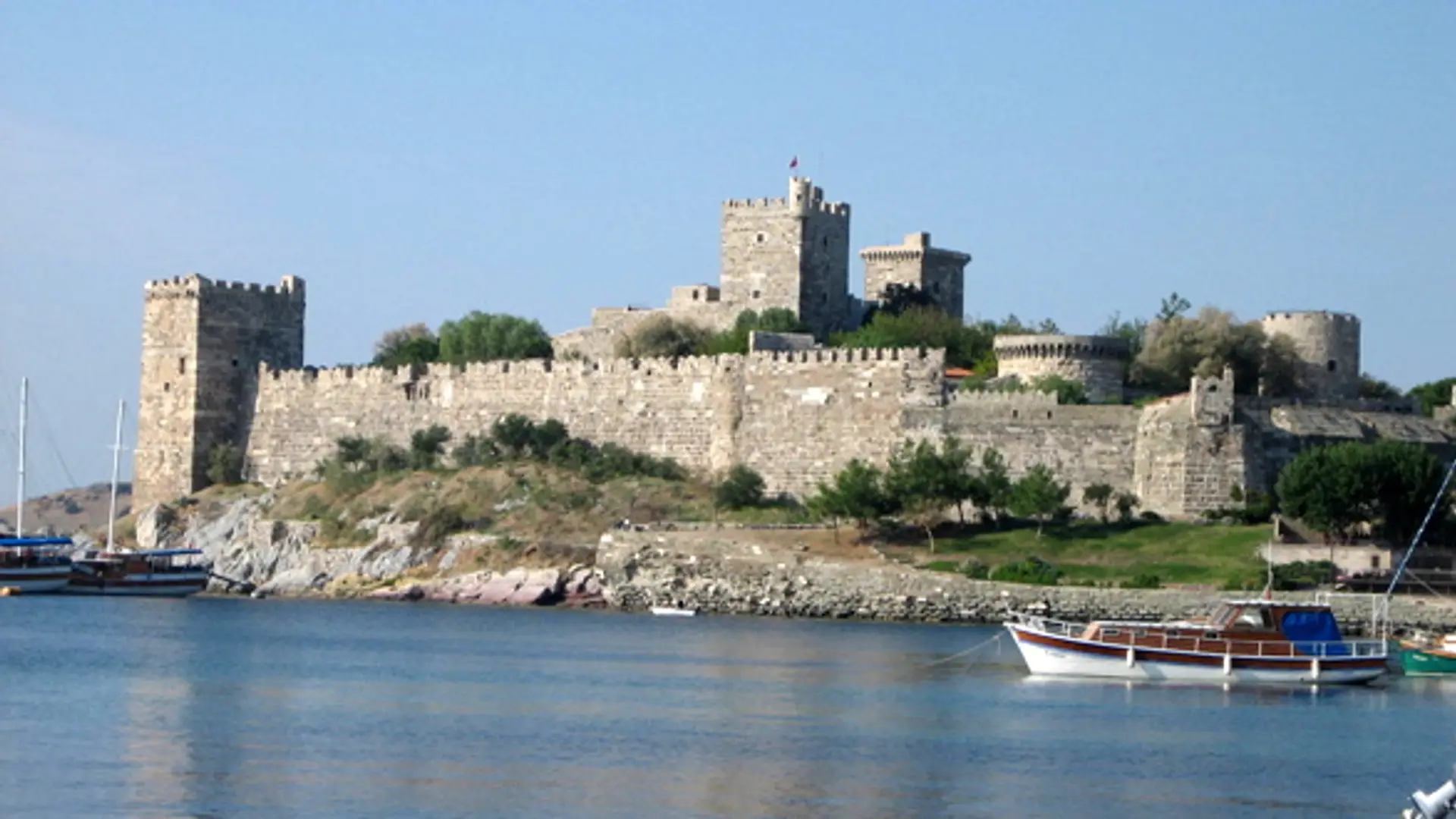
Then, in the 1400s, the Knights of St John arrived. These crusader knights, based on Rhodes, built a great castle on the harbor at Bodrum. When they strengthened it in the early 1500s, they found the ruined Mausoleum a convenient quarry. They cut its green stone into their walls and burned much of its sculpted marble down for lime.
If you look closely at Bodrum Castle today, you can still pick out blocks and pieces of relief from the Mausoleum set into its walls.
In the 1850s the British archaeologist Charles Newton excavated the site and shipped many of the surviving sculptures to London. Two huge figures, long believed to be Mausolus and Artemisia, now stand in the British Museum.
What you’ll see in Bodrum
The Mausoleum site. A walled garden in the middle of town with the foundations, scattered column drums and fragments, and a small museum with models and casts. It’s quiet and slightly bare. You’ll need imagination, but the models help.
Bodrum Castle. This is the highlight. The castle of St Peter sits on its own little peninsula between two bays, with towers named after the nations of the knights who built them: the English, French, Italian and German towers. Inside, the Museum of Underwater Archaeology displays shipwrecks and cargo pulled from the seabed, including some of the oldest wrecks ever excavated.
The ancient theatre, on the hillside above town, with lovely views across the bay.
The Myndos Gate, part of the old city walls that Alexander’s army besieged.
The man behind the name
Mausolus wasn’t a king in name. He was a satrap, a governor for the Persian Empire, ruling Caria in south-west Anatolia. In practice he ran it as his own kingdom, and he had big ambitions.
He moved his capital from inland Mylasa to the coast at Halicarnassus, and rebuilt it as a grand Greek-style city with a harbor, walls, a theater, temples and a palace. He loved Greek culture. He probably planned the tomb himself, as the crowning monument of his new city, placed where every ship entering the harbor would see it.
The Roman writer Pliny the Elder described it centuries later: 36 columns around the base, a pyramid of 24 steps above, and the marble chariot at the very top. Modern reconstructions vary a great deal, which is part of the fun of the museum’s models.
See the Mausoleum in London
The best pieces of the Mausoleum are not in Bodrum but in Room 21 of the British Museum in London. There you’ll find:
- the two colossal figures long identified as Mausolus and Artemisia, though no one is sure who they really are,
- a giant horse from the chariot group on the roof, its bronze bridle long gone,
- stretches of the Amazon frieze, Greeks and Amazon warriors locked in battle, some of the finest Greek carving to survive,
- and huge marble lions that once guarded the tomb.
It’s free to visit, and standing among them helps you understand why the ancient world was so amazed.
Day trips from Bodrum
- Kos, Greece. A ferry crosses in under an hour to the island where Hippocrates, the father of medicine, was born. Bring your passport.
- Didyma. About 1.5 hours north, the enormous Temple of Apollo, which held one of the great oracles of the ancient world. Its columns are so tall they make people go quiet.
- Ephesus. About 2.5–3 hours away, for the Temple of Artemis and one of the best-preserved ancient cities in the Mediterranean. A long day, but worth it.
Bodrum today
Bodrum is a glamorous, whitewashed resort town of bougainvillea, harbor restaurants, beach clubs and gulets, the traditional wooden sailing boats. It’s a strange and wonderful place to find an ancient wonder: one minute you’re looking at a 2,300-year-old foundation, the next you’re eating grilled octopus with your feet nearly in the sea.
Spend a day on a gulet cruise around the bays of the Bodrum peninsula. Romantics should catch the sunset in the hillside village of Gümüşlük, which sits over the sunken ruins of ancient Myndos. Watch the sun drop into the sea from a waterfront table.
When to go
May–June and September–October are perfect: warm seas, sunshine, and fewer crowds than July and August, when Bodrum is packed and its nightlife roars. Winter is quiet and mild, though many hotels close.
The honest bits
The Mausoleum itself is a small, rather sparse site. If you’re short on time, give it an hour and spend the rest at the castle. In peak summer Bodrum is crowded and expensive. But the story makes up for the missing stones. A queen loved a king so much that she gave the world a new word for remembering the dead.
Mausoleum at Halicarnassus: questions people ask
Why is it called a mausoleum?
The tomb was built for Mausolus, ruler of Caria, who died in 353 BC. It was so famous that his name became the general word for any grand tomb.
What happened to the Mausoleum at Halicarnassus?
It survived for more than 1,500 years before earthquakes damaged it. In the 15th and early 16th centuries, the Knights of St John took its stones to strengthen Bodrum Castle, and burned much of its marble for lime.
Where are the Mausoleum's sculptures now?
Many of the finest surviving pieces, including two great statues long thought to show Mausolus and Artemisia, are in the British Museum in London. Some fragments remain at the site in Bodrum.
Is the Mausoleum site worth visiting?
Only with the right expectations. It's mainly foundations, scattered fragments and a small museum. Pair it with Bodrum Castle, which is partly built from the Mausoleum's own stone and holds an excellent underwater archaeology museum.