On a summer night in 356 BC, a man named Herostratus walked into the greatest temple in the world and set it on fire.
He wasn’t a soldier, a priest or a rival king. When he was caught and questioned, he explained calmly that he’d done it to make his name live forever.
The people of Ephesus were horrified. They executed him, and then passed a law forbidding anyone from ever speaking or writing his name again. It didn’t work. A historian wrote it down, and here we are, 2,400 years later, writing it again. He got exactly what he wanted.
Legend adds one more twist. That very night, in Macedonia, Alexander the Great was born. Artemis, the story goes, was too busy attending his birth to save her own temple.
The temple everyone came to see
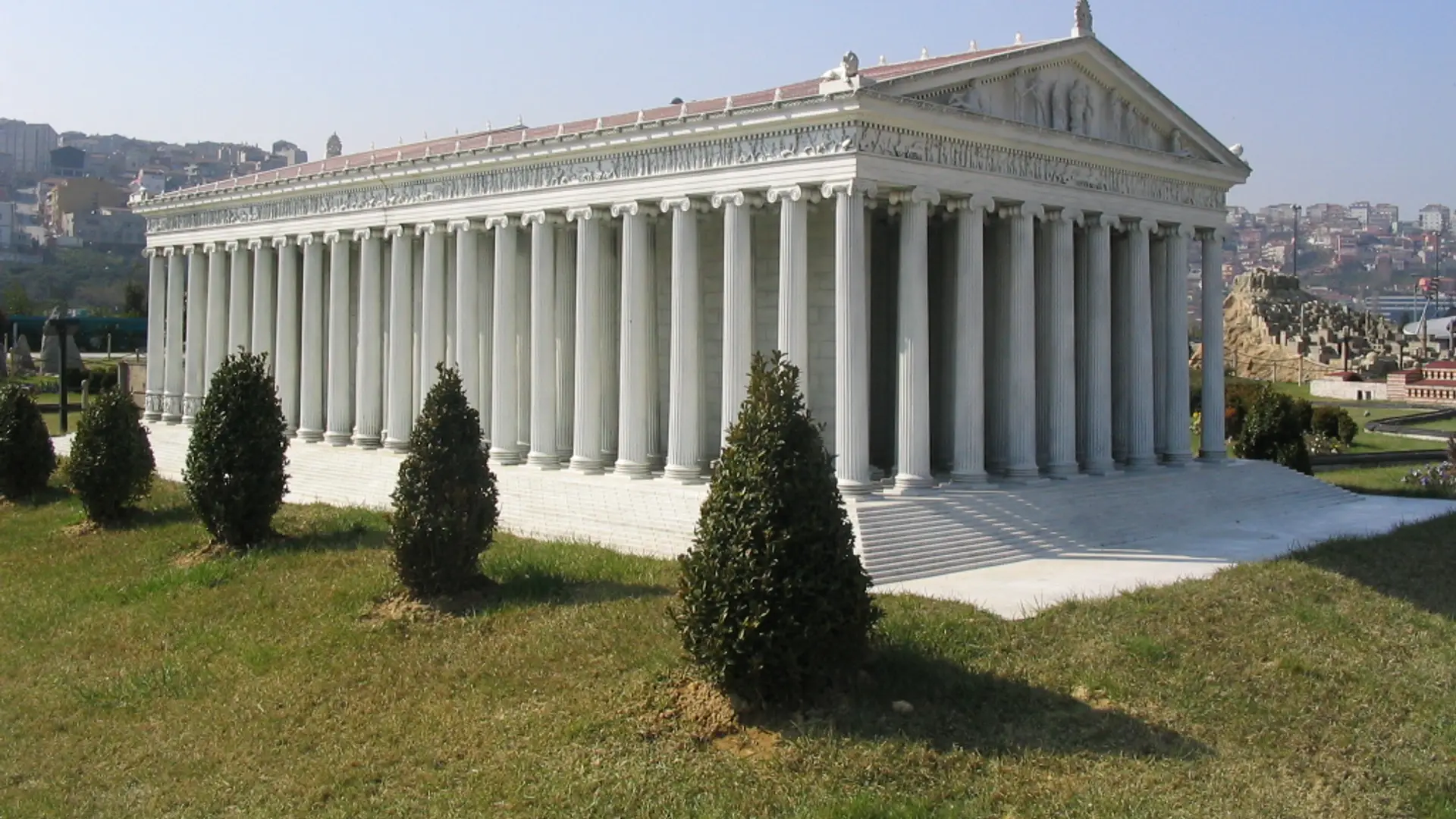
The Temple of Artemis at Ephesus was one of the largest buildings of the ancient world. It was about 115 meters long and surrounded by more than a hundred marble columns nearly 18 meters high. The first great version, around 550 BC, was funded in part by Croesus, king of Lydia, the man whose name still means “rich.”
Ephesus’s Artemis wasn’t quite the lean huntress of Greek myth. She was a mother goddess, shown with rows of mysterious egg-like shapes on her chest that are still debated today. Pilgrims came from all over the Mediterranean, bought little silver shrines and left offerings. The temple also worked as a bank, a place of sanctuary, and the city’s pride.
After the fire, the Ephesians rebuilt it on the same spot, even more magnificently. When Alexander passed through and offered to pay for it, they turned him down with a perfect diplomatic line: it wasn’t fitting, they said, for one god to build a temple to another.
The rebuilt temple stood for nearly six centuries, until the Goths raided it in AD 268. As Christianity spread, its stone was carried off. Some is said to have ended up in Istanbul’s churches and mosques.
What’s there now
On the edge of the town of Selçuk, in a marshy field that often floods in winter, stands a single column, pieced together from fragments in the 1970s. More often than not, a stork is nesting on top.
That’s it. It’s free, quiet and a little melancholy. Stand there at sunset with the frogs croaking and the hilltop Basilica of St John and the Isa Bey Mosque glowing behind you, and it’s strangely beautiful. The emptiness says more about the fall of great things than any rebuilt ruin could.
Ephesus, just down the road
The real reason to come is next door. Ephesus is one of the best-preserved ancient cities in the Mediterranean. In its heyday under Rome it was home to perhaps 200,000 people.
- Curetes Street, the marble main road, polished smooth by centuries of feet.
- The Library of Celsus, whose restored two-story facade is the most photographed sight in Türkiye. Come early, when the stone is pale gold and the crowds are thin.
- The Great Theatre, which held about 24,000 people. Saint Paul’s preaching here famously caused a riot among the silversmiths who made shrines of Artemis.
- The Terrace Houses, an extra ticket and worth every bit of it. These are the homes of wealthy Romans, under a protective roof, with frescoes and mosaic floors.
A main Ephesus ticket costs roughly €40, with the Terrace Houses extra. Türkiye now prices major sites in euros and raises them often. The Museum Pass Türkiye can save money if you’re visiting several sites.
Selçuk and around
- The Ephesus Museum in Selçuk holds two remarkable statues of the many-breasted Artemis. They’re the best way to picture the lost temple’s goddess.
- The Basilica of St John, on the hill, said to stand over the apostle’s tomb.
- The House of the Virgin Mary, in the hills above, a pilgrimage site for Christians and Muslims.
- Şirince, a pretty hill village known for its fruit wines.
When to go and getting there
April–June and September–October are ideal. Summer is hot and Ephesus has little shade. It also gets huge crowds when cruise ships dock at nearby Kuşadası. Arrive at opening (around 8 a.m.) or come in the last two hours of the day.
The nearest airport is İzmir, about an hour away, with trains to Selçuk. Stay in Selçuk itself, a friendly small town with family-run guesthouses, rather than in the big resorts of Kuşadası.
Walk Ephesus downhill
Ephesus has two entrances, the Upper (Magnesian) Gate and the Lower Gate near the Great Theatre. Most tour groups go in at the top and walk down, and that’s the smart way to do it. The whole route is a gentle descent along the marble streets, ending at the Library of Celsus and the theater.
If you’re on your own, take a taxi to the Upper Gate. You’ll pass:
- the Odeon, a small, beautiful theater used for concerts and city council meetings,
- the Temple of Hadrian, with a carved Medusa and a goddess in its arches,
- the public latrines, rows of marble seats side by side, where Ephesians chatted while they did their business,
- the Terrace Houses (go in),
- and finally the Library of Celsus and the Marble Street leading to the Great Theatre.
Allow three to four hours, plus an extra hour for the Terrace Houses. Shade is scarce, so a hat and water are essential.
The Seven Sleepers
Just outside Ephesus is a hillside of caves and graves linked to one of the oldest legends of the Christian and Islamic worlds.
The story says that during a Roman persecution of Christians in the 3rd century, seven young men hid in a cave near Ephesus. The emperor’s soldiers walled the entrance shut. The young men fell asleep, and woke up, they thought, the next morning. One went into town to buy bread with his old coins and found that the city was Christian and nearly two hundred years had passed.
The tale appears in Christian tradition and in the Quran, where they are the “Companions of the Cave,” and it was told all over the medieval world. Several places claim the cave, but Ephesus has the strongest tradition. The site is small and quiet, a short detour from the main ruins.
The honest bits
The temple site is a disappointment if you expect a building. Go knowing it’s a field and a column, and enjoy it for the story. At Ephesus, the heat and crowds in summer can be tough, and touts sell fake “ancient” coins at the gates. Bring water, a hat and patience. Then stand before the Library of Celsus in the early light. Ephesus is still an easy place to feel how big the ancient world once was.
Temple of Artemis: questions people ask
What is left of the Temple of Artemis?
Very little: one column reassembled from fragments, which often has a stork's nest on top, standing in a marshy field among scattered stones. Some sculpture from the temple is displayed in the British Museum in London.
Who destroyed the Temple of Artemis?
The famous temple was burned in 356 BC by a man named Herostratus, who wanted to be remembered forever. It was rebuilt even grander. That version was damaged by the Goths in AD 268 and later quarried away as the region turned Christian.
How far is the Temple of Artemis from Ephesus?
About 3 km. The temple stands on the edge of Selçuk town, and the main Ephesus ruins are a short taxi ride or a pleasant walk away.
How long do you need at Ephesus?
At least 3–4 hours for the main ruins, plus an hour for the Terrace Houses. Add the Ephesus Museum and the Temple of Artemis in Selçuk and you have a full, rewarding day.