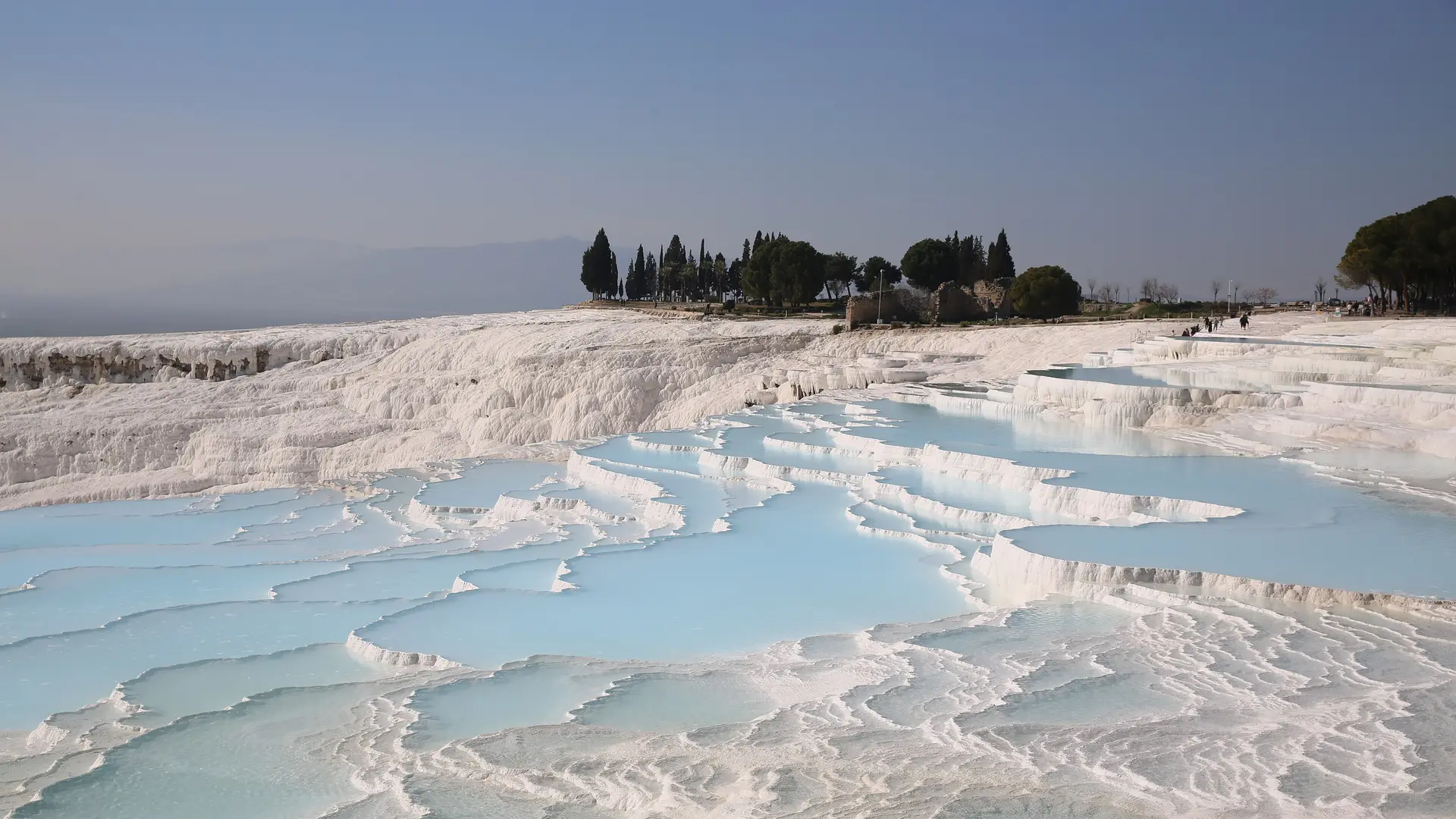
From a distance, it looks like a hillside covered in snow. In the middle of summer, in a warm valley in south-western Türkiye.
Get closer, and you see that it’s not snow at all, but rock: a cascade of brilliant white terraces, curving down the slope in shelves and frozen waterfalls. Each terrace holds a shallow pool of warm, sky-blue water. People wander among them barefoot, ankle-deep, like figures in a dream.
The Turks call it Pamukkale: the cotton castle.
Rock made by water
Deep under the hill, hot springs rise through the limestone, picking up dissolved calcium carbonate. When the warm water, about 35°C, reaches the surface and flows down the slope, carbon dioxide escapes and the minerals settle out, forming a hard white rock called travertine. Over thousands of years, layer upon layer, it has built up the terraces and frozen cascades you see today.
The terraces are fragile. In the 20th century, hotels were built on top of them and drained the springs to fill their pools, and parts of the white rock turned grey. In the late 1990s, the hotels were demolished, the area protected, and the water carefully redirected. Today, the flow is rotated between areas so that some terraces are always “resting.” Some will be dry when you visit. That’s part of protecting them.
The Roman city on top
At the top of the terraces lie the ruins of Hierapolis, a Greek and then Roman spa city founded in the 2nd century BC. People came from all over the ancient world to bathe in its healing waters.
- The theater, one of the best preserved in Türkiye, with carved reliefs of gods and a superb view over the valley.
- The necropolis, one of the largest ancient cemeteries in Anatolia, with hundreds of tombs and sarcophagi. Many visitors came here to be cured, and not all of them went home.
- The Martyrium of St Philip, built where the apostle Philip is said to have been martyred.
- The Plutonium, a cave known in ancient times as the “Gate to Hell,” where toxic gas killed animals sacrificed to the god of the underworld while priests, who knew to hold their breath, survived.
Together, Pamukkale and Hierapolis are a UNESCO World Heritage Site.
The Antique Pool
At the top of the hill, the Antique Pool, often called Cleopatra’s Pool, is a warm, natural spring pool where ancient marble columns lie on the bottom, toppled by earthquakes. You swim over them in fizzy, warm, crystal-clear water. Legend says Cleopatra swam here, though there’s no evidence. There’s an extra fee. Go early, before it gets crowded.
Visiting
- Shoes off. On the white terraces, you walk barefoot on a set path. The rock is slightly rough and can be slippery in the water, and cold early in the morning.
- Two entrances: the lower one in Pamukkale village (walk up the terraces barefoot) and the upper one near Hierapolis. Starting at the bottom and walking up is the most spectacular.
- Tickets: about €30, plus extra for the Antique Pool. Türkiye prices major sites in euros, and raises them often.
- Timing: avoid midday, when tour buses arrive and the glare off the white rock is intense. Come early in the morning or in the late afternoon, and stay for sunset, when the terraces glow pink and orange.
- Hot-air balloons float over the terraces at dawn.
Getting there
Pamukkale is near the city of Denizli, with flights from Istanbul. Many people visit as a long day trip from the coast, from Kuşadası, Bodrum or Antalya, but it’s much better to stay overnight in Pamukkale village and see the terraces at sunset and early morning.
Nearby, the ancient city of Aphrodisias, dedicated to the goddess of love, is one of the most beautiful ruins in Türkiye, and rarely crowded.
When to go
April–June and September–October are best. Summer is hot and very busy. Winter is quiet, with steam rising from the pools in the cold air.
The honest bits
Pamukkale is very popular, and the terraces can be crowded with people taking photos in the middle of the day. Some pools may be dry for conservation. The Antique Pool is busy and expensive.
But walk up the white hillside barefoot at sunset, the warm water flowing over your feet and the whole slope glowing pink, then climb to the theater at the top as the light fades over the valley. It’s a hillside the color of snow, in the warmth of the evening, and nothing else in the world looks quite like it.
Pamukkale: questions people ask
Can you walk on the Pamukkale terraces?
Yes, but only barefoot and only on the designated path. Shoes are not allowed, to protect the travertine. Carry your shoes in a bag.
Can you swim at Pamukkale?
You can paddle in some of the terrace pools along the path, and swim in the Antique Pool (often called Cleopatra's Pool) at the top, which has an extra fee and ancient columns lying on its floor.
When is the best time to visit Pamukkale?
Spring and autumn for mild weather. Go early morning or late afternoon to avoid the midday glare and tour groups, and stay for sunset over the terraces.