When Cleopatra was born, the Great Pyramid was already more than two thousand years old. She lived closer in time to the first Moon landing than to the people who built it.
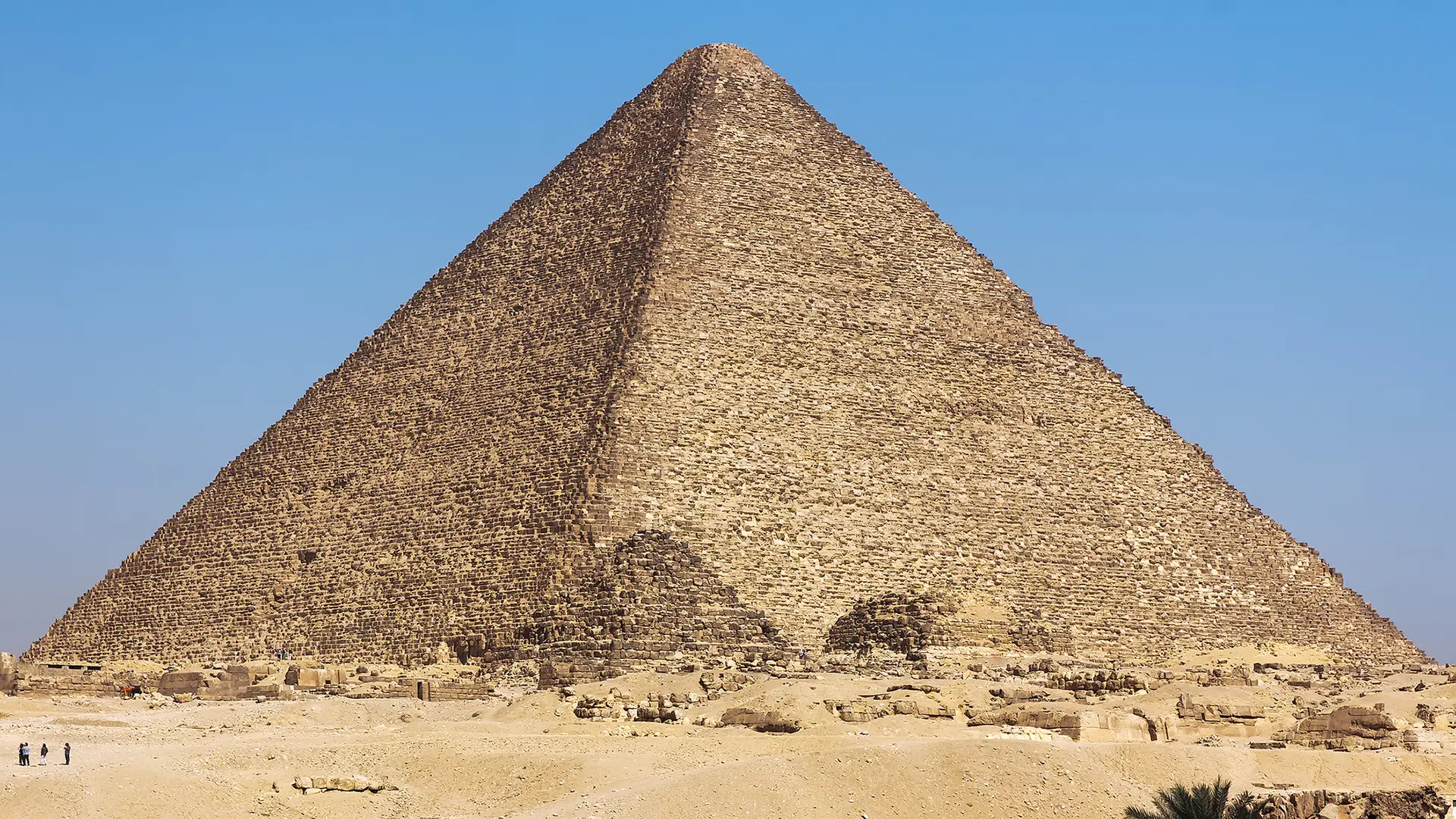
That’s the thought that hits you at the foot of it. You put your palm on a block of limestone the size of a car, then look up, and up, at 2.3 million of them stacked in rows into the hot white sky. Your guidebook says it’s big. It doesn’t prepare you for how big.
The pharaoh’s mountain
The Great Pyramid was built for Khufu, a pharaoh of the Fourth Dynasty, around 2560 BC. It took roughly twenty years. When it was finished it stood about 146 meters tall and was covered in polished white Tura limestone that shone in the sun like a crystal. Most of that casing was stripped off in the Middle Ages, much of it after a massive earthquake in 1303, to rebuild Cairo. You can still see a few casing stones near the base.
It was the tallest human-made structure on Earth for about 3,800 years, until Lincoln Cathedral’s spire beat it in the 14th century.
Its sides are aligned to true north, south, east and west with an error of a fraction of a degree. How the Egyptians managed that, and exactly how they raised the blocks, is still being researched. Ramps, levers, sledges and water poured on the sand to cut friction all seem to have played a part.
Who really built it
Not slaves, and not aliens. In the 1990s archaeologists found the workers’ town just south of the plateau: bakeries, breweries, dormitories, and a cemetery where workers were buried with bread and beer for the afterlife and honored for their labor. Some skeletons show healed broken bones, so someone was setting fractures.
A papyrus found in 2013, the Diary of Merer, is the oldest inscribed papyrus ever discovered. It records an inspector’s team ferrying limestone down the Nile for Khufu’s pyramid. It’s like reading a 4,500-year-old work log.
Going inside
You can enter the Great Pyramid with an extra ticket. You climb through a low passage, then up the Grand Gallery, a soaring corbelled corridor nearly 9 meters high and 47 meters long, into the King’s Chamber: a plain granite room holding an empty, broken sarcophagus.
It’s hot, humid and cramped, and the passages force you to stoop. If you’re claustrophobic, skip it. If you’re not, there’s something extraordinary about standing in the dead center of that mountain of stone, in total quiet.
The smaller pyramids of Khafre and Menkaure sometimes have cheaper, less crowded interiors open on rotation.
Around the plateau
- The Sphinx, carved from the bedrock, probably for Khafre. It’s smaller than you expect and more mysterious up close.
- The Panorama Point in the desert to the south-west, where all the pyramids line up. Walk, ride, or take the shuttle.
- The Solar Boat of Khufu, a 4,500-year-old cedar ship found in a pit beside the pyramid. It has now moved to the Grand Egyptian Museum.
- The Sound and Light Show at night. It’s dated and theatrical, but seeing the pyramids lit up against a black desert sky is still memorable.
The Grand Egyptian Museum
Just a couple of kilometers from the plateau, the Grand Egyptian Museum is now fully open. It’s one of the largest museums in the world dedicated to a single civilization, with the complete treasures of Tutankhamun displayed together for the first time. Its windows look out toward the pyramids. Give it at least half a day. Seeing the plateau in the morning and the museum in the afternoon is the perfect pairing.
When to go and practical tips
October to April is most comfortable. Summer temperatures easily top 40°C. Get there at opening, around 7–8 a.m., or come late afternoon when the light turns gold.
Tickets for the plateau, the pyramid interiors and the museum are bought separately. Egypt has raised foreign-visitor prices several times in recent years, so check current rates before you go. Card payment is increasingly expected at ticket offices.
Rules and access have been changing as the plateau is redeveloped, with a new visitor entrance and site shuttles. Ask your hotel or guide for the latest.
Where to stay
Several hotels in Giza have rooftop terraces or windows looking directly at the pyramids. Breakfast with the Great Pyramid in front of you is hard to beat. Downtown Cairo and Zamalek are livelier bases but involve a long, traffic-heavy drive.
A perfect Giza day
7:00 a.m. At the gate as it opens, with a licensed guide you’ve booked in advance. Go straight to the Great Pyramid while the air is cool and the plateau is quiet.
7:30 a.m. If you’re going inside, do it now, before the passages fill up and heat up.
8:30 a.m. Walk or ride out to the Panorama Point for the view of all the pyramids in a row. This is the moment for the camel ride, if you want one. Agree the price first.
9:30 a.m. Down to the Sphinx and the Valley Temple of Khafre, a hall of polished red granite pillars where the pharaoh’s body may have been prepared for burial.
11:00 a.m. Escape the midday heat in the Grand Egyptian Museum. Lunch there, and spend the afternoon with Tutankhamun’s golden mask, his chariots and the enormous statue of Ramesses II in the atrium.
Evening. A rooftop dinner in Giza with the pyramids lit up in front of you.
Beyond Giza: the pyramids most people miss
Giza is the famous one, but it isn’t where the story starts. A half-day south of Cairo lie the pyramids that show how the Egyptians learned to build.
Saqqara. The Step Pyramid of Djoser, built around 2650 BC by the architect Imhotep, is the oldest monumental stone building in the world. It’s essentially six stone platforms stacked like a wedding cake. Around it are tombs whose walls are carved with scenes of daily life: fishermen, bakers, cattle crossing a river, a man force-feeding geese. They’re astonishingly vivid, and often almost empty of visitors.
Dahshur. Here Khufu’s father, Sneferu, experimented. His Bent Pyramid changes angle halfway up, probably because the builders realized the original slope was too steep and would collapse. His Red Pyramid, next door, was their second attempt and the first true smooth-sided pyramid. You can climb down inside it, often with nobody else there. Standing alone in its echoing chambers is one of the eeriest experiences in Egypt.
Memphis, Egypt’s ancient capital, is now mostly palm groves. But its open-air museum holds a colossal statue of Ramesses II lying on its back.
A driver can do Saqqara, Dahshur and Memphis in one day. Do it, and you’ll understand Giza much better.
The honest bits
The pyramids are famous for touts: camel and horse handlers, “free” headscarf gifts, men claiming the area is closed or that you need a guide. They can be exhausting. Hire a licensed guide through your hotel or a reputable company, agree any price before you start, and stay friendly and firm.
The good news is that once you’re standing in the desert at Panorama Point, with the three pyramids lined up in front of you and the wind blowing over the sand, the noise just falls away. It’s been four and a half thousand years, and this one is still standing.
Great Pyramid of Giza: questions people ask
Who built the Great Pyramid of Giza?
It was built for the pharaoh Khufu around 2560 BC by skilled, paid Egyptian workers and rotating teams of laborers, not slaves. Archaeologists have found their village, bakeries and tombs right next to the plateau.
Is it worth going inside the Great Pyramid?
If you're curious and not claustrophobic, yes. The climb up the Grand Gallery is unforgettable. But it's hot and cramped, the chambers are bare, and it costs extra. If you're short on money or patience, the outside is the real show.
What's the best time to visit the pyramids?
October to April, when it's cooler. Arrive at opening time to beat the heat and the tour buses. Late afternoon also has lovely light.
Should I ride a camel at the pyramids?
It's up to you, but agree the price, route and length firmly before you get on, and don't pay until it's done. Animal welfare standards vary, so look for animals that seem healthy and well cared for.
How tall is the Great Pyramid?
It was built to about 146 meters. It's around 138 meters today, because its smooth white outer casing and capstone are gone. It stayed the tallest human-made structure on Earth for nearly 3,800 years.