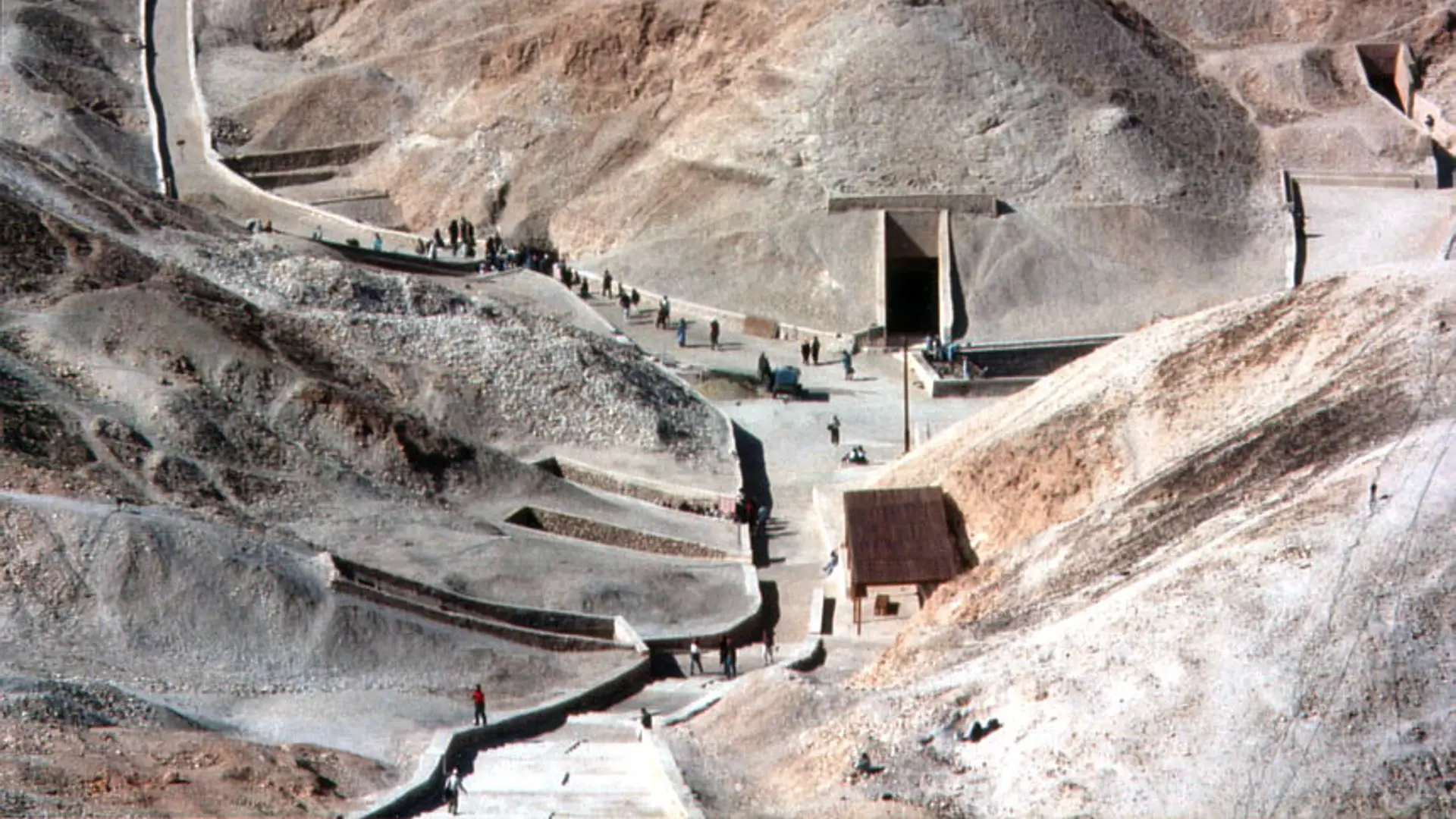
In November 1922, after years of searching and nearly out of money, the English archaeologist Howard Carter found a step cut into the rock of the Valley of the Kings. Then another. Then a sealed doorway.
On 26 November, with his patron Lord Carnarvon at his shoulder, he made a small hole in the inner door and held up a candle. Hot air rushed out and made the flame flicker. For a long moment, Carter said nothing. Carnarvon couldn’t stand it.
“Can you see anything?”
“Yes,” Carter said. “Wonderful things.”
It was the tomb of Tutankhamun, almost untouched for 3,300 years.
Thebes, city of a hundred gates
Modern Luxor sits on the site of ancient Thebes, the religious capital of Egypt at the height of its power during the New Kingdom (around 1550–1070 BC). The Nile divides it in two. The East Bank, where the sun rises, was the land of the living, with great temples to the gods. The West Bank, where the sun sets, was the land of the dead, with the tombs and mortuary temples of pharaohs and queens.
Luxor is often called the world’s greatest open-air museum. It’s not an exaggeration.
The East Bank
Karnak. The largest religious complex ever built, added to by pharaohs over some 2,000 years. Its heart is the Great Hypostyle Hall: a forest of 134 giant columns, the tallest about 21 meters, carved and once painted. Walking between them, you feel tiny. Look up for traces of the original colors on the capitals.
Luxor Temple. Smaller and graceful, right in the middle of town. Visit at dusk and after dark, when it’s beautifully lit. The Avenue of Sphinxes, a 2.7-kilometer processional road lined with sphinxes that once linked Luxor Temple to Karnak, was fully reopened in 2021.
The Luxor Museum, small, calm and full of masterpieces.
The West Bank
The Valley of the Kings. A dry, rocky valley where pharaohs were buried in tombs cut deep into the cliffs, decorated with brilliantly colored scenes of the journey through the underworld. More than 60 tombs have been found. The standard ticket covers three of those open on the day. The finest tombs cost extra:
- Seti I: the longest and most beautiful, its walls covered in vivid paintings.
- Tutankhamun (KV62): small, but it still holds his mummy, under glass, a few meters from where Carter first stood.
- Ramesses VI, with a stunning ceiling painted with the sky goddess Nut swallowing the sun.
The Temple of Hatshepsut (Deir el-Bahari). A great terraced temple set against a wall of cliffs, built for one of Egypt’s few female pharaohs. Hatshepsut ruled for about 20 years and was often shown with a false beard. After her death, her successor had many of her images chiseled away.
Medinet Habu, the mortuary temple of Ramesses III, with deep, colorful carvings. It’s much less crowded.
The Valley of the Queens, including the exquisite (and expensive) tomb of Nefertari, and the twin Colossi of Memnon on the roadside.
Balloons, feluccas and cruises
- Hot-air balloons lift off over the West Bank at sunrise, drifting over temples, fields of sugarcane and the Nile. It’s a Luxor classic. Choose a licensed, well-reviewed operator.
- Felucca sailing on the Nile at sunset is the gentlest way to end the day.
- Nile cruises between Luxor and Aswan (3–4 nights) stop at the temples of Edfu and Kom Ombo. A smaller boat or a traditional dahabiya is far more romantic than a big cruise ship.
Tickets and tips
- Each major site has its own ticket. The extra tombs (Seti I, Tutankhamun, Nefertari) are sold separately. Prices change often.
- Start early on the West Bank. The valley is a heat trap by late morning.
- Consider a good Egyptologist guide for at least one day.
When to go
October to April is best, with warm days and cool mornings. Summer is brutally hot, often over 40°C, though quieter and cheaper.
The honest bits
Luxor has persistent touts, horse-carriage drivers and “helpful” strangers, and the main sites are busy with tour groups. Tomb interiors can be hot and crowded, and extra tickets add up.
But stand in the Great Hypostyle Hall at Karnak early in the morning, with the low sun slicing between the columns, and then cross the river to walk down into a painted tomb where a pharaoh was laid to rest 3,000 years ago. Like Carter, you’ll see wonderful things.
Luxor & the Valley of the Kings: questions people ask
Which tombs should I see in the Valley of the Kings?
The standard ticket covers three tombs, chosen from those open that day. Many people add the tomb of Seti I, the most beautiful, and Tutankhamun's tomb, which still holds his mummy. Each is a separate ticket.
Is Tutankhamun's treasure still in his tomb?
No. His treasures are in the Grand Egyptian Museum near Cairo. His mummy and sarcophagus remain in his small tomb in the Valley of the Kings.
How many days do you need in Luxor?
Two to three days: one for the East Bank (Karnak and Luxor Temple), one or two for the West Bank (Valley of the Kings, Hatshepsut's temple, Medinet Habu).
Is the Luxor hot-air balloon worth it?
Many people love it: you float over the West Bank temples and fields at sunrise. Choose a well-reviewed, licensed operator.