In 1813, a Swiss traveler disguised as a Muslim scholar was making his way along the Nile in southern Egypt. His name was Johann Ludwig Burckhardt, the same man who, a year earlier, had become the first European in centuries to see Petra.
Near the village of Abu Simbel, he looked up at a cliff and saw an enormous stone face sticking out of a sand dune: the head of a giant statue, buried up to its neck. He couldn’t dig it out. He mentioned it to a friend, the Italian strongman-turned-explorer Giovanni Belzoni, who came back in 1817 and dug for weeks through the sand until he found a doorway.
Behind it lay one of the greatest temples of ancient Egypt.
Ramesses the Great
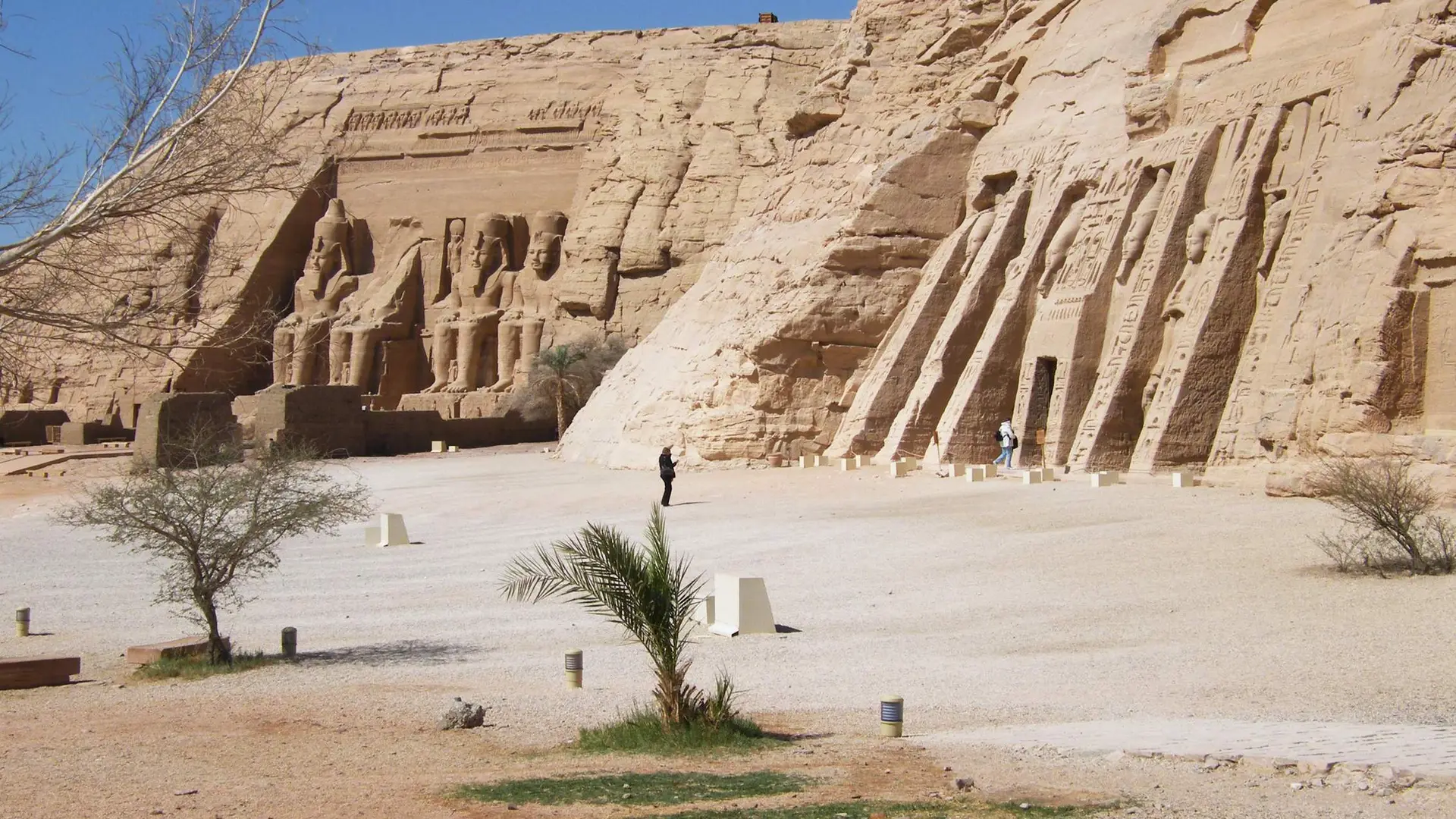
The temples of Abu Simbel were carved straight into a sandstone cliff by Ramesses II, the most powerful and self-promoting pharaoh of all, around 1264 to 1244 BC. They stood at Egypt’s southern border, facing Nubia: a giant message to anyone traveling north up the Nile about who was in charge.
The Great Temple is fronted by four seated statues of Ramesses, each about 20 meters tall. One has lost its head and upper body to an ancient earthquake; the pieces still lie at its feet. Small figures of his wives, children and mother stand around his legs. Inside, the halls are carved with scenes of his victories, especially the Battle of Kadesh, which he claimed as a triumph, though it was more like a draw.
The Small Temple, next door, is dedicated to the goddess Hathor and to his favorite queen, Nefertari. Unusually, she is shown as large as the king on its facade. An inscription says the temple was built for her, “for whom the sun shines.”
The miracle of the sun
Deep inside the Great Temple, in the innermost sanctuary, sit four statues: the gods Ra-Horakhty, Amun and Ptah, and Ramesses himself, as a god.
Twice a year, around 22 February and 22 October, the rising sun shines straight through the doorway, down the whole length of the temple, about 60 meters, and lights up the faces of three of the statues. Ptah, a god associated with the underworld, stays in shadow.
Some believe the dates once marked Ramesses’ birthday and coronation. Thousands of people gather before dawn to watch. It’s crowded and emotional.
The temple that moved
In the 1960s, Egypt built the Aswan High Dam. The lake behind it, Lake Nasser, was going to drown Abu Simbel forever.
UNESCO led an international rescue. Between 1964 and 1968, engineers cut the temples, statues and the cliff faces into more than 1,000 blocks, some weighing over 20 tonnes. They lifted them 65 meters up the hill and about 200 meters back from the water, and rebuilt them inside an artificial hill of concrete and rock. It’s one of the greatest feats of archaeological engineering ever. The sun alignment still works, now about a day later than before.
Go round the back to see the huge concrete dome holding the “mountain” up.
Visiting
- From Aswan: about 3–4 hours each way by road across the desert, usually leaving around 4 a.m. to arrive early. Short flights from Aswan are quicker. Some Lake Nasser cruises stop at Abu Simbel and let you see the temples floodlit and at sunrise from the water.
- Stay overnight in Abu Simbel village if you can. When the day tours leave around midday, you’ll have the temples nearly to yourself, and the sound and light show in the evening projects colors onto the statues.
- Photography rules and fees change. Check before you go.
Pair it with Aswan
Aswan is one of Egypt’s most relaxing towns. Sail on a felucca at sunset, visit the island temple of Philae (another temple moved by UNESCO), wander colorful Nubian villages, and take tea on the terrace of the Old Cataract Hotel, where Agatha Christie is said to have written part of Death on the Nile.
When to go
October to April is the most comfortable. Southern Egypt is extremely hot in summer, often over 40°C. For the Sun Festival, book well ahead and expect crowds.
The honest bits
The trip from Aswan is long and the start is very early. On festival days, the inside of the temple is packed. And the temples have been rebuilt, which some people find odd once they know.
But stand at the feet of those four giants as the morning sun turns them gold, then step inside and look down the long dark halls toward the gods at the end. Three thousand years later, Ramesses’ plan still works: you’ll be overwhelmed.
Abu Simbel: questions people ask
When is the Abu Simbel Sun Festival?
Around 22 February and 22 October each year, when the rising sun shines down the length of the Great Temple and lights up the statues in the inner sanctuary. Expect big crowds.
How do you get to Abu Simbel from Aswan?
It's about 3–4 hours each way by road across the desert, usually leaving before dawn. There are also short flights from Aswan, and some Lake Nasser cruises stop there.
Were the Abu Simbel temples really moved?
Yes. In the 1960s, to save them from the rising waters of Lake Nasser, they were cut into more than a thousand huge blocks and rebuilt about 65 meters higher, inside an artificial hill.